




Guide for Going Global: How to Obtain and Use Korean Proxy IPs



Clean IP picks: Static IPs from $1.5 each, Dynamic IPs from $0.5/GB


Whether you're conducting market research, operating an e-commerce platform, or testing games and social applications, using high-quality Korean proxy IPs allows you to access websites smoothly, just like a local user.
This article will introduce the types of Korean proxy IPs, usage methods, and practical applications, helping you enter the Korean market more safely and efficiently.
Why Use Korean Proxy IPs?
Overcome Geographic Restrictions
Many Korean streaming services (such as NAVER TV, Tving) and gaming platforms (such as Nexon, NCSoft) impose geographic restrictions on IPs outside Korea.
Improve SEO and Localized Search
Using a native Korean IP to access NAVER (Korea's largest search engine) ensures search results are automatically matched to the local Korean market.
You will see the results that local Korean users see, which is valuable for market research.
E-commerce Platform Operations
When running stores or scraping data on platforms like Coupang and Gmarket, frequent IP changes or mismatched locations can trigger risk control measures, potentially leading to account suspension.
Network Latency Optimization
Korea's backbone network is highly developed. Using high-quality proxy nodes can reduce latency in cross-border access, providing a smoother experience.
Main Types of Korean Proxy IPs
1. Dynamic Residential Proxies
These proxy IPs come from real users' home broadband connections, offering high authenticity and making them difficult for platforms to detect.
Suitable for e-commerce account management, social media marketing (Instagram/TikTok Korea), purchasing concert tickets, and complex data collection.
However, these IPs are billed by traffic and tend to be relatively expensive.
2. Static Residential Proxies
Also called ISP or long-term proxies, they combine the speed of data center proxies with the authenticity of residential IPs, and the IP addresses remain fixed long-term.
Suitable for scenarios requiring a stable login environment, such as managing Coupang backend accounts.
3. Mobile Proxies
Mobile proxy IPs come from the 4G/5G networks of Korea's three major carriers (SKT, KT, LG U+).
These proxies are the safest and least likely to be banned: millions of users share the same public IP pool in Korea, making it difficult for platforms to block individual IPs.
Due to their anti-blocking properties, these IPs are also the most expensive.
Suitable for multi-account social media management (Instagram/KakaoTalk), mobile app automation testing, and high-intensity risk control avoidance.
4. Data Center Proxies
Generated from data center servers, these IPs are fast, stable, and generally unlimited in traffic.
However, they are easy for platforms to recognize as proxies, suitable for simple data scraping or bulk access where high anonymity is not required.
Summary Table
| Proxy Type | Suitable Use Cases | Price Level |
|---|---|---|
| Dynamic Residential Proxy | E-commerce account management, social media marketing (Instagram/TikTok Korea), concert ticket purchases, complex data collection | High |
| Static Residential Proxy | Stable login environments, such as Coupang backend management | Medium-High |
| Mobile Proxy | Multi-account social media management (Instagram/KakaoTalk), mobile app testing, high-intensity risk control avoidance | Highest |
| Data Center Proxy | Simple data scraping, bulk access | Low |
How to Get Korean Proxy IPs
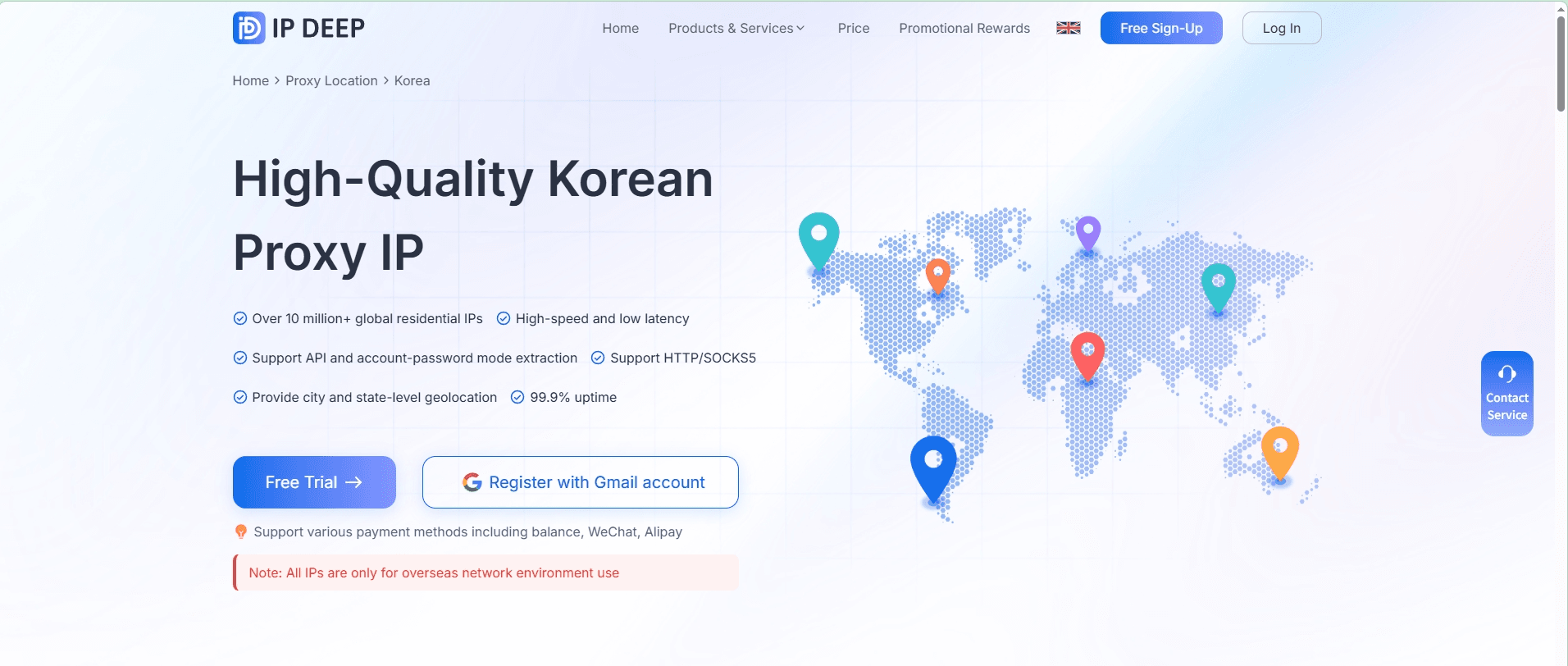
1. Visit the IPDeep website, register, and log in
2. Select the proxy IP type you need and purchase
3. Go to the dashboard to retrieve the proxy IPs
For more detailed steps, see:
Important Notes After Acquiring Korean Proxy IPs
1. Identify Native IPs vs. Broadcast IPs
Many providers claim their IPs are genuine Korean IPs, but in reality, they broadcast IP ranges from other countries using technical methods.
Such IPs are likely to be flagged when accessing sensitive sites like NAVER.
After obtaining Korean proxy IPs, first check their registration information to confirm they belong to Korean telecom providers (SK, KT, LG U+).
2. Prefer Providers Supporting SOCKS5 Protocol
Compared to HTTP, the SOCKS5 protocol performs better for games, video streaming, and complex applications. It offers stronger anonymity and better simulates real browsing environments.
3. Pay Attention to IP Pool Refresh Rate
For large-scale data collection (scraping), choose a provider with a large pool of Korean residential IPs, ensuring you can quickly switch IPs before any are blocked, avoiding service interruptions. Check providers here.
How to Set Up Korean Proxy IPs
1. Browser Setup (Most Common)
If you only need to access specific Korean websites (like NAVER or Coupang), using a browser extension is the easiest method.
Detailed setup steps: SwitchyOmega Guide: Proxy Configuration & Alternatives - IPDEEP
2. System-Level Setup (Windows/macOS)
This method routes most network traffic from your computer through the Korean proxy.
Windows 10/11:
Go to Settings > Network & Internet > Proxy.
Enable "Use a proxy server" under manual proxy setup.
Enter the Korean proxy IP and port, then save.
macOS:
Go to System Settings > Network > (Select active network) > Details > Proxies.
Check the relevant protocol (SOCKS5 or HTTP) and enter the IP and port.
Note: System settings generally do not support proxy authentication. If the proxy requires a username and password, we recommend using Proxifier.
3. Mobile Setup (iOS/Android)
WiFi setup (applies only to current network):
Go to Settings > WiFi, tap the “i” or “Details” next to your connected network.
Find "Configure Proxy" and select "Manual".
Enter the Korean IP and port, then save.
Detailed guide: How to Set Up WiFi Proxy on Android – Step-by-Step
Practical Application Tips
Scenario A: Korean E-commerce (Coupang/Gmarket) Management
We recommend using dedicated static residential IPs. E-commerce platforms require a clean environment; shared IPs may lead to account suspension due to association.
Scenario B: NAVER Marketing and SEO Research
NAVER is very sensitive to bots. Use dynamic residential IPs and set reasonable request frequency to simulate human scrolling and clicking behavior.
Scenario C: Korean Mobile Game Studios
Korean games require low latency and low packet loss. Choose static data center IPs with direct nodes for stable multi-account gaming.
Conclusion
The Korean market offers great opportunities, but the technical threshold is high.
A high-quality Korean proxy IP is not just a tool for access; it helps businesses maintain account security, obtain accurate data, and improve user experience in a competitive overseas market.
FAQ
1. How much does a Korean proxy IP cost per month?
Prices vary by provider. For example, IPDeep:
Dynamic Residential IP: $0.5–$1.3 per GB
Static Residential IP: $3.2–$3.8 per IP/month
Mobile IP: $1.75–$5 per GB
Static Data Center IP: $2.3–$2.7 per month
2. Besides Korean local platforms, which platforms can I target for overseas expansion?
You can also operate on YouTube, which is used by nearly 90% of Koreans.