





How Accurate Is City-Level Geolocation for Residential IPs?



Clean IP picks: Static IPs from $1.5 each, Dynamic IPs from $0.5/GB


Whether for cross-border e-commerce, social media marketing, or brand protection, static residential IPs are becoming a popular choice for many professional teams due to their residential network characteristics and higher level of trust.
City-level geolocation can also affect the localization, regional targeting, and market testing of certain business operations.
So, how reliable is the city-level geolocation of a static residential IP? How should we understand its accuracy and limitations?

How Static Residential IP Geolocation Works
To understand how reliable IP geolocation is, it is important to first understand the underlying characteristics of residential IPs.
Static residential IPs typically come from ISP network resources associated with consumer or residential networks.
As a result, they generally have more natural network geolocation characteristics at the country, region, and city levels.
However, an IP address is not the same as a physical home address. City-level geolocation is still a probabilistic result inferred from databases and network information.
IP geolocation databases typically combine network allocation data, ISP and ASN information, routing data, historical geolocation data, and network measurement results to estimate an IP address's approximate geographic location.
When using a residential proxy, the destination server sees the proxy's exit IP and can obtain country, region, or city-level geolocation information associated with that IP through GeoIP databases.
Therefore, IP geolocation is best understood as a regional geographic reference rather than GPS-level precise positioning.
Key takeaway: GeoIP geolocation is not accurate enough to reliably identify a specific street, household, or individual.
Major GeoIP databases such as MaxMind also emphasize that their data should be understood as a regional geographic reference rather than an exact physical coordinate.
Levels of IP Geolocation Accuracy
The accuracy of IP geolocation can generally be understood across the following levels:
How Reliable Is City-Level Geolocation?
Why Does the Same IP Show Different Cities in Different Tools?
This is a common occurrence. The main reasons include:
· Different GeoIP databases, such as MaxMind, IP2Location, and DB-IP, use different data sources, update schedules, and methodologies;
· Some databases may not be updated promptly after IP ranges are reassigned, causing outdated location information;
· Different tools may use different database versions, which can produce inconsistent results.
How Accurate Is City-Level Geolocation in Practice?
According to publicly available GeoIP industry data, country-level geolocation is generally highly accurate, while city-level accuracy is significantly lower and can vary considerably across countries and network types.
For example, city-level accuracy may be relatively high in some countries but considerably lower in others.
Therefore, in practical applications:
· Prioritize country- and region-level consistency;
· For city-level geolocation, use the target platform's actual location detection as the primary reference;
· Compare results from multiple GeoIP databases instead of relying on a single IP lookup tool.
Advantages of Static Residential IPs for Geolocation
· Consistent identity: A static IP remains unchanged during the rental period, helping prevent fluctuations in geographic signals caused by frequent IP changes.
· Residential network characteristics: IPs from residential ISP ranges are more likely to be identified as consumer network connections.
· Multi-source validation: Quality providers may use routing optimization, network information, and IP database checks to improve consistency between an IP's geolocation and its target location.
However, no IP geolocation service can guarantee 100% accuracy.
A static residential IP should not be interpreted as automatically giving an account a "whitelist" status or complete trust from the target platform.
Practical Applications of City-Level Geolocation
Cross-Border E-Commerce Account Management
A fixed IP can maintain a more consistent network exit point, helping reduce platform verification triggered by frequent changes in IP or geographic signals.
For platforms such as Amazon and eBay, consistency between IP geolocation and store registration information may contribute to a more consistent account environment.
Social Media and Content Operations
Using an IP associated with the target city for content publishing or engagement can provide the platform with a geographic signal that matches the target city, helping create a more localized user environment.
Platform algorithms typically consider multiple signals, including IP geolocation, language settings, and time zone.
SEO and Market Research
Search engines may display different results depending on the user's location.
Using a city-level IP can provide a search environment that more closely reflects local users, making it easier to monitor local rankings and competitor pricing.
Localized Service Testing
For location-dependent AI recommendations or local services, IP geolocation can serve as a useful signal for testing city-level localization.
Conclusion
So, how reliable is city-level geolocation for static residential IPs?
The answer: At the country and broader regional levels, residential IPs can provide relatively reliable geographic signals.
City-level geolocation, however, is more subject to regional and network-specific variations.
It is ultimately a probabilistic geographic result based on database inference, rather than precise positioning at the street or coordinate level.
✅ Generally reliable: Country and region-level geolocation, where residential IPs typically provide relatively strong geographic signals;
⚠️ Use with caution: City-level geolocation should be verified using multiple databases and actual platform feedback;
❌ Do not expect: Street-level precision. GeoIP data alone generally cannot reliably determine a specific street, household, or individual location.
Final recommendation: Treat city-level IP geolocation as a supporting geographic signal rather than GPS-style precise location data.
In practice, combining IP geolocation with account activity, device environment, and other signals is a more reliable approach.
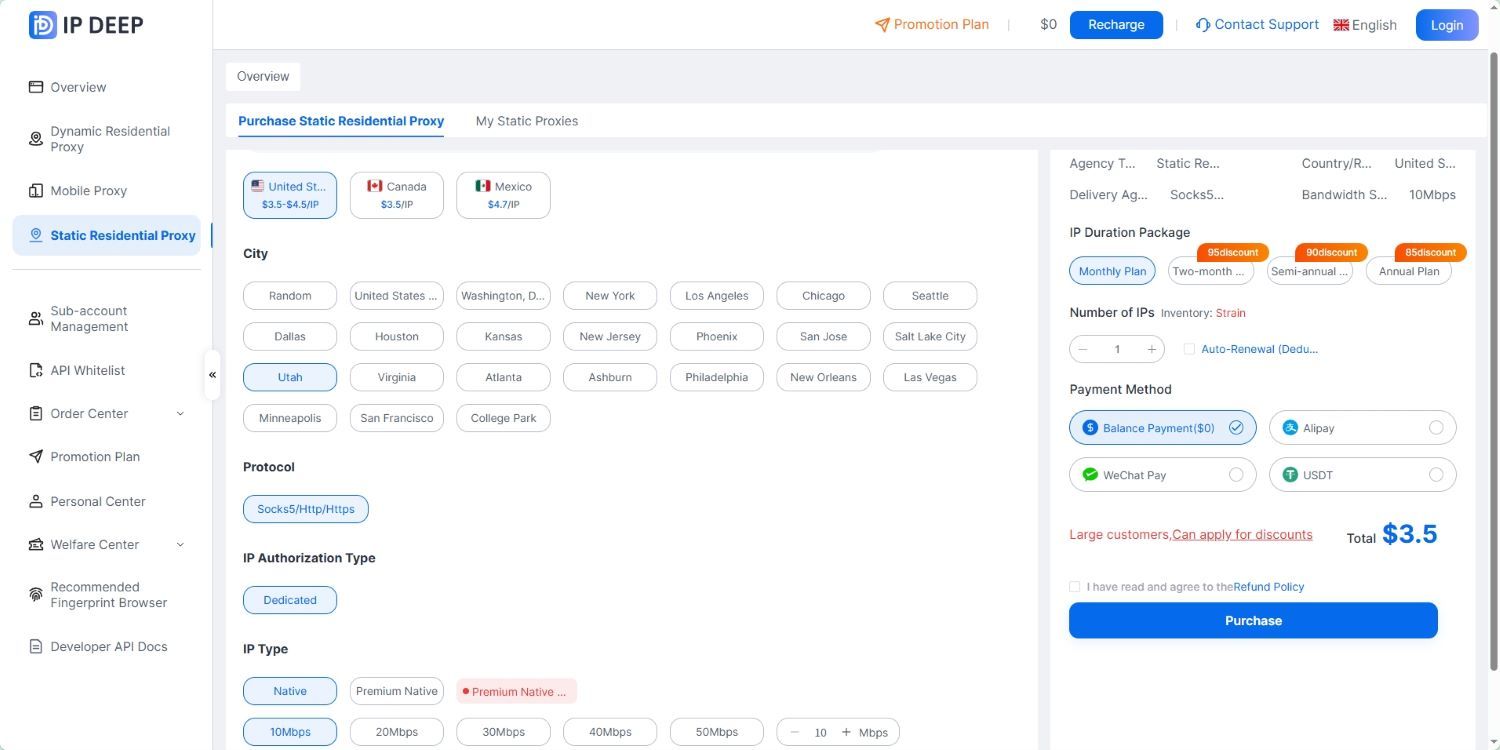
IPDeep provides high-quality static residential IPs with city-level targeting. Visit the IPDeep website to learn more.
Frequently Asked Questions (FAQ)
Q1: Why Do Different IP Lookup Tools Show Different Cities?
Different tools use different GeoIP databases, which may vary in data sources, update frequency, and methodologies.
It is recommended to use the target platform's actual geolocation result, such as the result shown by an e-commerce dashboard or Google, as a reference while comparing multiple sources.
Q2: Does IP City-Level Geolocation Affect Internet Speed?
Geolocation accuracy itself does not affect internet speed. Actual performance mainly depends on proxy bandwidth, network quality, the user's local connection, and the target server's response.
Testing network performance in the target region is recommended.
Q3: What Should I Do If the IP Location Does Not Match the Requested City?
First, keep in mind that IP geolocation has inherent limitations: different GeoIP databases may show different cities, and the target platform may identify the IP differently from an IP lookup tool.
If major GeoIP databases and the target platform all show a significant location mismatch, contact the provider for a manual review.
Quality providers may offer IP replacement or request updates to their IP geolocation data.