




How to choose a cost-effective static residential IP provider for your cross-border business?



Clean IP picks: Static IPs from $1.5 each, Dynamic IPs from $0.5/GB


For overseas enterprises, the stability and security of the network environment are the foundation for business development.
Static residential IPs, due to their high network stability and characteristics close to real user environments, have become an important network infrastructure in many cross-border business scenarios.
This article will objectively discuss how to choose a cost-effective static residential IP provider based on the latest industry trends, helping your business avoid low-cost and low-quality traps for stable growth.

Core Concept: The Positioning of Static Residential IP in Cross-Border Business
Static residential IP usually refers to a residential network or ISP network exit IP that remains fixed for a long time, commonly used in business scenarios that require stable network identity and long-term connections.
Technical Supplement:
Common static residential/ISP proxies in the industry may source their resources from real home broadband, commercial broadband, or data center hosting but belong to ISP network exits. The actual quality needs to be judged comprehensively based on ASN attributes, IP types, and risk scores.
Compared to traditional data center (server room) IPs, it has the following advantages in cross-border business:
Reduce proxy identification risk: Compared to server room IPs, residential IPs are closer to the network environment of ordinary users.
In the risk control systems of mainstream platforms (such as Amazon, TikTok, Facebook), it can reduce the probability of additional verification or risk control audits caused by abnormal IP types, but account security still depends on the overall network environment and user behavior.
Ensure business continuity: A long-term fixed IP address can avoid account login anomalies or forced secondary verification caused by frequent changes in exits, suitable for the long-term operation of high-value brand accounts.
Support environment isolation: Exclusive static residential IP can serve as an important component for account environment isolation, being one of the basic elements for multi-account anti-association operations.
Four Key Indicators for Selecting Cost-Effective Providers
When evaluating providers, one should not only look at the nominal unit price but also comprehensively measure the "actual cost-effectiveness" based on the following four key dimensions:
1. IP Purity and Resource Coverage
IP purity is one of the important indicators for measuring proxy quality. Quality providers usually have a stable pool of residential or ISP network resources covering multiple regions, capable of providing localized IP solutions that meet target market demands.
Practical Advice: Prioritize providers that support precise positioning down to the city or even specific ISP dimensions, which helps enhance the authenticity of localized operations.
2. Connection Performance and Stability
Different business scenarios have different requirements for network latency and connectivity rates. For example, live streaming and high-concurrency businesses are more sensitive to network jitter.
Reference Indicators:
Network latency is strongly correlated with the physical distance between proxy nodes and target servers (for example, the average latency for direct connections from mainland China to US nodes is typically in the range of 150ms-250ms, which is normal), and it is recommended to conduct practical tests based on actual business scenarios.
3. Data Security and Compliance Assurance
In an increasingly complex network environment, cost-effective providers should have a complete data security protection mechanism (such as support for secure protocol transmission) and clear data management and privacy protection policies to ensure the security of transmission links.
4. Assessing "Actual Effective Cost"
Some low-priced packages may have low unit prices, but poor IP availability or connectivity rates can lead to frequent request failures or being blocked, which in turn raises overall costs.
Actual Cost Calculation Formula:
Actual Cost = Purchase Price ÷ (IP Availability × Business Success Rate)
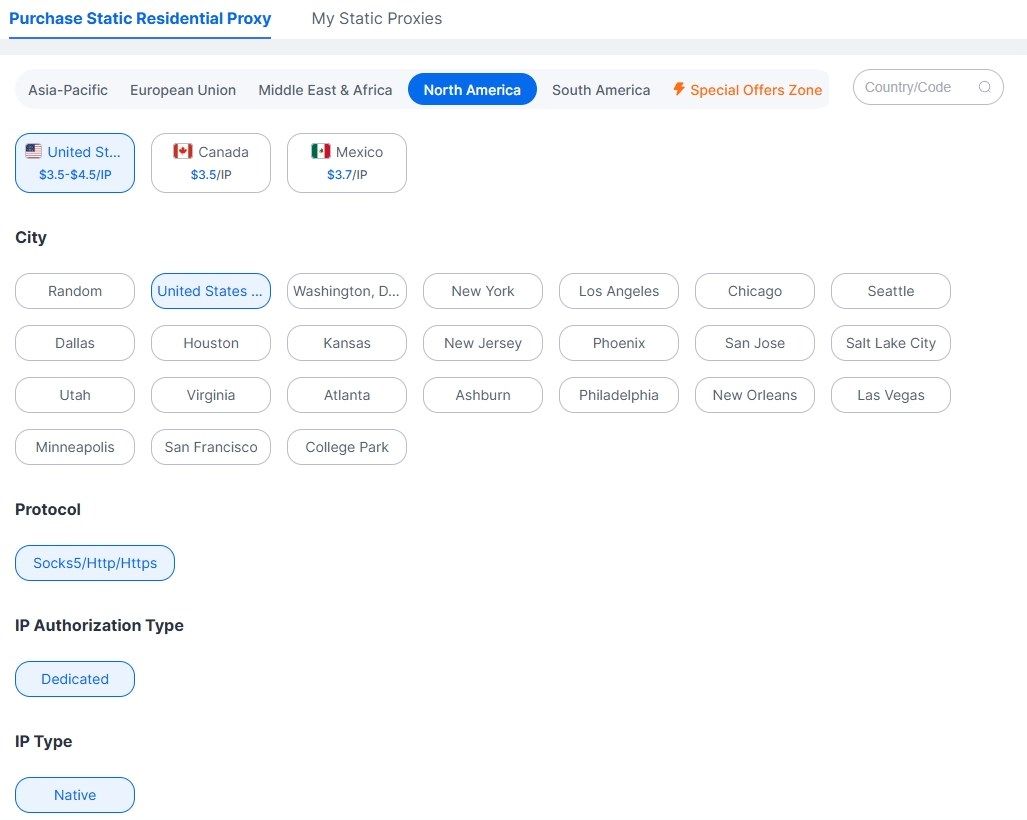
IPDeep provides static residential IP services covering multiple regions and supports different business scenarios to choose corresponding packages, helping enterprises reduce additional costs arising from network instability.
Practical Pitfall Avoidance Suggestions in Cross-Border Operations
To ensure account and business security, it is recommended to follow the following practical principles during selection and usage:
Choose Exclusive vs. Shared Based on Scenarios:
For high-risk scenarios such as account operations, priority should be given to exclusive IP resources to avoid being flagged due to others' violations; while shared proxy pools are usually more suitable for cost-sensitive, large-scale data collection scenarios.
Adhere to "Test Before Buy":
Do not blindly purchase long-term large packages. It is recommended to first purchase small traffic or short-term packages for practical testing, confirming that IP connectivity, risk scores, and unlocking capabilities of the target platform meet expectations before bulk purchasing.
Combine with Fingerprint Browsers for Comprehensive Isolation:
With the upgrade of platform risk control technologies, single IP compliance is no longer sufficient to ensure account security.
It should be combined with professional fingerprint browsers (such as Bit Browser, etc.) to achieve comprehensive isolation and management of "IP + Browser Fingerprint + Device Environment."
Establish Natural Account Operation Habits:
After binding a new IP to an account, it is recommended to maintain stable and natural operational behavior during use, avoiding high-frequency or abnormal operational rhythms in a short period.
Conclusion
Choosing a static residential IP provider is a comprehensive game of "quality, safety, and cost."
High cost-effectiveness is not merely about low prices, but about providing ultimate connection efficiency and localized support while ensuring business stability and reducing risk.
If you are looking for a solution that ensures business security and has competitive static residential proxy options, feel free to visit IPDeep Official Website for more professional information and technical support.
Frequently Asked Questions (FAQ)
Q1: What is the essential difference between static residential IP and dynamic residential IP?
The main difference lies in the fixed nature and lifecycle of the IP address. Static residential IPs provide long-term fixed addresses, suitable for scenarios that require stable identities such as account operations;
Dynamic residential IPs, on the other hand, rotate according to the provider's strategy based on time, requests, or session cycles, making them more suitable for data collection, market research, and other scenarios.
Q2: Is it legal to use static residential IP?
Proxy IPs, as a network transmission and access technology, are legal technical tools in themselves. However, users must ensure that their business activities comply with local laws and regulations as well as the service terms of the target platform.
Q3: Why are data center IPs not prioritized in account operation scenarios?
Data center IPs are concentrated from cloud service providers or server rooms, and their IP ranges are highly public and easily recognized by risk control systems.
Some high-risk platforms conduct stricter risk assessments on data center IPs, so in scenarios such as account operations, residential IPs usually have a lower proxy identification risk.
Q4: How to assess the quality of an IP?
Core evaluation dimensions include:
Whether the IP is listed in mainstream databases as blacklisted/high-risk, whether connection latency and packet loss rates meet business needs, whether the ASN is a native ISP resource of the target market, and the success rate of connectivity in actual business requests.