

Cheap Static Residential IPs: Are They Worth It? 2026 Prices, Risks & Buying Guide



Clean IP picks: Static IPs from $1.5 each, Dynamic IPs from $0.5/GB


Can a cheap static residential IP actually work? Yes — but price alone tells you very little. Some cost only a dozen yuan or so a month and run fine for weeks on end. Others aren't cheap at all, yet still deliver unstable connections, shifting addresses, or a region that doesn't match what was advertised.
Think of a static residential IP as renting a place for the long haul. A fixed address is just the baseline; what really decides whether it holds up over time is line quality, usage history, and how well the provider maintains the service.
If all you need is a fixed network exit, there's no reason to blindly buy an expensive plan. But if you want the most stability for the least money, you first have to understand what 2026 pricing actually looks like.

1. 2026 static residential IP pricing compared: what counts as cheap?
Static residential IPs aren't as expensive as they used to be. Some dedicated options cost as little as $3 a month, but providers differ widely on minimum order size, bandwidth, and the regions they cover.
Here are the reference prices published on vendor websites as of November 2026:
| Provider | Dedicated static residential IP price | Minimum purchase |
|---|---|---|
| IPDEEP | From $3.50/IP/month | Sold by region |
| Decodo | $3.33/IP/month | 3 IPs minimum |
| Bright Data | $3.50/IP/month | 10 IPs minimum |
| Oxylabs | From $3.20/IP/month | 5 IPs minimum |
Note: all figures are publicly listed starting prices. Actual pricing may differ by region, tax, traffic allowance, and purchase conditions. The provider's checkout page is the final reference.
On paper, IPDEEP, Decodo, and Bright Data start at fairly similar per-IP rates, but what you actually pay is not the same.
Decodo, for instance, works out to $9.99 a month for three IPs, plus tax; Bright Data comes to $35 a month for ten. If you only need one or two fixed IPs, the minimum order size often matters more than the headline unit price.
Region affects pricing too. With IPDEEP, for example, Hong Kong static residential IPs start at $3.3 a month, Korea at $5.9, and Japan at $3.2. It's a mistake to assume Asia is always more expensive than North America.
2. Where do cheap static residential IPs usually go wrong?
First, oversharing on the line. Some products are cheap because multiple users draw on a limited pool of network resources. Access is fine during the day, noticeably slower at night, and persistent connections may time out.
Second, IP history and reputation. An address may have passed through several users, so if it carries a lot of abnormal access records from before, you may run into extra verification or access restrictions. A higher price is no proof of IP quality.
Geolocation is another point people skip. A seller labeling an IP as a specific US city doesn't mean every geolocation database will report the same location. If your use case has strict regional requirements, verify it after purchase.
Then there's the messier scenario: the listing promises an address that stays fixed, and after a while it changes. If support responds slowly and the replacement terms are vague, whatever you saved upfront may not cover the hours you burn troubleshooting.
3. Cheap and stable static residential IP — how do you choose?
Don't shop on the monthly price alone. Focus on these checks:
| What to check | How to test it |
|---|---|
| Address stability | Watch it for 7 consecutive days and see whether the IP changes after reconnecting |
| Latency and packet loss | Test during the day and again in the evening, and log both results |
| Real-world speed | Use a fixed test node and compare performance across different time slots |
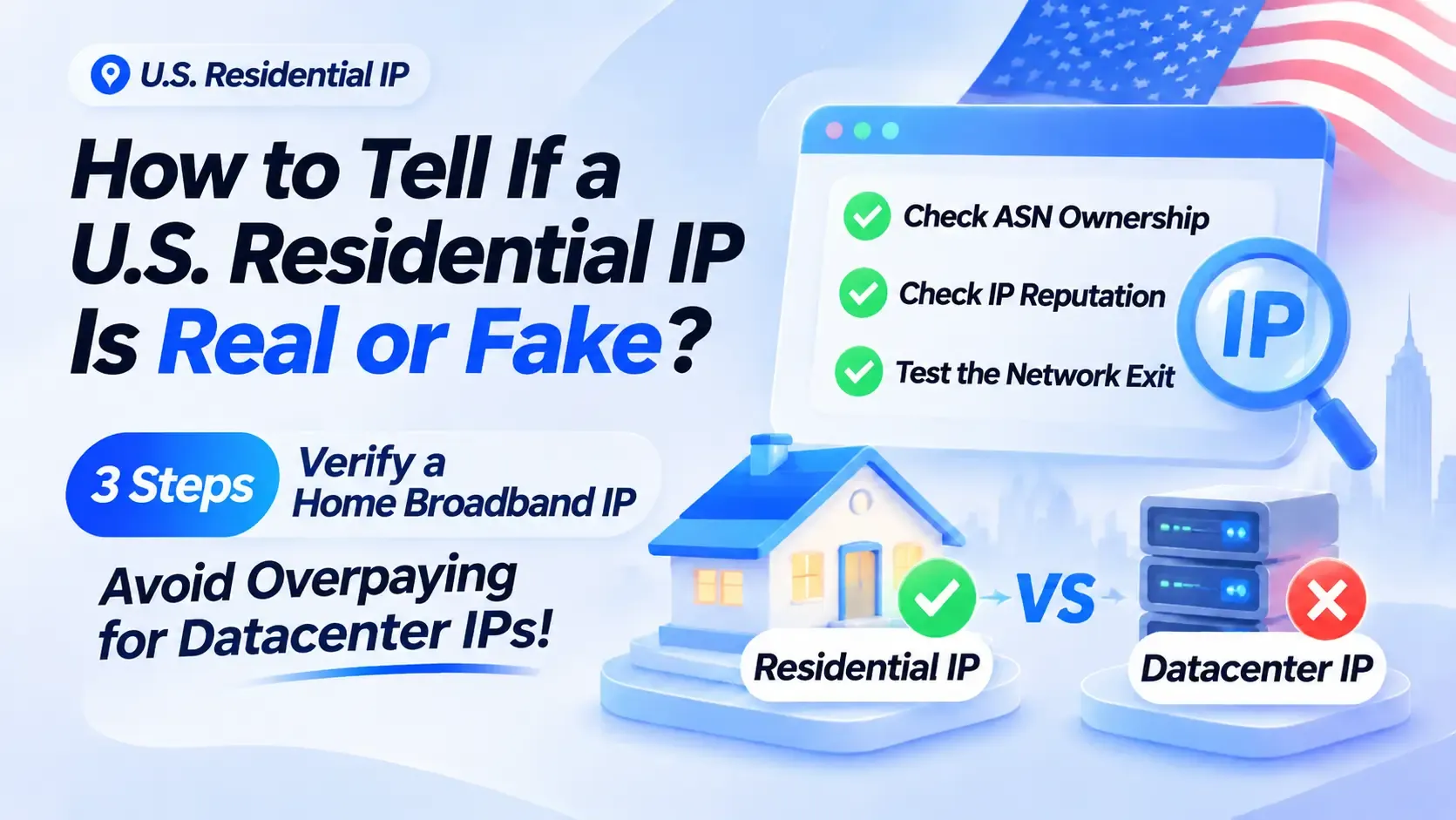
| IP ownership | Cross-check the ASN, WHOIS, and geolocation databases |
| After-sales support | Confirm the fault-handling and replacement rules |
The IP ownership check deserves particular attention. The ASN helps identify which network an address belongs to, but a carrier ASN doesn't automatically mean a genuine home broadband connection. Don't classify an IP on the strength of a single lookup.
Start with monthly billing and a small order, then test for 7 to 14 days. Pay attention to evening speeds, how often the connection drops, and whether the address stays fixed. Until you have real measurements, committing to a long-term plan in one go isn't advisable.
4. IPDEEP — a good fit for budget-conscious users?
If your main need is a stable long-term exit and you want to keep costs under control, IPDEEP is worth adding to your comparison list.
IPDEEP offers dedicated static residential IPs across multiple countries and regions, selectable by region, with customizable bandwidth on some lines. Standard US pricing starts at $3.5 a month, and specific cities may run promotional rates from time to time.
That said, a low-cost plan won't suit every use case. Before buying, confirm stock in your target region, the actual bandwidth allocation, and how connection faults are handled.
If you're just getting started, buy one or two IPs to test rather than a dozen at once. As long as the region is accurate, the address holds steady, and the speed meets your needs, a cheaper product can serve you just as well long term.
5. Common questions about the cheapest residential IP
Is a more expensive static residential IP always more stable?
Not necessarily. Price also reflects region, bandwidth, how exclusive the IP is, and order size. Stability is something you have to verify through actual testing.
Can a static residential IP that costs a few dollars a month be used long term?
Yes, but confirm that it's dedicated, check whether there's a traffic cap, and make sure the address can stay fixed over time.
How many devices can connect to one static residential IP at the same time?
There's no universal number. It mainly depends on the plan's concurrent connection limit, bandwidth, and actual usage load, so ask the provider before you buy.
Is it normal for a cheap static residential IP to be slow?
Lower bandwidth doesn't automatically mean poor quality, but if the connection drops constantly or becomes unusable in the evening, check the line load or contact the provider.
The bottom line
A cheap static residential IP isn't a bad purchase — the mistake is treating low price as the only criterion. In 2026, dedicated static residential IPs can be found in the $3–5 per month range. What's genuinely worth comparing is the purchase threshold, region, bandwidth, and long-term stability.
Buy a small quantity, test it in practice, then decide whether to commit long term. That's a far more reliable approach than hunting for the lowest quote.