





How to Choose a Static Residential IP: Use Cases & Guide



Clean IP picks: Static IPs from $1.5 each, Dynamic IPs from $0.5/GB


As cross-border business, social media operations, and global data needs continue to grow, static residential IPs have become a commonly used networking tool for many professionals.
Compared with some data center IPs, static residential IPs are associated with residential ISP networks and provide a relatively consistent network endpoint, making them useful for scenarios that require a stable network environment over time.
This article covers the technical fundamentals, key use cases, and selection criteria to help you make a more informed decision.

What Is a Static Residential IP?
A static residential IP typically refers to a proxy IP associated with a residential ISP network that can maintain a consistent exit IP address over an extended period.
Its key characteristics include two main aspects:
Residential attribute: The IP belongs to a residential ISP network and may have more natural network characteristics in certain website reputation assessments.
Static attribute: Under normal service conditions, the exit IP assigned to the user generally remains unchanged, making it suitable for businesses that need to maintain a consistent network environment over time.
It is important to note that network architectures vary between providers. Some IPs may belong to residential ISPs while being hosted on data center infrastructure.
Therefore, a static residential IP does not necessarily mean that the exit connection comes directly from a real household device. When choosing a provider, it is important to understand the underlying resource type.
Compared with some data center IPs, IPs associated with residential ISPs may exhibit different network characteristics in certain scenarios, but this does not mean they cannot be detected or restricted.
Whether a website considers an IP trustworthy depends on multiple factors, including IP reputation, ASN, proxy detection results, and actual user behavior.
Key Use Cases for Static Residential IPs
1. Maintaining a Stable Network Environment for Cross-Border E-Commerce Accounts
E-commerce platforms such as Amazon, eBay, and Shopify place certain requirements on the consistency of account login environments.
For cross-border sellers with legitimate multi-store operations, a stable and consistent network environment can help reduce unusual login signals caused by frequent changes in login locations.
A static residential IP can provide a relatively fixed and consistent exit point for long-term store management, reducing fluctuations caused by frequent IP changes.
It is important to remember that IP addresses are only one factor in a platform's risk assessment. They cannot replace platform requirements or guarantee that different accounts will not be associated.
2. Long-Term Management of Overseas Social Media Accounts
Social platforms such as TikTok, Facebook, and Instagram may consider factors including IP address, device information, login location, and account activity when assessing login risks.
For long-term account management, maintaining a relatively stable network environment can help reduce unusual login alerts or verification requests caused by frequent changes in login locations.
Since a static residential IP maintains a consistent network endpoint throughout the service period, it is suitable for routine login and management of social media accounts that require long-term maintenance.
However, content quality, engagement patterns, and compliance with platform policies also affect account status.
3. Market Research and Long-Term Data Monitoring
For tasks that require access from a specific region and long-term monitoring, such as:
tracking competitors' price changes, inventory updates, or SEO rankings
a static residential IP can provide a relatively stable network endpoint and reduce data consistency issues caused by frequent changes in the exit IP.
Please note that data collection should comply with the target website's robots.txt rules, terms of service, and applicable laws and regulations.
How to Choose a High-Quality Static Residential IP
With so many providers available, it is recommended to evaluate them based on the following four key criteria:
IP Authenticity and Reputation
A quality provider should offer IP resources genuinely associated with residential ISPs rather than misrepresenting data center IPs as residential IPs.
IP reputation, including whether an IP has previously been associated with abusive activity, can directly affect its network reputation.
Before purchasing, you can cross-check the IP using WHOIS, ASN lookup tools, and third-party IP databases.
Connection Stability and Availability
Since static residential IPs are often used for long-term operations, pay close attention to actual uptime, connection success rates, response times, and IP replacement policies.
SLAs, node availability, ISPs, and network routes vary between providers, so it is best to evaluate them based on your specific business requirements.
Geographic Coverage
Choose countries, regions, and cities based on your actual business needs. If precise geographic matching is important, also check city-level location accuracy, ISP information, and ASN details.
The number of countries covered is not the only factor that matters. If your business only needs a few key markets, prioritize the quality of resources available in those target regions.
Flexible Management Features
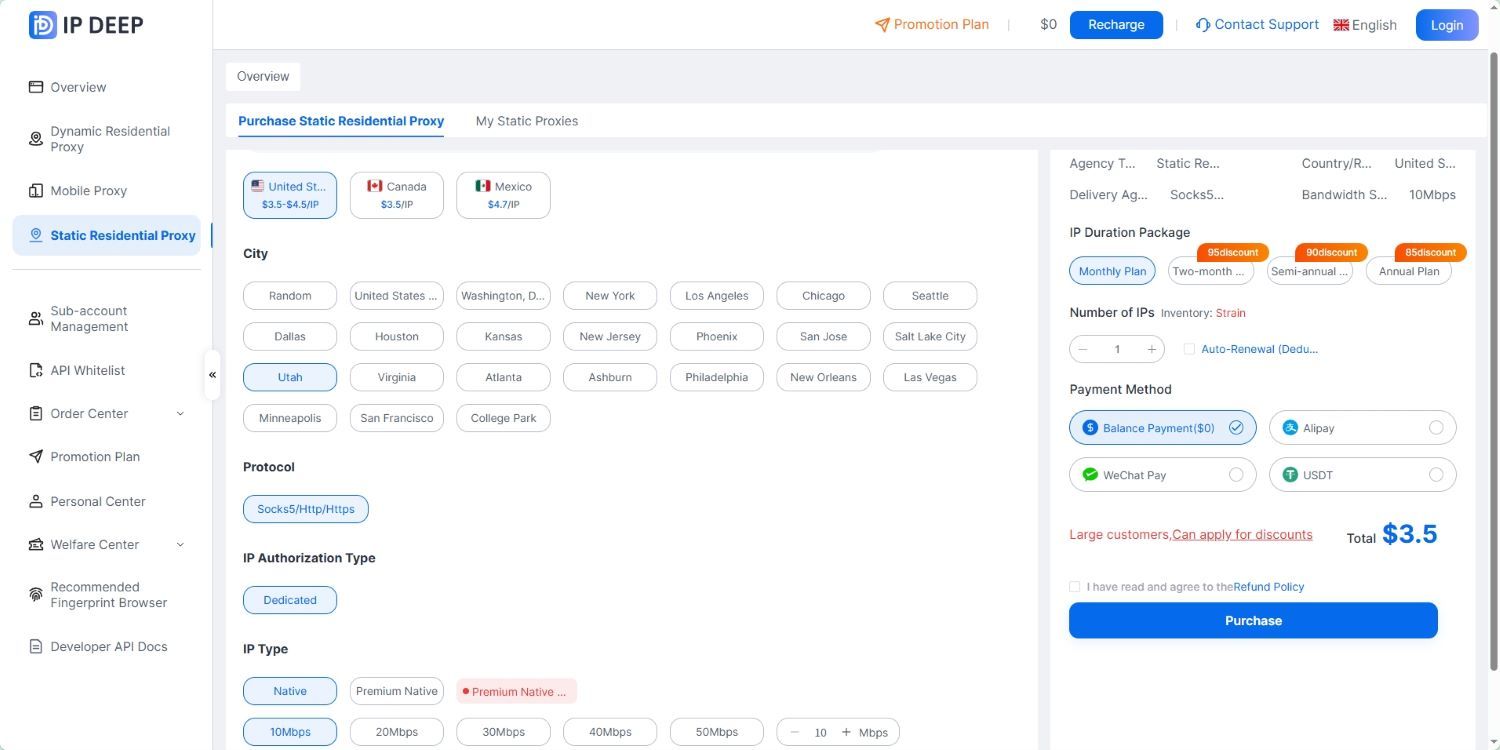
Features such as HTTP/SOCKS5 support, API management, and detailed traffic statistics can significantly improve team efficiency.
Static vs. Dynamic Residential IPs: Which Should You Choose?
Neither option is inherently better than the other. The right choice depends on your specific business requirements:
Frequently Asked Questions (FAQ)
Q1: Can a target platform detect that I am using a static residential IP?
Static residential IPs typically have residential ISP attributes, but registration details, historical reputation, and network architecture can vary between IPs.
Target platforms may consider multiple signals, including ASN, IP reputation, device fingerprints, account activity, and login locations. Therefore, a static residential IP does not mean that it cannot be detected.
When choosing an IP, you can use IP detection tools to check its ASN, ISP, IP type, and reputation as references.
Q2: Why do static residential IPs usually cost more than data center IPs?
Static residential IP resources are relatively limited and more costly to obtain, often involving compliant partnerships with ISPs in different regions.
Although static residential IPs generally cost more, their stability may make them a better fit for long-term account management, regional access, and ongoing monitoring.
Q3: Can I get a free trial of a static residential IP?
Testing policies vary by provider. Some offer a small number of test IPs, short-term trials, or low-cost test packages.
Before making a purchase, it is recommended to test the target country, ISP, connection stability, and IP reputation before committing to long-term use.
Q4: What should I do if my IP suddenly stops working?
If an IP suddenly becomes unavailable, pause related activities, check your proxy configuration and network status, and contact the provider to confirm the node status.
If the provider supports IP replacement, follow its replacement policy. For long-running operations, it is also recommended to understand the provider's fault handling, IP replacement, and support policies in advance.
Conclusion
When choosing an static residential IP, stability, IP reputation, and geographic coverage are key factors to consider.
However, it is important to keep in mind: a static residential IP alone cannot guarantee account security or compliance, nor can it replace responsible account usage and adherence to platform policies.
With the right IP configuration, businesses can maintain a more stable and consistent network environment for cross-border operations while meeting regional access and data requirements.