

How Much Does a Japan Static Residential IP Cost per Month? 2026 Pricing, Plans, and Buying Guide



Clean IP picks: Static IPs from $1.5 each, Dynamic IPs from $0.5/GB


How much does a Japanese static residential IP cost per month? Some providers quote around 20 yuan; others ask for a hundred or more. They all look like the same kind of fixed Japanese IP, yet the price differs several times over. Brand isn't the whole story — whether the IP is dedicated, how much bandwidth you get, traffic caps, and the billing cycle all move the number.
If you're planning to use a Japanese network node long term, there's no need to start with a premium plan. Work out what configuration you actually need, then compare real costs — that usually leads to a better fit.
1. What does a Japanese static residential IP cost in 2026?
Today, Japanese static residential IPs come either as per-IP monthly plans or as packages priced by bandwidth, traffic, or purchase volume. Some entry-level plans run only a dozen or so yuan a month; products with heavier bandwidth needs or extra services can reach tens or even hundreds of yuan.
Take IPDEEP's published pricing as an example: a standard Tokyo static residential IP is USD 3.2 per IP per month, with some discounted locations at USD 2 per IP per month. Both are dedicated, with bandwidth up to 50 Mbps.
| Plan | Monthly price | What you get |
|---|---|---|
| Discounted Tokyo static residential IP | USD 2 / IP | Dedicated, Tokyo location |
| Standard Japan static residential IP | USD 3.2 / IP | Dedicated, fixed exit |
| Custom bandwidth plan | Quoted per project | Bandwidth chosen to match the workload |
These figures reflect IPDEEP's published pricing as checked in November 2026. Discounted capacity is subject to stock; the final price and configuration are whatever the checkout page states.
2. Why do Japanese static residential IP prices vary so much?
First, dedicated versus shared. A shared IP is used by several customers at once, which keeps the cost down, but peak-hour performance can be affected by what everyone else is doing. A dedicated IP is allocated to one user and suits long-term projects that need a stable network exit.
Second, the IP resource itself. Japanese residential networks run through carriers such as NTT and KDDI, and different resources differ in network ownership, line quality, and supply cost. Some products carry Japanese carrier registration details but are actually hosted in data centers, so you can't judge the network type from the label alone.
Then there's bandwidth and how billing works. Some cheap plans come with a traffic cap; others charge per IP and treat bandwidth as a separate line item. Before buying, confirm what's actually included — otherwise it's easy to compare monthly fees and miss the follow-on costs.
3. Static residential IP or rotating residential IP — which one?
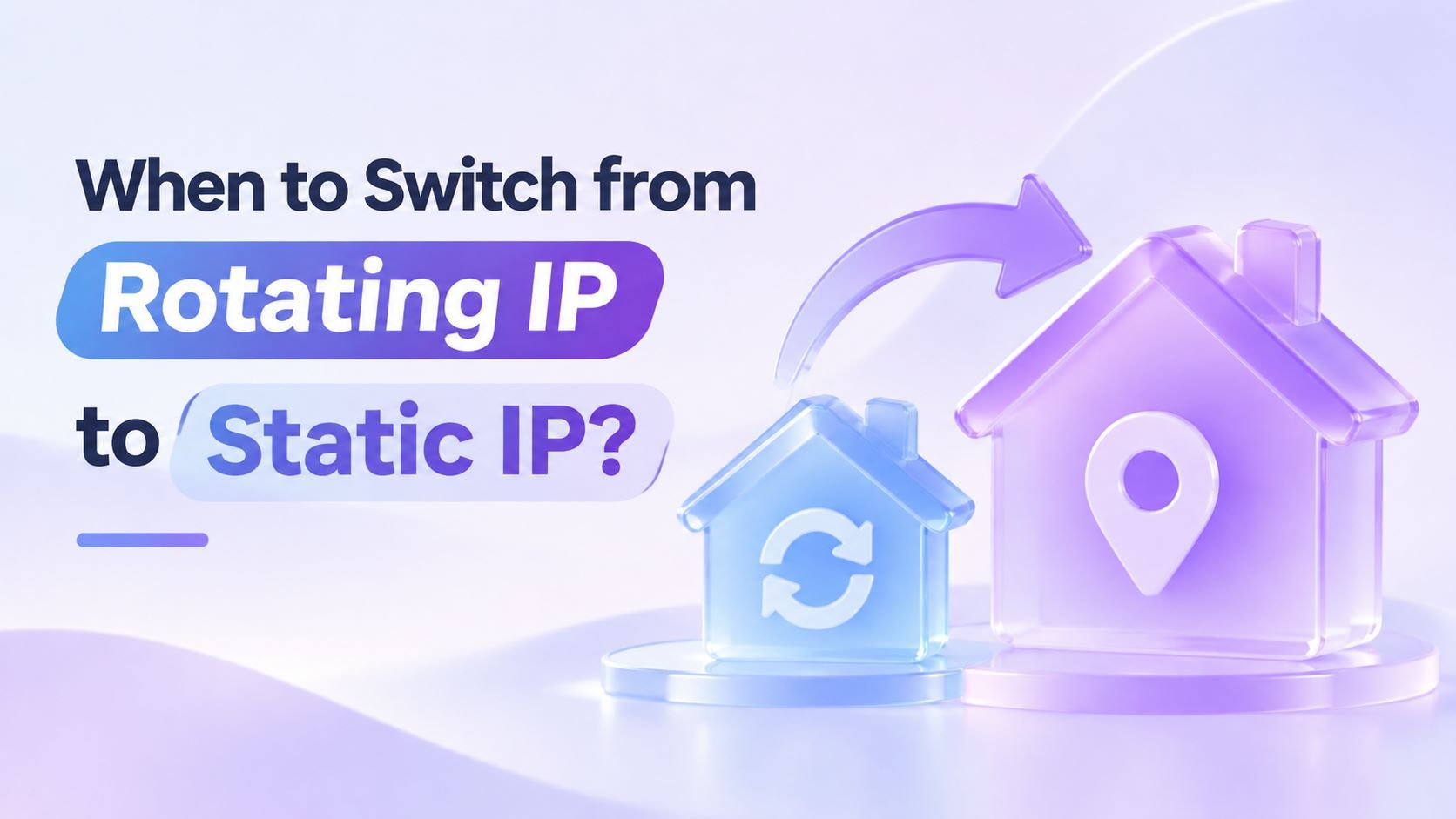
The biggest difference is how long the exit address lasts. A static residential IP normally stays the same for the whole rental period, which suits company remote access, whitelisted access to a fixed IP, back-office management of overseas accounts, and long-running observation of the Japanese market.
A rotating residential IP can switch its exit under the provider's rules, so it fits short sessions or public data lookups that don't need a permanent address. Some rotating products also offer sticky sessions for a set period — the IP doesn't necessarily change on every connection.
In short, if the work needs the same Japanese exit for several days running, a static residential IP is the better fit. If you don't need a fixed address, compare the cost of a rotating plan first.
4. What to check before you buy
First, look at where the IP is registered.
Public IP lookup tools let you verify country, city, ASN, and ISP. Keep in mind that database results are only a reference — on their own they can't prove how the IP is actually connected.
Second, check connection quality.
Real latency to Tokyo and Osaka nodes depends on your local carrier, the routing, and the time of day. Rather than trusting the latency figures in the marketing copy, test speed and sustained uptime in the environment you'll actually use.
Third, confirm the plan limits.
Look at HTTP, HTTPS, and SOCKS5 support, the bandwidth ceiling, the IP replacement policy, and the renewal price. For long-term projects especially, find out upfront whether the original IP can be kept for the whole rental period.

5. Is IPDEEP's Japanese static residential IP worth it?
For users who need a fixed Japanese exit, IPDEEP offers a fairly low entry point.
Its Tokyo static residential IPs are dedicated, support HTTP, HTTPS, and SOCKS5, and go up to 50 Mbps. Standard and discounted plans are listed publicly, so you can pick according to budget.
That said, a discount doesn't mean everything is bundled into the base price. At checkout, verify bandwidth, available stock, and renewal terms. If it's your first time on a project, buy a single IP, confirm the connection performs as expected, then scale up.
FAQ
What's a reasonable monthly price for a Japanese static residential IP?
There's no universal benchmark. IPDEEP currently lists standard Japanese plans at USD 3.2 per IP per month and discounted ones at USD 2. Whether any other product is reasonable depends on dedicated access, traffic, and bandwidth.
Can a Japanese static residential IP stay fixed long term?
Usually the same address holds for the length of the rental term, but don't read that as permanent. Resource maintenance, expiry, and service adjustments can all affect whether the IP is retained.
Tokyo or Osaka — which node should I pick?
If your work requires a specific city, go with that city. If not, compare actual connection quality, price, and availability first.
Monthly or annual billing — which is better value?
Short projects are better off on monthly billing, which makes configuration easier to adjust. For long-term projects, test until things are stable, then look at whatever longer-term discount is on offer.
Summary
When picking a Japanese static residential IP in 2026, the monthly number alone won't tell you much. Dedicated versus shared access, network ownership, bandwidth caps, and renewal policy all change what you actually end up paying.
If budget is tight, start by checking IPDEEP's current Tokyo plans and test with a single IP. Lining the price up against the real configuration before committing long term is a safer bet than chasing the lowest headline rate.