




Where to Buy Unlimited Residential Proxies? Top Providers



Clean IP picks: Static IPs from $1.5 each, Dynamic IPs from $0.5/GB


In cross-border businesses such as web scraping, large-scale data collection, ad verification, and multi-account management, residential proxies have become an essential network infrastructure for maintaining business continuity.
Traditional residential proxies are usually billed based on data usage.
However, with the rapid growth of large-scale data collection, high-volume content delivery, and high-frequency API requests, unpredictable traffic costs can become a major challenge for businesses.
In this context, unlimited rotating residential proxies have gained popularity among high-volume and high-concurrency businesses due to their predictable costs and no data usage concerns.
This article explores the technology behind unlimited rotating residential proxies, key factors to consider when choosing a provider, and reliable service recommendations.

What Is an Unlimited Rotating Residential Proxy? What Are Its Key Benefits?
Unlimited rotating residential proxies are proxy services built on real residential IP pools.
When users access target websites through proxy nodes, the system automatically assigns or rotates different residential IP addresses based on predefined rules.
Instead of charging based on actual traffic usage, these services typically use time-based, bandwidth-based, or subscription-based pricing models.
This model keeps the advantages of residential IPs, including a network environment that closely resembles real users, while reducing traffic costs for large-scale data collection and high-frequency access scenarios.
For rotating residential proxies, the unlimited model mainly addresses the cost challenges of frequent requests and large-scale data transfers. It does not mean that IP resources are unlimited or that there are no technical restrictions.
Comparison of Common Residential Proxy Types
Do Fully Unlimited Rotating Residential IPs Really Exist?
In practice, a service that is completely unlimited in every aspect does not exist due to technical and physical limitations.
When providers advertise "unlimited traffic" or "unlimited usage," they usually apply reasonable controls in other areas to prevent network abuse.
Common limitations for unlimited rotating residential proxies include:
Concurrent connections: Limits on the number of simultaneous connections or threads users can run, affecting multi-task performance.
Bandwidth limits: Maximum throughput limits for individual channels (such as 100 Mbps or 200 Mbps) to ensure fair network usage.
Request rate: Reasonable limits on requests per unit of time to prevent abuse and reduce the risk of triggering website protection systems.
Location availability: Some plans may limit the available IP locations or regions.
IP pool management: Providers use intelligent allocation strategies to optimize IP distribution and prevent excessive usage of the same IP. This also means users may not have complete control over the exact IP assigned during each rotation.
Therefore, businesses should choose providers with transparent pricing, clear bandwidth options, and no hidden speed limitations.
4 Key Factors When Choosing a Reliable Unlimited Rotating Residential Proxy Provider
To avoid issues such as slow speeds, unstable connections, or residential proxies being identified as data center IPs, businesses should carefully evaluate the following four factors when selecting a provider:
1. Authentic ISP Attribution and IP Reputation
A quality residential IP should have a genuine ISP attribution and allow verification of ASN and carrier information through IP databases.
If a proxy is actually a data center IP disguised as a residential IP, it may easily trigger security systems on social platforms or e-commerce websites, resulting in account restrictions.
2. IP Pool Size and Abuse Management
IP abuse is one of the biggest concerns for unlimited proxy services.
If a provider has a small IP pool or lacks effective IP rotation and cleaning mechanisms, multiple users sending frequent requests from the same IP range can cause those IPs to be widely blocked by target websites.
3. Bandwidth Capacity and Network Stability
Due to complex routing paths, traditional rotating residential proxies may experience packet loss when handling high-bandwidth tasks such as bulk video uploads or large data transfers.
Therefore, unlimited proxy services should support dedicated bandwidth options or high-performance backbone networks to improve connection stability and reduce network fluctuations.
4. Concurrent Connections and Request Frequency
Some providers advertise "unlimited traffic" while still placing strict limits on concurrent connections or request rates.
For teams running multi-threaded crawlers or managing multiple accounts, these restrictions can significantly reduce operational efficiency.
When selecting a provider, make sure the connection limits, request rates, and bandwidth options match your actual business requirements.
What Are Unlimited Rotating Residential Proxies Used For?
Unlimited rotating residential proxies can significantly improve efficiency and reduce costs in high-volume and high-frequency business scenarios, including:
Large-scale data collection and AI training:
When collecting large amounts of publicly available industry data, search engine results (SERPs), or public social media information, unlimited plans help prevent tasks from being interrupted by traffic limits.
Cross-border e-commerce operations and price monitoring:
Automatically track competitor pricing, inventory changes, and product reviews across international markets to obtain accurate market insights through frequent data access.
Ad verification and fraud detection:
Monitor advertising campaigns across different locations over extended periods and overcome limitations caused by restricted traffic usage.
Market research and sentiment analysis:
Collect consumer feedback, news updates, and regional market information to support better business decisions.
Reliable Residential Proxy Provider Recommendation: IPDEEP
After evaluating IP pool quality, product variety, and technical support, IPDEEP is a reliable provider for cross-border businesses and data collection use cases.
Its core advantages include:
Global coverage: IPDEEP provides proxy resources across more than 200 countries and regions, with over 30 million high-quality residential IPs for accurate localized access.
Stable technical performance: Offers high-anonymity proxies with intelligent IP rotation systems and optimized connection stability for different business scenarios.
Flexible product portfolio: IPDEEP provides dynamic residential proxies, static residential proxies, and mobile proxies to meet different business requirements.
For users who need unlimited traffic and high-frequency access, IPDEEP's dynamic residential proxies offer bandwidth-based pricing and use rotating residential IP pools to support large-scale data collection and cross-region access.
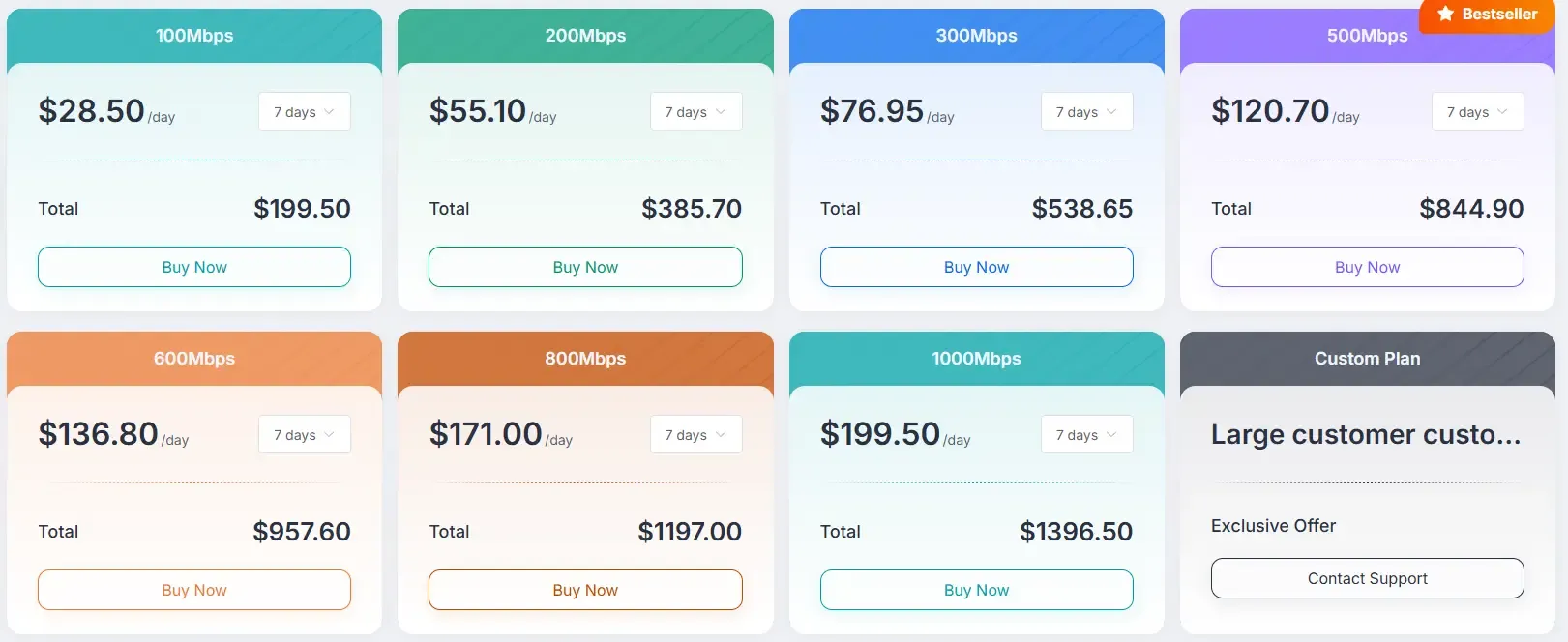
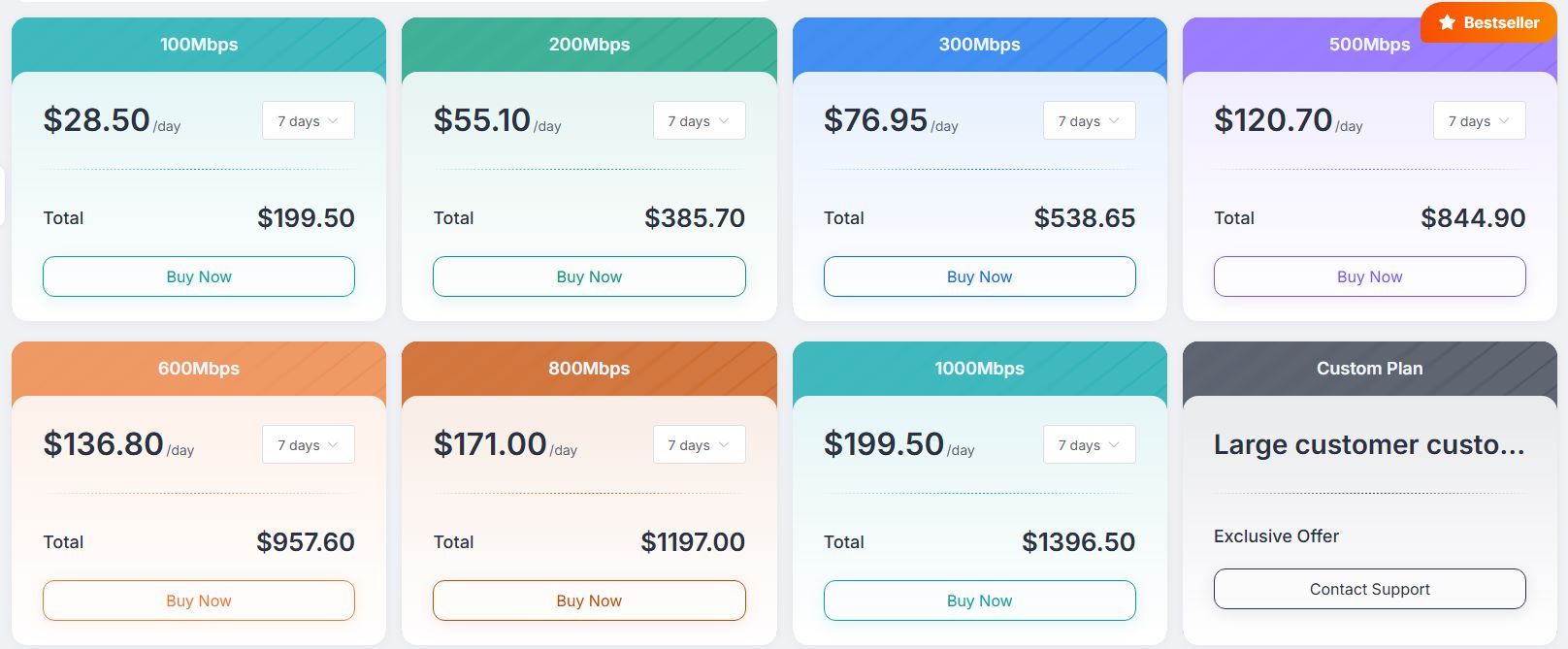
Transparent bandwidth-based pricing with unlimited traffic: IPDEEP's dynamic residential proxy plans are designed to eliminate concerns about unexpected traffic costs.
The plans are transparent and support flexible options for businesses of different sizes:
Whether you are running small-scale multi-account operations or TB-level data collection projects, IPDEEP provides cost-effective solutions tailored to different needs.
Conclusion
Choosing an unlimited rotating residential proxy is essentially about finding the right balance between connection stability and predictable costs.
For high-frequency and high-volume cross-border businesses, choosing a professional provider with a large IP pool, legitimate ISP resources, and transparent bandwidth-based pricing can help teams reduce traffic cost concerns and improve operational efficiency.
If you are looking for stable, anonymous, and cost-effective unlimited rotating residential proxies, visit IPDEEP official website to explore enterprise-grade proxy solutions with global coverage.
Frequently Asked Questions (FAQ)
Q1: Why do some providers advertise "unlimited" plans but still deliver poor performance?
This is usually because providers limit concurrent connections, request rates, or place users in overcrowded shared IP pools without effective IP rotation and reputation management.
In these cases, although there is no traffic cap, network congestion and frequent packet loss can significantly reduce actual performance.
Therefore, choosing a provider with a high-performance network infrastructure and a large residential IP pool is essential for reliable performance.
Q2: Why do rotating residential IPs need to change regularly? Can they be used as long-term static IPs?
Rotating residential IPs naturally change over time due to factors such as residential network reconnections and ISP address allocation.
If your business requires a long-term fixed IP environment, such as managing stores or maintaining consistent account access, a static residential proxy is a better choice than a rotating proxy.
Q3: Can unlimited rotating residential proxies completely prevent website blocks?
No proxy provider can guarantee a 100% block-free experience.
High-quality residential IPs can significantly reduce the risk of detection, but aggressive usage patterns may still trigger protection systems on target websites.
Users should follow reasonable access patterns and maintain behavior that resembles normal user activity.