




Which Proxy Works for Large-Scale IP Rotation? Unlimited IP Guide



Clean IP picks: Static IPs from $1.5 each, Dynamic IPs from $0.5/GB


For small-scale requests, pay-per-GB residential proxies are usually enough.
But when a task needs to run continuously for long periods, handle a large number of requests, and frequently rotate exit IPs, proxy costs can increase with traffic and become difficult to predict in advance.
In this case, unlimited residential proxies are worth considering. Instead of paying for “how many GB you use,” you pay based on “how much bandwidth you need.”
This guide covers three things: why large-scale tasks need IP rotation, which proxy type to use for frequent IP rotation, and when unlimited residential proxies make sense.
Why Do Large-Scale Tasks Need Frequent IP Rotation?
Sending a large number of requests from a single IP within a short period can easily trigger rate limiting on the target site.
Common responses include CAPTCHAs, 429 Too Many Requests, and 403 Forbidden errors. In more serious cases, stricter access restrictions may be applied, and the related IP range may also be restricted.
IP rotation distributes request traffic across multiple exit IPs, reducing the request volume handled by each individual IP. However, the rotation strategy should match the session requirements of the task. Faster rotation is not always better:
Per-Request Rotation: A new exit IP is assigned to each request. This works well for stateless data retrieval tasks, such as scraping public product listings and collecting SERP data.
Sticky Session: The same exit IP is maintained for a set period. This is suitable for workflows that depend on server-side state, such as multi-step form submissions, logged-in pages, and shopping carts. Changing IPs during a session may cause the login session to expire or interrupt the workflow.
It is also important to remember that IP is only one part of the access environment. Target sites may also consider request frequency, cookies, session consistency, and client characteristics. Changing the IP does not remove other restrictions.
Which Proxy Type Should You Choose for Frequent IP Rotation?
One thing is worth clarifying: proxy type alone does not determine access success.
IP reputation, ASN, target site, location, session strategy, and request patterns can all affect actual performance. Even with residential proxies, results can vary significantly between IP pools, locations, and request methods.
For data collection tasks that require a large number of requests and frequent exit IP rotation, residential proxies are generally a suitable choice. If the task also involves high data transfer volumes, unlimited residential proxies may be worth considering.
What Are Unlimited Residential Proxies?
Unlimited residential proxies are typically residential proxy plans priced based on bandwidth and usage period.
For IPDeep, unlimited products are a type of residential proxy with dynamic IPs. The main difference is the pricing model: instead of paying per GB, you pay based on bandwidth and usage period.
“Unlimited” means there are no additional charges based on the actual GB consumed during the plan period. It does not mean every aspect of the service is unlimited.
▸ Mbps is a bandwidth specification, not a speed guarantee: A plan listed at 300 Mbps or 500 Mbps generally refers to the bandwidth specification of the plan. It does not mean a single request or device can consistently reach that speed.
Actual bandwidth performance can also be affected by the proxy node, target server, and network conditions.
▸ IP pool size and regional availability are still limited: Residential IPs can be rotated, but this does not mean an unlimited number of IPs from a specific country or city can be accessed concurrently.
▸ Concurrency and usage rules depend on the plan: Different providers may define “unlimited” differently. Before purchasing, check the bandwidth specification, concurrency limits, IP pool size, location coverage, and usage policy.
What Large-Scale Tasks Are Unlimited Residential Proxies Suitable For?
When choosing unlimited residential proxies, first determine whether your main bottleneck is traffic volume or the number of IPs.
If the main challenge is high data transfer rather than the need for a large number of unique IPs, bandwidth-based unlimited residential proxies may be worth considering.
This model is generally suitable for tasks with the following characteristics:
▸ Large-Scale Data Collection: Pages may contain HTML, images, CSS, JavaScript, and API requests, making total traffic significantly higher than a simple estimate based on “number of pages × average page size.”
▸ AI Data Collection and Public Data Processing: Continuously collecting large amounts of text, images, or other public data from the web can result in high traffic usage over time.
▸ E-commerce Price and Inventory Monitoring: Frequently accessing large numbers of product pages over long periods can generate continuous traffic.
▸ SEO and SERP Monitoring: High-volume queries that require sustained throughput.
▸ Long-Running Automated Tasks: Price monitoring, rank tracking, and website availability checks running 24/7.
▸ High-Throughput Web Requests: Tasks with relatively high concurrency and large request sizes.
One important point: unlimited plans address traffic-based pricing, not unlimited concurrency. Actual concurrency depends on the plan specifications and the provider’s usage rules.
Conversely, for low-frequency or small-scale data retrieval, pay-per-GB proxies are usually more flexible, so a bandwidth-based plan may not be necessary.
Unlimited Residential Proxies vs. Pay-Per-Traffic Residential Proxies
The two models can use the same type of IPs. The main difference is the pricing model.
If you cannot estimate your monthly traffic yet, a practical approach is to start with a pay-per-GB plan, track your actual usage for a period, and then decide whether to switch to bandwidth-based pricing.
If the task runs continuously and consumes significant traffic, compare your actual monthly usage with the cost of a bandwidth-based plan before switching to an unlimited model. For low-volume tasks or tasks with flexible usage periods, pay-per-GB pricing is usually more flexible.
What to Look for When Choosing Unlimited Residential Proxies?
▸ Bandwidth Options: Make sure the available bandwidth meets your actual throughput needs and can scale with your business requirements.
▸ IP Pool Size: A small pool can lead to more repeated IPs during long-running tasks and limit the range of available IPs.
▸ IP Rotation Methods: Check whether both per-request rotation and sticky sessions are supported and whether they can be configured for different tasks.
▸ Location Coverage: Check whether the provider supports targeting specific countries or cities.
▸ Concurrency and Usage Policies: Check whether concurrency limits, session rules, and terms of use are clearly stated.
These factors can be verified with a small-scale test before purchasing. Start by using an IP detection tool to check the exit IP’s ISP, ASN, network type, and geolocation. Then run actual requests for a period of time and monitor success rates, response times, and failure reasons before scaling up.
IPDeep Unlimited Residential Proxies
IPDeep offers both pay-per-GB residential proxies and bandwidth-based unlimited residential proxies. Both use dynamic residential IPs and support HTTP / HTTPS / SOCKS5 protocols.
The unlimited plans use bandwidth + usage period pricing, with multiple bandwidth options including 100 Mbps, 200 Mbps, 300 Mbps, 500 Mbps, 600 Mbps, 800 Mbps, and 1000 Mbps. No additional traffic needs to be purchased on a per-GB basis during the plan period.
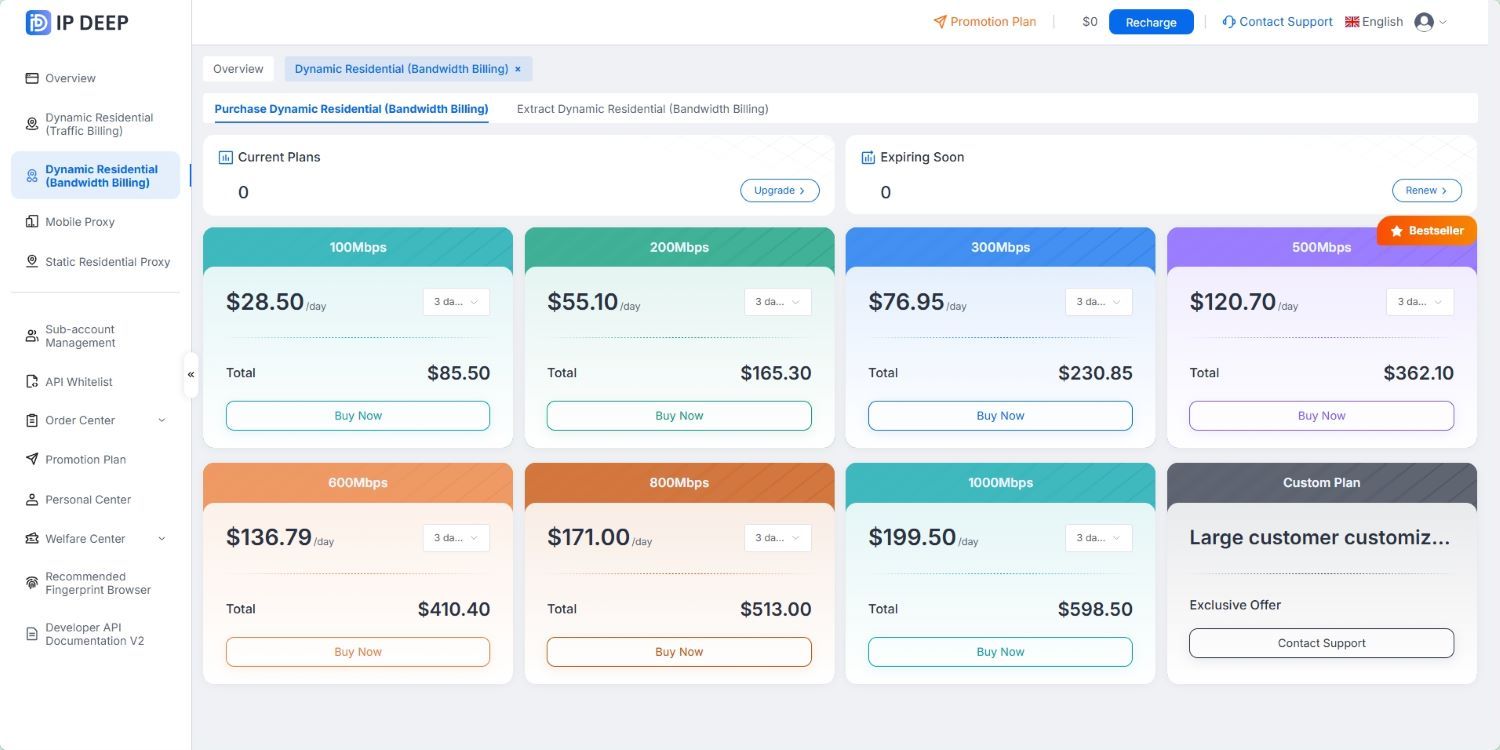
If the main challenge is high traffic rather than the number of IPs, a bandwidth-based unlimited residential proxy plan can make costs easier to predict than a pay-per-GB model. For low-volume or flexible-duration tasks, pay-per-GB pricing is more flexible.
These two models can be switched based on your business needs. For current bandwidth options, plan periods, pricing, available locations, and network performance, see the current official page.
Frequently Asked Questions
Q1: Are Unlimited Residential Proxies Really Unlimited?
“Unlimited” means there are no additional per-GB traffic charges during the plan period. Bandwidth specifications, concurrency, IP pool size, and location coverage still have limits, and usage rules depend on the plan.
Q2: Can Frequent IP Rotation Slow Down Access?
Proxy rotation itself may add some routing overhead, but speed is usually affected more by node distance, proxy server load, target server response times, and local network configuration.
If you experience significant timeouts, check these factors first before adjusting the proxy node or rotation strategy.
Q3: Why Am I Still Blocked After Switching to a Residential IP?
A residential IP only addresses the network exit and IP type. Target sites may also evaluate request frequency, cookies, session consistency, and client-side signals when determining whether to allow access.
If you use browser automation, also check whether the proxy location matches the browser’s time zone and language, and whether DNS, WebRTC, or other settings could expose your real network environment.