




LLM Training Proxies: How to Choose Unlimited Residential Proxies



Clean IP picks: Static IPs from $1.5 each, Dynamic IPs from $0.5/GB


Large language model training requires massive amounts of Web data, and the environment for AI data collection in 2026 is different from what it was a few years ago:
websites are no longer focused solely on traditional “anti-bot” measures but are increasingly introducing access controls specifically for AI crawlers.
In 2026, Cloudflare further strengthened its AI crawler management capabilities, distinguishing between different types of AI crawlers, including Search, Agent, and Training, while introducing mechanisms such as Content Signals that allow websites to indicate whether their content can be used for AI training.
Its Browser Rendering service also lists training, RAG, research, and content monitoring as specific use cases, while following robots.txt and AI Crawl Control by default.
In other words, AI data collection is gradually becoming a dedicated data infrastructure challenge rather than just another form of Web scraping.
This guide explains when residential proxies are needed for LLM training, which tasks are suitable for unlimited bandwidth-based plans, and how to choose one.
Why Do LLMs Need Residential Proxies?
When large-scale access to public Web data is required and target websites have IP-based risk controls or geographic restrictions, residential proxies can be part of the data collection infrastructure.
LLM data collection mainly faces three challenges:
1. IP Restrictions
High-frequency, concurrent requests can trigger rate limits on target websites, resulting in 429 or 403 errors. Unexpected connection interruptions can leave datasets incomplete and increase the cost of data cleaning and rerunning failed tasks.
2. Regional Content Differences
When training models for multilingual and multi-region applications, a lack of local network exits can affect the content retrieved due to geographic redirects or regional content restrictions.
3. Large Data Volumes
Pretraining datasets are often extremely large, making data collection a long-running process where cost and stability both matter.
Which Proxy Type Is Best for LLM Data Collection?
Keep in mind: Datacenter IPs are generally easier to identify based on their network ownership.
On websites that use IP reputation databases, Bot Management, and behavioral detection, datacenter proxies are more likely to trigger additional verification or access restrictions.
However, for public, low-risk data sources such as government datasets and academic mirrors, datacenter proxies can still offer advantages in speed and cost.
That said, residential proxies are not a universal solution.
Genuine residential IPs can reduce some restrictions caused by datacenter IP reputation or network ownership, but actual collection performance still depends on the target website’s Bot Management, request frequency, browser environment, and access behavior.
Selection takeaway: For large-scale, continuous collection of public Web data, a residential proxy network with IP rotation and high throughput is generally suitable. For high-volume tasks, unlimited bandwidth-based plans can make traffic costs more predictable.
Why Use Unlimited Residential Proxies for LLM Training?
Proxy IP plans typically use either pay-per-GB pricing or bandwidth-based pricing (unlimited / Mbps).
One common misconception needs to be clarified: unlimited does not mean unlimited speed.
Unlimited residential proxies generally mean that traffic is not billed or capped by GB, rather than having no speed limit. Actual throughput still depends on the selected bandwidth tier and may also be subject to concurrency, node availability, and Fair Use Policy restrictions.
For high-volume LLM data collection, unlimited residential proxies billed by bandwidth offer several practical advantages:
▸ More predictable costs: Fixed bandwidth-based pricing is less affected by fluctuations in traffic volume, making long-term collection easier to budget.
▸ Built for continuous operation: Unlimited traffic helps prevent pipelines from being interrupted when a traffic quota is exhausted, making these plans suitable for 24/7 workloads.
▸ Flexible bandwidth options: Multiple tiers from 100Mbps to 1000Mbps are available to match different workload requirements.
How to Choose an Unlimited Residential Proxy
1. Actual Bandwidth
Choose a bandwidth tier based on your concurrency and throughput requirements rather than focusing only on the word “unlimited.”
2. IP Pool and Geographic Coverage
Check the size of the residential IP pool, geographic coverage, and whether country- and city-level targeting is supported.
3. IP Rotation and Sticky Sessions
Confirm whether IPs can be rotated on demand or at scheduled intervals, and whether sticky sessions are available for tasks that require persistent sessions.
4. Protocol and Tool Compatibility
Support for HTTP, HTTPS, and SOCKS5 makes the proxy compatible with common scraping tools and frameworks such as Python Requests, Scrapy, and Playwright.
5. Concurrency and Service Stability
Check supported concurrent connections and actual connection stability. Rather than relying only on advertised average latency or success rates, test performance based on your target websites, locations, and concurrency levels.
In real-world evaluations, the actual cost per successful request can be more useful than simply comparing the price per GB.
IPDeep Unlimited Residential Proxies
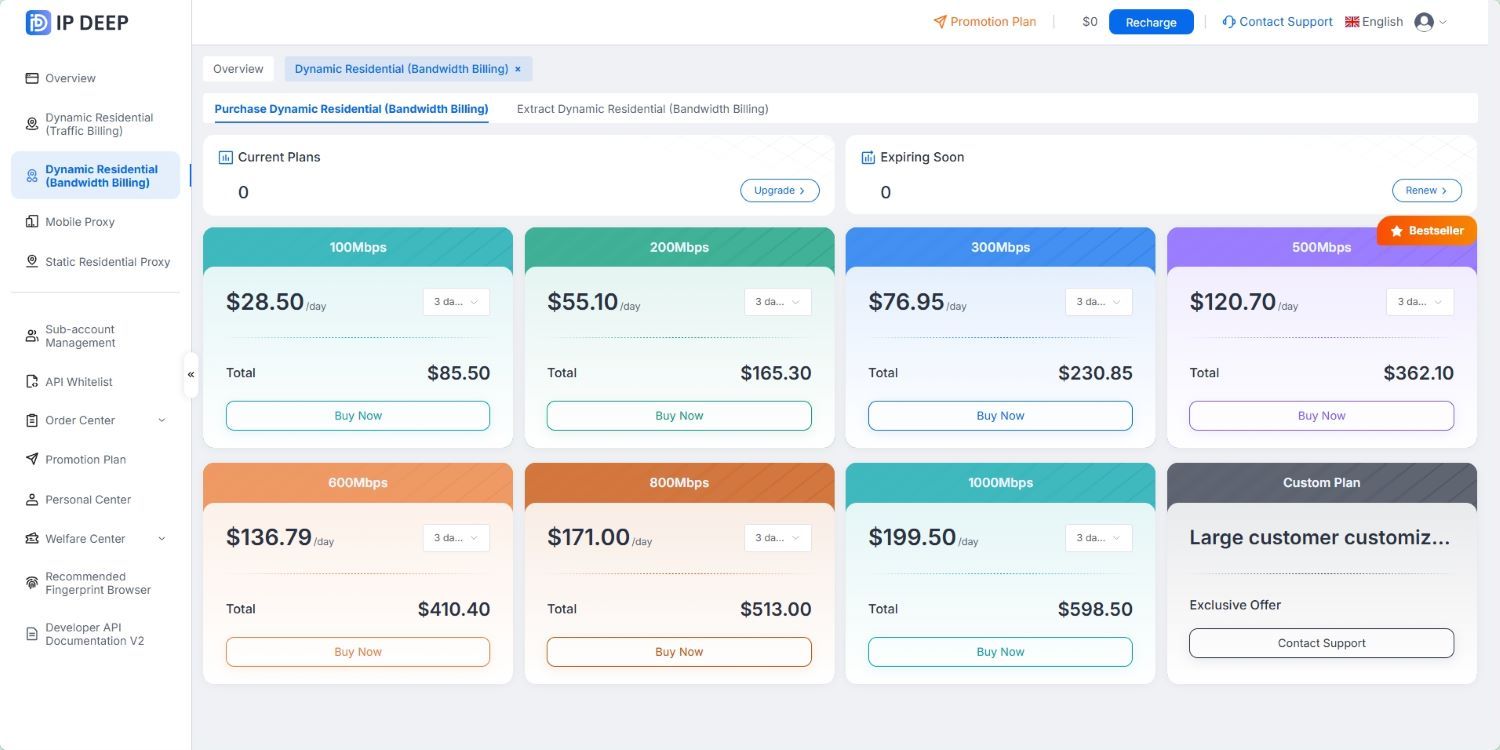
IPDeep offers unlimited residential proxies billed by bandwidth, with multiple bandwidth tiers currently available, including 100Mbps, 200Mbps, 300Mbps, 500Mbps, 600Mbps, 800Mbps, and 1000Mbps.
Plans are billed by bandwidth rather than GB and support on-demand or scheduled millisecond-level automatic IP rotation.
▸ Protocols: HTTP, HTTPS, and SOCKS5, compatible with a wide range of scraping frameworks and automation tools.
▸ Geographic Coverage: Coverage across multiple countries and regions worldwide, with country- and city-level targeting.
▸ Pricing Model: Billed by bandwidth tier with unlimited traffic, making costs relatively predictable.
Suitable for large-scale Web scraping, SERP monitoring, AI data collection, and other public data processing tasks that require sustained, high-throughput proxy connections.
For current bandwidth tiers and available nodes, visit the IPDeep website.
Data Collection Architecture Tips
Even with a high-quality unlimited residential proxy, a well-designed collection architecture is still important:
▸ Set concurrency limits based on the target website to avoid triggering rate limits.
▸ Use exponential backoff and limited retries for 429/5xx responses.
▸ Configure separate proxy pools for different target regions to avoid mixing geographic exits.
▸ Use sticky sessions for tasks that require persistent sessions.
▸ Use browser environments such as Playwright for JavaScript-rendered pages.
▸ Use caching to avoid redundant requests.
▸ Follow the target website’s robots.txt, terms of service, and applicable data-use requirements.
Frequently Asked Questions
Q1: Are unlimited residential proxies really unlimited in traffic?
Unlimited generally means that traffic is not billed by GB, while bandwidth still depends on the selected Mbps tier and may be subject to concurrency, node availability, and Fair Use Policy restrictions.
Q2: Do LLMs always need residential proxies?
Not necessarily. Public, low-risk data sources can be accessed with datacenter proxies, while residential proxies can be considered when higher geographic authenticity is required or when stricter IP-based risk controls are in place.
Q3: How do I choose between rotating and static residential proxies?
Rotating residential proxies are generally more suitable for large-scale Web scraping.
For tasks that require a fixed exit IP or persistent sessions, consider static residential proxies.
Q4: Can residential proxies bypass Cloudflare?
Residential proxies can only address some IP-level access issues and cannot determine Cloudflare’s verification outcome on their own.
Systems such as Cloudflare also consider bot behavior, browser characteristics, request patterns, and other factors when evaluating access. A proxy is only one part of the data collection architecture.
IPDeep provides stable network access and high-throughput proxy infrastructure for legal and compliant public Web data collection.
To plan an LLM training data pipeline or evaluate the actual bandwidth performance of unlimited residential proxies, visit the IPDeep website for more information.