

Can You Choose a City for a US Static Residential IP?



Clean IP picks: Static IPs from $1.5 each, Dynamic IPs from $0.5/GB


US static residential IPs can be selected by city, but not every city has available IP resources.
Some proxy providers allow users to select US static residential IPs in specific cities, such as New York and Los Angeles. Available cities, ISPs, and IP quantities depend on the provider's inventory.
City targeting means selecting an IP associated with a particular location. It does not mean you can change the location of an existing fixed IP.
This article explains the differences between state, city, and ZIP code targeting, along with how to verify whether a purchased IP meets your location requirements.

Which US Cities Can You Choose for Static Residential IPs?
Static residential IPs generally refer to proxy IPs associated with residential ISPs that maintain a fixed exit IP throughout the rental period. Some products are also known as ISP proxies.
Compared with rotating residential proxies, they are better suited to tasks that require a consistent exit IP over time.
1. City Selection vs. Random Assignment
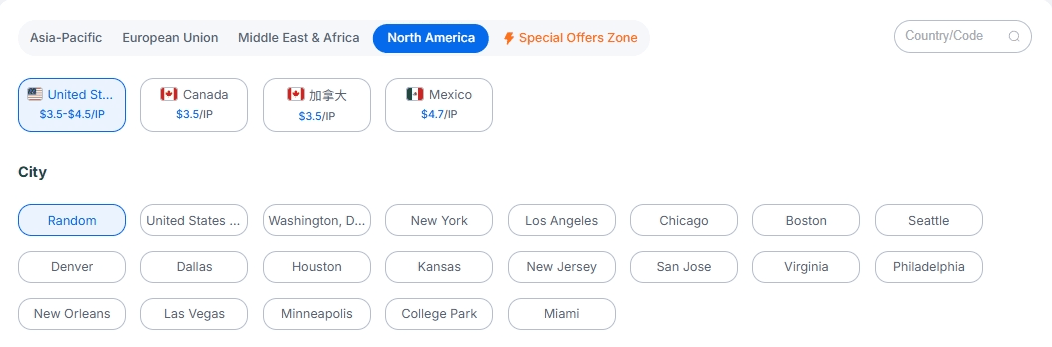
Take IPDEEP as an example. Its standard US static residential IPs offer two options: receive a randomly assigned US IP when ordering, or select from approximately 20 available cities, including Los Angeles, New York, Chicago, Seattle, and Dallas.
Both options cost the same. The main difference is whether you need an IP associated with a specific city.
2. Why Are Some Cities Unavailable?
The cities a provider can offer depend on its fixed IP inventory and product configuration. Not every US city is necessarily available for selection.
Major cities such as New York and Los Angeles are commonly covered by proxy providers, but actual availability still depends on their network resources.
Some smaller cities may have no available static residential IPs. Always check the available locations before purchasing.
State vs. City vs. ZIP Code Targeting: What's the Difference?
These three targeting methods differ in geographic coverage and are suited to different use cases.
1. When Should You Use State-Level Targeting?
State-level targeting restricts the exit IP to a particular state, such as California or Texas, without guaranteeing a specific city. It is suitable for tasks that require a state-level location but have no strict city requirements, such as state-level market monitoring or regional content testing.
2. When Is City-Level Targeting Necessary?
If your task requires an exit IP associated with a specific city, such as monitoring local search results in Los Angeles or checking city-specific ad delivery, city-level targeting is the appropriate choice.
City-level residential IPs can provide a location-specific network environment for local SEO monitoring, helping you observe differences in search results across cities.
However, for long-term local keyword ranking tracking, you should also standardize device settings, language, and search parameters, and verify results using dedicated rank-tracking tools rather than relying solely on the IP location.
3. Why Can't a City-Level IP Guarantee a Specific ZIP Code?
This is a common misconception. City-level targeting narrows the geographic area associated with an IP, but it cannot guarantee a match with a particular ZIP code.
For example, ZIP code 90210 primarily corresponds to Beverly Hills, not the entire city of Los Angeles. IP geolocation estimates a general location using network information and is different from GPS positioning.
IP geolocation relies on third-party databases that analyze and infer locations from network data. Although some databases provide ZIP code information, ZIP-level accuracy is generally lower than country- or state-level accuracy and cannot guarantee an exact match with the ZIP code of the IP's actual location.
Therefore, if you need to verify services or ad delivery within a specific ZIP code, use the target platform's own ZIP code targeting features and conduct practical tests rather than relying on the IP address alone.
For general city-level content access, selecting an IP in the target city is usually sufficient.
What Else Should You Check Before Buying a US Static Residential IP?
Beyond location, several other IP attributes should be verified separately.
1. ISP, ASN, and Residential Network Classification
City targeting determines the geographic location associated with an exit IP, while ISP and ASN information helps identify the network operator to which the IP belongs.
Before purchasing, you can check whether an IP belongs to the expected residential ISP. However, the ISP name alone does not prove that the IP uses an actual residential connection or that it is free from proxy indicators or a history of misuse.
2. Dedicated IPs, Fixed IP Duration, and Connection Stability
Before purchasing, confirm whether the IP is dedicated, whether it remains fixed throughout the subscription period, whether renewal allows you to retain the same IP, and what replacement policies apply if a node fails.
For accounts that require long-term access, a consistent exit IP and reliable network performance are generally more valuable than simply choosing a well-known ISP.
3. IPDEEP US Static Residential IP Locations and Network Options
If your business requires a long-term fixed US exit IP, you can choose a network option based on whether you need a specific city.
IPDEEP offers randomly assigned US IPs, city-specific IPs, and NTT network options.
Standard US static residential IPs support either random assignment or selection from available cities. The NTT option is offered separately and currently does not support city selection. For more details, see the US NTT Static Residential IP Buying Guide.
According to IPDEEP's published product information, standard US static residential IPs start at $3.50 per IP per month, while NTT IPs are priced at $4.50 per IP per month.
These products support HTTP, HTTPS, and SOCKS5 protocols, with configurable bandwidth of up to 50 Mbps. They use dedicated fixed IPs that normally remain unchanged throughout the subscription period.
How to Verify Whether Your IP Is Located in the Target City
1. How to Check an IP's Geographic Location
After purchasing, connect through the proxy and visit an IP lookup tool such as IPinfo to confirm that your exit IP has changed. Then check the country, state, city, ISP, and ASN information, and cross-check the results using another IP geolocation database.
If your task requires a specific city, also test the location displayed by the target website. Geolocation results may vary between databases, so do not rely on a single lookup tool to determine whether an IP meets your requirements.
2. What If Different Databases Show Different Cities?
Third-party IP geolocation databases use different algorithms and update schedules, so the same IP may appear in slightly different cities across lookup tools. In densely populated areas, databases may associate IPs from smaller surrounding towns with nearby major cities.
If different tools report different cities, first check whether the country, state, ISP, and ASN match your requirements. Then evaluate the results based on how the target platform actually identifies the location.
If your task requires a specific city but the IP is consistently identified as being elsewhere, contact the provider to confirm the node's location or request a replacement. Matching the state and ISP alone does not guarantee that an IP meets every business requirement.
Frequently Asked Questions (FAQ)
Q1: Does IPDEEP Charge Extra for Selecting a US City?
No. IPDEEP's standard US static residential IPs have the same reference price of $3.50 per IP per month for both random assignment and city selection. Actual pricing is subject to the checkout page.
Q2: Why Doesn't My IP's City Match Its ZIP Code?
IP geolocation is not the same as precise address positioning. Even if an IP is identified as being in the target city, it may not match a specific ZIP code. For ZIP-level verification, use the target platform's location features and conduct practical tests.
Q3: Can I Select a Specific US State for a Static Residential IP?
State-level targeting availability depends on the provider's network coverage. IPDEEP primarily offers random assignment or city selection for its US static residential IPs. If you need an IP in a particular state, check the available inventory before purchasing.
Q4: Can I Keep the Same City When Replacing a Static Residential IP?
This depends on the provider's IP replacement policy. If an IP must be replaced due to a node failure, confirm with the provider in advance whether the replacement IP can remain in the same city.
Q5: Should I Choose City Targeting or a Random US IP?
Choose city targeting if your task requires a fixed exit IP in a specific city. If you only need a stable US exit IP and have no city requirements, random assignment is sufficient. Both options cost the same.
Whether you need city targeting for a US static residential IP depends on your geographic requirements. If you only need a stable US exit IP, a randomly assigned node may be sufficient. If you need a specific city, check the available inventory first and verify the IP's location after purchasing.
IPDEEP offers randomly assigned and city-specific US static residential IPs, as well as a separate NTT option. Visit the IPDEEP static residential IP product page to check available locations and plans, and choose a fixed exit IP that meets your targeting requirements.