

How to Choose Overseas Static Residential IPs: Price, Exclusivity, and Stability Compared



Clean IP picks: Static IPs from $1.5 each, Dynamic IPs from $0.5/GB


When people shop for overseas static residential IPs, price is usually the first thing they look at. Two packages both labelled "US static residential IP" can differ wildly — a few dollars a month on one, several tens of dollars on the other. On the surface you're getting the same thing, a fixed IP address, but real-world performance can be another story.
For anyone who needs a stable connection over the long haul, whether the address stays put, whether it's dedicated, and whether the location is accurate often matter more than the first month's price. Here's how to judge an overseas static residential IP before you buy.

1. Where do static IP price differences come from?
Costs for overseas static residential IPs usually track four things: the type of resource, the usage rights, the bandwidth allocation and the service term.
First, exclusivity. A dedicated IP is generally assigned to a single user, so resource contention stays predictable; shared resources can be affected by what other users are doing, though how much depends on the provider's allocation model.
Second, IP sourcing and supply cost. Residential IPs are tied to the network resources of local internet service providers, and supply varies by country, city and carrier — so pricing varies with it.
Third, bandwidth caps, concurrent connection limits and billing cycles. Some cheap plans throttle connection speed, and some advertise a discounted first month that reverts to list price on renewal.
So when you compare static IP prices, compare the actual plan specs and the annual total, not the lowest number on the homepage.
2. Dedicated or shared IP — which should you pick?
If you need the same exit address for the long term, start by understanding how a provider allocates dedicated IPs.
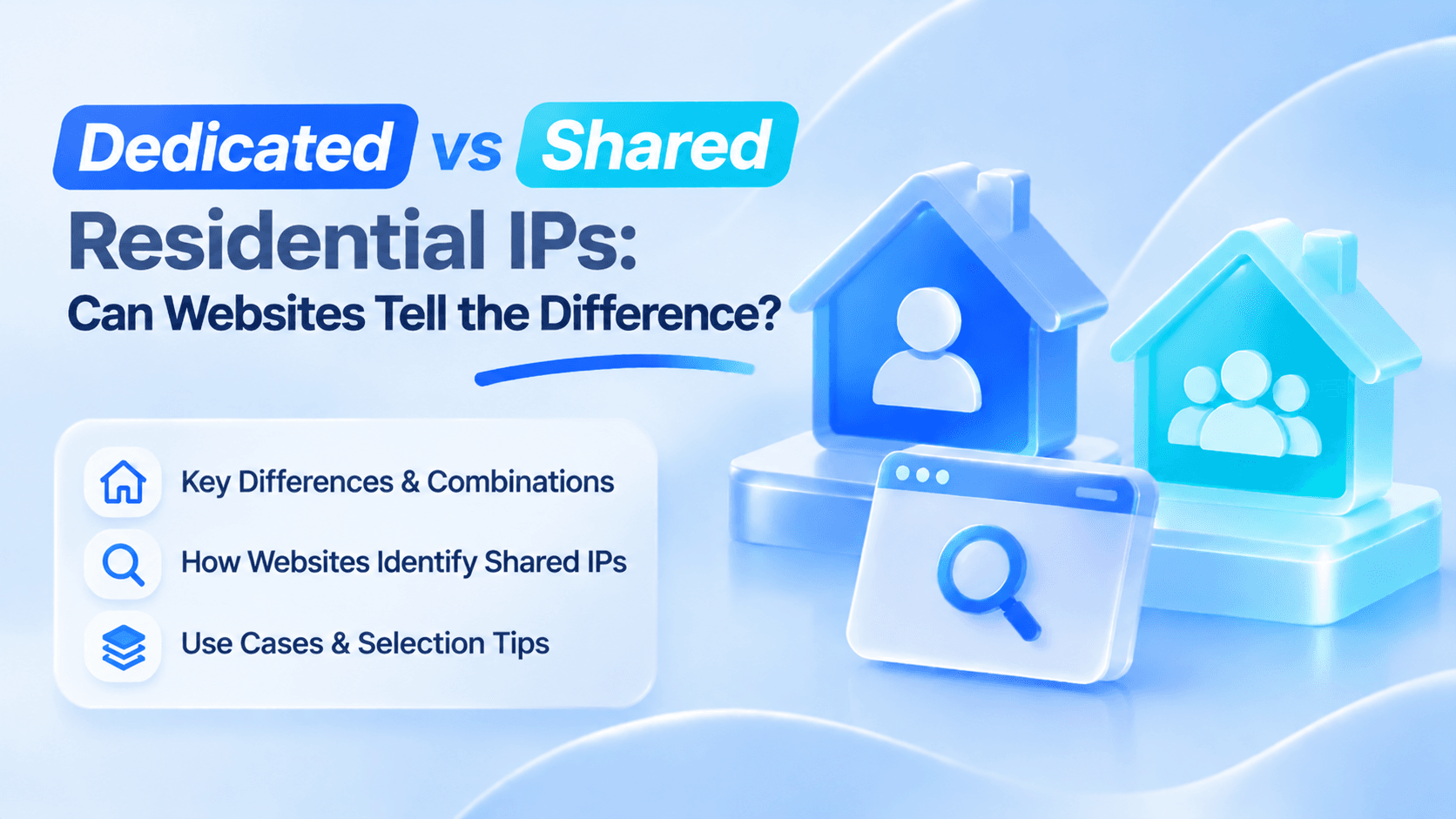
A dedicated IP generally means the address is yours for the length of the plan; a shared IP means several users share the network exit. Neither is inherently better — what matters is your use case and how much stability you need.
Worth noting: dedicated doesn't mean permanently fixed. Some products let you keep a specific IP long term, some only guarantee the address won't change within a single billing period, and others offer a connection that holds the address stable for the duration of a session.
Before buying, confirm three things: does the address change after a reconnect, does renewal keep the same IP, and can line maintenance trigger a reassignment?
Those details shape the long-run experience, and they tell you whether a plan actually fits what you need.
3. How do you tell whether overseas residential IPs are genuine?
Don't go by the product name alone. Combine ASN ownership, IP registration data, network type and actual test results.
| Check | What to look at | How to judge it |
|---|---|---|
| ASN ownership | Look up the autonomous system and operating entity behind the IP | Whether it's tied to a local internet service provider |
| IP registration | Check the registering body and allocation records for the address | Whether registration details match the stated network source |
| IP network type | Query how an IP database classifies the address | Whether it's identified as residential rather than a data center network |
| Geolocation | Look up the country and city the IP maps to | Whether it broadly matches the region you selected at purchase |
| IP history | Check whether the address has a record of abnormal use | A supporting signal on how the IP has been used |
| DNS leak test | Check the actual resolution path of DNS requests | Whether queries resolve through the expected path without leaking local DNS information |
One caveat: no single check proves an IP is residential. An ASN belonging to a local ISP doesn't guarantee the address comes off a home broadband line, and a clean DNS leak test doesn't prove the IP is a genuine residential address either.
Cross-check the static IPs available from IPDEEP against third-party lookup tools to tighten your confidence in the result.
4. Is a more precise overseas residential IP location always better?
When you buy an overseas static residential IP, city matters as much as country.
Two US IPs, one in Los Angeles and one in New York, can differ in routing, latency and the content some regional sites surface. If your work needs network resources in a specific city, confirm the plan supports city-level selection.
IP geolocation databases aren't always accurate, either. Even when the address really sits in the target region, different sites may identify it differently.
Pick the country and city that fit your needs first, then verify speed, location detection and stability with a live connection test.
For latency-sensitive work, test the target route from the location where you'll actually use it, rather than assuming an IP in a given country will automatically be faster.
5. Does unmetered traffic mean unlimited speed?
Plenty of overseas residential IP plans advertise "unmetered traffic", but unmetered traffic isn't the same as unlimited bandwidth.
Bandwidth sets how much data can move in a given window; concurrent connections determine how things behave when several tasks run at once. If your real workload exceeds the plan's configuration, speeds can drop even with no traffic cap.
Worth comparing side by side:
| What to compare | What to confirm |
|---|---|
| IP usage rights | Dedicated or shared |
| Address stability | Whether renewal and reconnects keep the same IP |
| Network configuration | Bandwidth ceiling and concurrent connection limits |
| Billing model | Monthly, usage-based, and overage charges |
| Support policy | Fault response and IP replacement rules |
Put these side by side rather than comparing monthly fees alone, and it's much easier to see what each plan is really worth.
6. For long-term use, watch the support and replacement policy too
Static residential IPs can still be affected by carrier maintenance, network faults or resource reallocation.
So before you buy, find out whether the provider offers fault support and IP replacement, and whether you can keep the same country or city after a swap.
If there's a self-service panel, check whether you can view your current IP, plan expiry and traffic usage. These features don't affect speed directly, but they make day-to-day management considerably easier.
7. Before you buy overseas residential IPs, test for 3–5 days
If it's your first purchase, start with a short trial or a smaller plan rather than committing to a long, expensive term upfront.
During the test, record the IP address, ASN and geolocation result first, then check whether DNS resolution follows the path you expect. After that, run connection tests at different times of day and watch latency, packet loss and dropped connections.
Pay particular attention to whether the IP changes after a reconnect, and confirm the renewal policy. Three to five days of testing will surface some stability problems, though it can't guarantee a fault-free future.
FAQ
What's the difference between an overseas static residential IP and a data center IP?
The main difference is where the network resource comes from. Data center IPs usually belong to a data center or hosting network; residential IPs are typically tied to the access network of a local internet service provider. Choose based on your use case, performance needs and budget.
What's a reasonable price for a static IP?
There's no universal benchmark. Country, exclusivity, bandwidth allocation and service term all move the number, so compare total cost against the plan terms.
Can one static residential IP be used on multiple devices?
That depends on the provider's authentication method, connection limits and plan terms. Not every product allows several devices to connect at once.
Will the IP definitely stay the same after renewal?
Not necessarily. Some plans preserve the original IP on renewal; others may reassign it. Go by the terms you confirm before purchase.
Final thoughts
Buying an overseas static residential IP isn't just a price decision. Exclusivity, how the address is kept fixed, IP sourcing, city-level location, bandwidth configuration and after-sales policy all shape how it performs in practice.
If you're in it for the long term, confirm your requirements first, run a short test, then compare total cost across plans.
When you evaluate providers such as IPDEEP, you can check their product specs and service terms against these same criteria. The IP resource that suits long-term use isn't necessarily the cheapest one — it's the one with clear specs, a stable connection and easy administration.