

Can Websites Tell Dedicated and Shared Residential IPs Apart?



Clean IP picks: Static IPs from $1.5 each, Dynamic IPs from $0.5/GB


In cross-border e-commerce, overseas social media management, and data collection, whether a residential IP is dedicated or shared can affect network stability and the overall user experience.
Many users have the same question when purchasing residential proxies: Can websites distinguish between dedicated and shared residential IPs? If multiple users share the same residential IP, does this increase the likelihood of CAPTCHAs, access restrictions, or account issues?
Websites cannot directly read a label indicating whether an IP is dedicated or shared. However, they can analyze how an IP address is being used through signals such as its reputation history, request frequency, concurrent activity, client fingerprints, and session characteristics.
IP addresses associated with unusual request patterns or frequent reuse by multiple users may receive higher risk scores from anti-abuse systems.
What Is the Difference Between Dedicated and Shared Residential IPs?
IP addresses generally fall into two main network categories: data center networks and residential ISP networks.
Data center IPs come from cloud servers or hosting networks, while residential IPs are associated with consumer internet service providers (ISPs). Residential IPs can be further divided into dedicated and shared IPs based on how they are allocated.
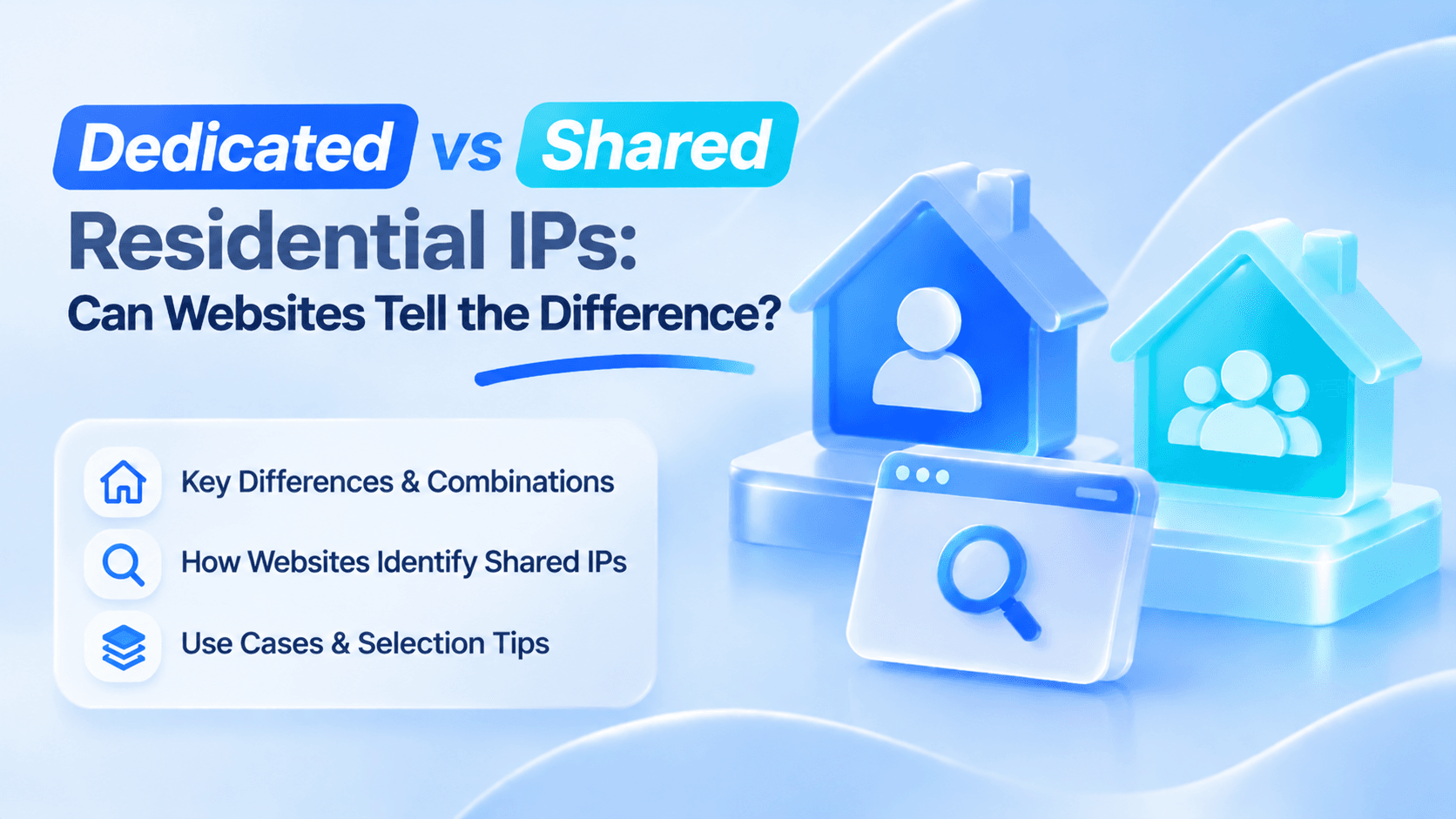
▸ Dedicated Residential IP: An IP address assigned exclusively to one user for an agreed period. No other users share the same outbound IP address during that period.
▸ Shared Residential IP: An IP address used by multiple users, who may send requests through the same outbound IP during the same period.
Both types are associated with residential ISP networks. The main difference lies in how the IP addresses are allocated and used.
It is also important to distinguish between dedicated and shared IPs and static and rotating IPs. The former describes who uses an IP address, while the latter describes whether the IP changes over time.
These are separate characteristics that can be combined in different ways (for a more detailed comparison of residential, data center, static, and rotating IPs, see our Residential IP Selection Guide):
How Do Websites Identify Shared Residential IPs?
Websites cannot directly read whether an IP address is dedicated or shared. Instead, they evaluate how an outbound IP is being used based on signals such as network ownership, request patterns, and IP reputation.
1. ASN and Network Ownership
Websites can use IP addresses, Autonomous System Numbers (ASNs), and network registration databases to determine whether requests originate from data center networks or residential ISPs.
However, an ASN only identifies the network operator. It cannot determine whether an IP is dedicated or shared. IP addresses belonging to the same ISP may be used independently by individual households or shared among multiple users through a proxy service.
2. Concurrent Requests and Client Fingerprinting
When multiple users share an IP address, their requests may have different User-Agent strings, TLS fingerprints, and browsing patterns. If the same IP generates an unusually high volume of concurrent requests within a short period, anti-abuse systems may assign it a higher risk score.
However, multiple client fingerprints can also originate from legitimate household or corporate networks. Websites need to consider request frequency and historical activity before drawing conclusions.
3. IP Reputation and Threat Intelligence
Websites can assess request risks using third-party IP databases and historical abuse records.
If a shared IP has previously been used for large volumes of suspicious activity, other users may also be affected. This is commonly known as the "bad neighbor effect."
However, a risk score alone does not determine whether a website will restrict access.
4. Session Consistency and IP Change History
Websites can examine login cookies, IP addresses, and access timestamps to identify changes in an account's network environment.
A dedicated static residential IP maintains the same outbound address throughout the rental period, reducing interference from IP rotation and other users' activity.
Dedicated vs. Shared Residential IPs: Which Should You Choose?
Dedicated residential IPs are generally better suited to the following use cases:
▸ Cross-border e-commerce store management that requires a consistent login network environment.
▸ Day-to-day management of overseas social media accounts, where minimizing the impact of other users' activity on IP reputation is important.
▸ API access that requires a fixed IP address for IP allowlisting.
Shared or rotating residential IPs are generally better suited to the following use cases:
▸ Large-scale public data collection that uses IP rotation to access multiple regions.
▸ Search engine ranking monitoring and ad verification across different locations.
▸ Cost-sensitive tasks where sharing an outbound IP is acceptable.
The key is to match the IP type to your requirements rather than assuming one is always better. Dedicated IPs offer greater control over usage history and more consistent outbound connections.
Shared or rotating IPs are generally more cost-effective and offer greater flexibility across locations, making them suitable for tasks that are less sensitive to IP reuse.
How to Check Residential IP Exclusivity and Quality
Before deploying a proxy for business use, it is a good idea to start with a small test package and evaluate its performance.
Step 1: Check IP Ownership
Use IPinfo or RDAP to look up the ASN, registered organization, and network type.
Step 2: Check IP Reputation
Use Scamalytics or IPQualityScore to review risk scores and proxy detection results.
Step 3: Check the Network Environment
Check whether the outbound IP, geolocation, DNS, and WebRTC information match your expectations.
Step 4: Test Actual Connection Performance
Evaluate latency, packet loss, and session stability. Also, confirm the provider's definition of dedicated IP allocation and its IP replacement policy.
Keep in mind that third-party testing tools cannot directly verify whether an IP is dedicated. Its exclusive allocation must ultimately be confirmed with the provider.
What Dedicated Residential IP Options Does IPDEEP Offer?
Dedicated residential IPs are worth considering for businesses that need a consistent outbound connection or want to minimize interference from other users.
IPDEEP offers static and dynamic residential IP solutions that support HTTP, HTTPS, and SOCKS5 protocols.
▸ Static Residential IPs: Suitable for applications that require a fixed outbound IP and a consistent network environment throughout the rental period.
▸ Dynamic Residential IPs: Suitable for applications that require IP rotation according to predefined rules, particularly multi-region access and public data collection.
Users can choose packages based on their target country, city, bandwidth requirements, and rental period.
For cross-border e-commerce, overseas social media management, and other applications that require a fixed outbound IP, we recommend testing a dedicated static residential IP first and deciding whether to continue based on its actual performance.
Visit the IPDEEP Static Residential IP or Dynamic Residential IP pages to explore available configurations and current pricing.
Frequently Asked Questions
Q1: Can websites directly identify whether a residential IP is dedicated or shared?
Not directly. However, websites can infer how an outbound IP is being used by analyzing request patterns, client fingerprints, and IP reputation history.
Q2: Can other users' activities on a shared residential IP affect my connection?
Yes. Unusual or abusive activity from other users may damage the reputation of the shared IP, potentially causing other users to encounter CAPTCHAs or access restrictions.
Q3: Are dedicated static residential IPs always safer than shared residential IPs?
Not necessarily. Dedicated IPs can reduce interference from other users, but IP reputation, client environment, and actual usage patterns can also affect access results.