




South Korea Proxy Guide: How to Buy Clean Residential IPs



Clean IP picks: Static IPs from $1.5 each, Dynamic IPs from $0.5/GB


In many cases, even when using a South Korean proxy, your accounts on Coupang or Korean game servers still end up getting banned.
The most likely reason is: you are mostly purchasing cheap data center IPs rather than genuine residential IPs.
This article will break down the different categories of South Korean proxy IPs and teach you how to identify and purchase truly clean South Korean residential IPs.

What is a South Korean Proxy IP?
Simply put, a South Korean proxy IP is an intermediary server located in South Korea.
When you connect to it, your network requests are first sent to this server, which then forwards them to the target website.
At this point, the target website sees the visitor information as the South Korean server's IP address, rather than your actual address.
Conversely, if you use a standard Data Center IP, websites will perceive you as a server-based bot, leading to an inevitable ban.
Comparing Three Types of Korean Proxies: At a Glance
Why Choose a Clean South Korean Residential IP?
Internet censorship and account risk management are extremely strict in South Korea. If you use abused IPs or obvious data center segments, you will face the following issues:
Account Association Bans: If multiple users log into Naver or Kakao using the same IP, the platforms will flag this as suspicious activity.
Restricted Access to Games: Many Korean games (e.g., Lost Ark, DNF) block the vast majority of non-residential network segments.
Frequent CAPTCHAs: Websites trigger verification when they detect non-human access patterns.
"Clean" refers to an IP that hasn't been blacklisted and maintains a low Fraud Score. The ideal state is a Native Residential IP.
How to Purchase Clean Korean Residential IPs?
With countless providers on the market, follow these three steps to ensure high-quality IPs:
1. Select Providers with City-Level Targeting
Providers that can pinpoint specific cities like Seoul, Busan, or Daegu typically offer higher-quality IP pools.
2. Distinguish Between "Rotating" and "Static" Residential IPs
Rotating Residential IPs: Change automatically at set intervals or per request. Ideal for data collection but carry a moderate risk for account management due to frequent changes.
Static Residential IPs (ISP): Provide a fixed, long-term IP from a real home broadband connection. Perfect for running e-commerce stores or gaming, with an extremely low ban risk.
3. Recommended Provider for 2026: IPDeep
As a global proxy IP provider, IPDeep covers over 200 countries and regions, including premium South Korean resources.
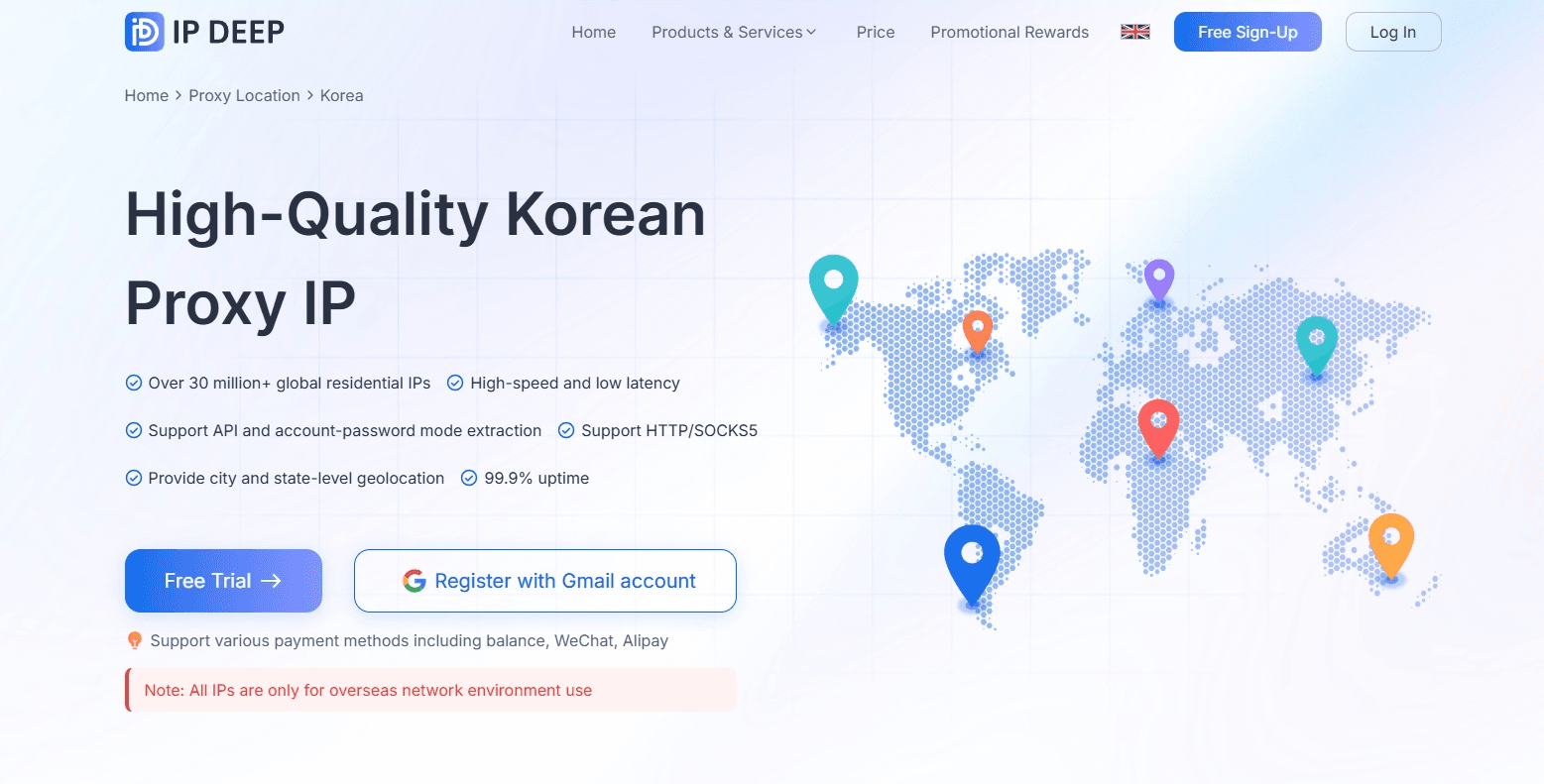
Resource Authenticity: IPs originate from real Korean household devices, supporting API extraction, IP whitelisting, and User/Pass authentication.
Low-Cost Testing: IPDeep offers 200MB of free Korean dynamic residential traffic for new users to test stability.
Ease of Use: The purchasing process is straightforward, and IPs can be seamlessly integrated with popular anti-detect browsers.
Configuration Advice:
Prioritize IPDeep's Static Residential IPs for long-term business continuity. For high-concurrency web scraping, combine them with dynamic pools to balance costs.
Scam Avoidance: How to Test IP Purity?
Once you've purchased an IP, don't rush into bulk operations. Test it using these tools:
1. Check IP Type: Visit ipinfo.io or other online IP detection tools.
2. Inspect Company or ASN: If it shows KT or SK Broadband, it's a Residential IP. If it shows AWS, Microsoft, or a hosting provider, it's a Data Center IP.
3. Check Fraud Score: Use scamalytics.com to check the Fraud Score. A lower score (0-20) indicates a cleaner IP.
Frequently Asked Questions (FAQ)
1. What is the difference between a Korean Proxy and a Korean VPN?
VPNs usually provide global encryption with shared data center IPs, making them easy to detect. Proxies (especially residential ones) are more flexible, supporting HTTP/SOCKS5 protocols for specific software binding with higher stealth.
2. Can I use free Korean proxy lists?
Absolutely not recommended. Free proxies are usually leaked botnet IPs with abysmal speeds. Your personal data is at risk, and you are almost 100% certain to face account bans for professional use.
3. Do Static Residential IPs expire?
Yes. Static IPs are typically leased on a monthly basis. If you need to maintain a long-term Korean account, ensure you enable auto-renewal; once an IP is released, it is very difficult to retrieve the same address.
4. Why is my Seoul residential IP so slow?
Physical distance matters. Even if the IP is from Seoul, if the provider's transit server is located in the US or SE Asia, you will experience high latency. Confirm the provider's transit route before buying.
Summary
We hope this guide has helped you understand South Korean Proxy IPs and how to acquire them.
Whether you are in cross-border trade or the gaming industry, choosing a compliant, transparent, and testable provider will significantly reduce operational uncertainty.
Related Reading on South Korean Proxies:
Entering the Korean Market: Why Naver Marketing Requires Native Residential IPs