




Why Are Your Korea IPs Banned? Datacenter vs. Residential IP



Clean IP picks: Static IPs from $1.5 each, Dynamic IPs from $0.5/GB


In your daily browsing, you may have encountered this frustrating scenario:
While attempting to register for a Lost Ark (KR) account, the page immediately triggers an error message: "비정상적인 접속 (Abnormal Access)."
Meanwhile, your friends living in South Korea enjoy a seamless experience—streaming, gaming, and shopping without a hitch.
The root of this discrepancy isn't just the numbers in the IP address; it's because you've selected the wrong IP type.
So, why do your South Korean IPs keep getting banned, and how can you choose the right South Korea Proxy IP? Let's dive in.

Datacenter IPs: Hosting-based High-Frequency IPs
Datacenter IPs, as the name suggests, originate from data centers, cloud service providers, and VPS providers located around the globe.
These IPs typically share several distinct characteristics:
· Source: They belong to Internet Data Centers (IDCs). The IP ranges are registered under the names of cloud vendors or hosting providers.
· Reverse DNS (rDNS): They often resolve to addresses with a clear server-side footprint, such as server123.kinx.net or compute.amazonaws.com.
· Whois Information: The operating entity is usually a tech corporation, and the physical location points to a server room rather than a residential neighborhood.
· Resource Utilization: Hundreds or even thousands of users often share the same IP range or even the same public IP address.
Datacenter IPs are inexpensive, offer high bandwidth, and are highly stable—making them ideal for website hosting or large-scale web scraping.
However, they hold no secrets from anti-fraud systems: in the risk control manuals of major platforms, "Datacenter ASNs" are flagged as high-risk.
Residential IPs: ISP-based Terminal IPs
Residential IPs are the IP addresses used by standard South Korean households. In Korea, these resources are primarily managed by the "Big Three" ISPs: KT, SK Telecom, and LG U+.
Compared to datacenter IPs, residential IPs have completely different traits:
· Physical Source: Broadband lines assigned directly by ISPs to apartments, houses, and ordinary families.
· Reverse DNS: Usually displays ISP suffixes like xxx.seoul.kt.com, which aligns with real user environments.
· Binding Relationship: Each IP usage is typically tied to a real-name verified broadband account.
· Traffic Model: The behavior patterns match those of real humans—natural active hours and reasonable access frequencies.
The core reason platforms trust residential IPs is the high barrier to entry.
Whether it's operating costs or rental prices, residential IPs are significantly more expensive than datacenter IPs.
At a Glance: Datacenter IP vs. Residential IP
Why are South Korean Datacenter IPs Banned So Often?
Even among datacenter IPs, South Korean nodes are banned far more frequently than US nodes. This is driven by several local factors:
1. High Industrial Concentration:
Korea is home to dominant local platforms like NAVER, NEXON, and Coupang. To protect their ecosystems, these companies have tuned their risk models to be exceptionally sensitive.
Gaming companies, in particular, often employ a "blacklist the entire range" strategy against datacenter IPs.
2. Scarcity of IP Resources:
Due to the limited landmass, South Korea has a finite number of data centers. This results in highly concentrated VPS IP ranges (e.g., Oracle's Seoul region has very few blocks).
Once a single block is flagged, every user within that range suffers a collateral ban.
3. Poor Historical Reputation:
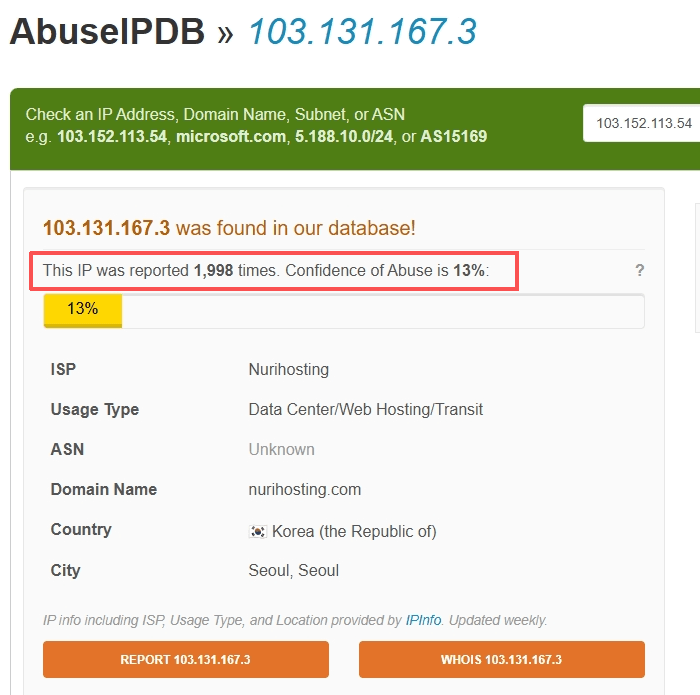
Years of botting and automated scraping have left many Korean datacenter ranges with abysmal scores in risk databases like AbuseIPDB and IPinfo.
Many IPs are effectively blacklisted before they are even assigned to a new user.
4. Real-Name System Cross-Verification:
South Korean law requires ISPs to verify users' real identities.
Platforms can technically distinguish that residential IP users are likely verified locals, whereas datacenter IP users are anonymous, leading the system to automatically categorize the latter as high-risk.
How to Accurately Identify IP Attributes?
To verify your current IP type, you can use an IP information lookup tool:
1. Check ISP Information
If the name shows Amazon, KINX, or Oracle, it is a datacenter/hosting IP.
If it shows SK Broadband or Korea Telecom, it is likely a residential or business line and requires further inspection.
2. Review IP Risk Scores
Check the "Usage Type." If it is labeled as "Hosting," it is a server-based IP.
Additionally, fraud scores from sites like scamalytics.com serve as a vital reference point.
3. Analyze the ASN (Autonomous System Number)
Note: A single ASN can mix different business types. For example, AS4766 (KT) includes residential, business, and some hosting segments.
Conversely, AS31898 (Oracle Cloud) and AS16509 (AWS) are 100% datacenter-based.
Solutions for Avoiding South Korean IP Bans
Depending on your specific needs, consider the following strategies:
Long-Term Stable Business (e.g., Gaming, E-commerce)
It is highly recommended to purchase Static Residential IPs. While costs are higher, they provide a network reputation indistinguishable from a local resident.
Always confirm with your provider that the IP is "Exclusive Static Residential" rather than shared.
IPDeep provides Exclusive Static Residential Proxies, effectively preventing bans caused by the illicit activities of other users.
Short-Term Data Collection (Scraping, Research)
For well-funded commercial scraping projects, Dynamic Residential Proxies are the better choice.
They rotate IPs to bypass rate limits. While the per-unit cost is high, they are the standard for large-scale tasks.
Alternative Solutions
You can ask a friend in South Korea to host a Raspberry Pi or an old router to provide access.
This type of IP has the highest possible reputation and is completely exclusive—just don't forget to treat your friend to a nice dinner!
Legal and Risk Disclaimer
When using these services, beware of fake "cheap residential IPs."
Some market offerings are actually residential botnets controlled by malware. Using these resources poses both technical risks and potential legal liabilities.
Furthermore, bypassing geographic restrictions may violate a platform's Terms of Service (ToS).
We advise all users to ensure their activities are legal and compliant within the scope of technical exchange.
Conclusion
The fundamental difference between datacenter and residential IPs lies in the "trust level" they represent.
If you wish to be seen as a South Korean local in the digital world, you must be prepared for the associated costs.
IPDeep offers premium South Korea Proxy IPs, including residential, datacenter, and mobile proxies, helping you effectively minimize the risk of being banned.