




US Static Residential IP Guide: Boost Account Stability & Security



Clean IP picks: Static IPs from $1.5 each, Dynamic IPs from $0.5/GB


In today's global cross-border business, a stable network environment has become the foundational infrastructure that determines success or failure.
US Static Residential IPs are becoming an industry standard for cross-border operations due to their ability to simulate an internet environment of real residential users.

Why Choose Static Residential IPs over Datacenter IPs?
Lower Risk of Triggering Anti-Fraud Systems: Most cheap proxies use datacenter IPs.
The ASN information for these IPs identifies them as cloud servers or hosting providers (such as AWS, DigitalOcean, Vultr, etc.). Social media and e-commerce platforms easily flag this as an anomaly, leading to shadowbans on new accounts or account suspension due to linkage.
Identity Consistency: Frequent IP address changes are the biggest mistake when nurturing accounts.
Static residential IPs ensure that the geographic location and exit node remain completely identical for every login. This prevents "IP hopping" from triggering secondary verification methods from the platform, such as CAPTCHAs or email verifications.
High Purity and Low Fraud Scores: Premium static residential IP providers typically keep the fraud scores of their IPs at a very low level (e.g., below 30).
How to Evaluate the Quality of a US Static Residential IP?
When choosing a monthly US static residential IP subscription, it is recommended to evaluate providers based on the following technical dimensions:
Exclusivity Confirmation: Ensure the IP you buy is a "dedicated" resource.
During your subscription period, the IP should be used exclusively by you. This avoids the risk of being blacklisted by platforms due to a "neighbor's" policy violations.
Double ISP Certification: For high-risk projects like TikTok operations, US PayPal, or Stripe registrations, prioritize IPs with Double ISP certification.
This means both the network type (Usage Type) and the Autonomous System Organization (Org/ASN) show up as a real telecom carrier, resulting in an extremely low fraud weight.
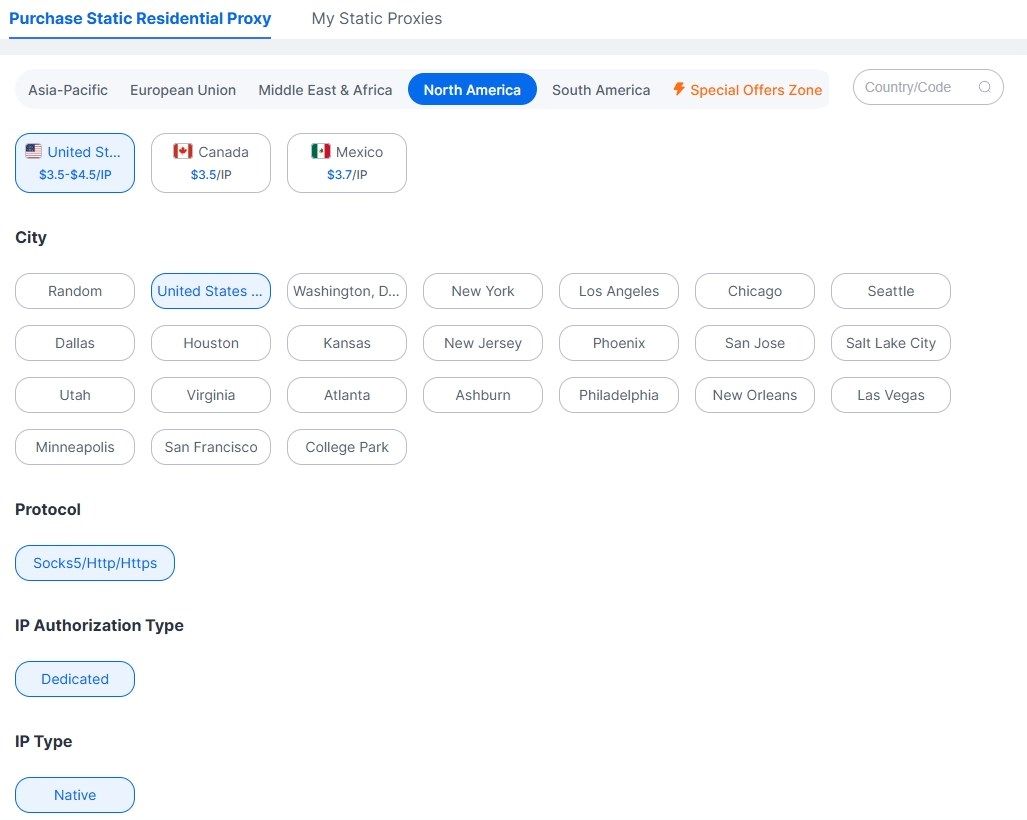
Geographic Granularity: Does your business need to target a specific city (such as Los Angeles, New York, or Chicago)?
Providers that support city-level or even zip-code-level targeting can better meet the needs of localized testing and precise ad targeting.
Protocol and Anti-Detect Browser Support: Excellent proxy tools should support HTTP, HTTPS, and SOCKS5 protocols simultaneously, and perfectly integrate with anti-detect browsers to achieve complete environment isolation for multiple accounts.
Performance Metrics: For cross-border operators based in regions far from the US, direct connections to US residential IPs typically have a latency of around 150ms–250ms due to physical distance and international bandwidth.
Rather than obsessing over absolute low latency, cross-border businesses should focus on stability and zero packet loss to ensure smooth, lag-free operations within anti-detect browsers.
Buying Guide and Cost Considerations
The monthly cost of a US static residential IP generally ranges from a few dollars to tens of dollars. The price variance depends primarily on IP purity, the quality of the direct carrier connection, and overall stability.
For startup teams, cost-effective and practical options are a great starting point.
For large sellers managing account assets worth tens of thousands of dollars, enterprise-grade suppliers with high SLA (Service Level Agreement) guarantees should be the priority.
Before purchasing a large package, it is highly recommended to run a small-scale trial in your actual business scenarios. Monitor the login success rate, page loading speed, and check if any geographic location shifting occurs.
Frequently Asked Questions (FAQ)
Q1: Can using a static residential IP guarantee 100% suspension-free accounts?
No provider can guarantee a 100% ban-free experience. Static residential IPs solve the infrastructure compliance side of things—meaning they provide a clean, authentic US internet environment.
Account security ultimately depends on a combination of factors, including user behavior, device fingerprints, and content quality.
Q2: Which is more cost-effective: static residential IPs or dynamic residential IPs?
It depends entirely on your business scenario. If you are doing large-scale data scraping, pay-as-you-go dynamic IPs are more appropriate.
If you are managing social media accounts, e-commerce stores, or running ad campaigns where you need to stay online continuously with a fixed identity, a monthly static IP offers a much higher ROI (Return on Investment) by preventing business disruptions caused by bans.
Q3: Can one static IP be used on multiple devices simultaneously?
This is not recommended. Having multiple devices or multiple accounts sharing a single static IP simultaneously can easily trigger platform risk audits, leading to account linking and suspensions.
However, this doesn't mean you can only run one account per computer. It is recommended to use them alongside anti-detect browsers.
—By assigning a dedicated static IP to each isolated profile within an anti-detect browser on a single computer, you can safely achieve a secure "one computer, multiple accounts" and "one account, one IP" isolated operation.
Q4: Why is the latency of the IP I bought higher than that of a datacenter IP?
Because residential IP signals must route through ISP backbone networks and local residential networks, making their physical path much more complex than a dedicated datacenter line.
As long as it does not affect normal webpage operations, a latency of around 150ms–250ms when accessing the US region is completely normal for account nurturing and store management.
If you want to get more industry insights and high-quality US static residential IP resources, please visit the IPDeep Official Website.