




Switzerland Dedicated Proxy: Premium Overseas Business Solution



Clean IP picks: Static IPs from $1.5 each, Dynamic IPs from $0.5/GB


In today's increasingly sophisticated cross-border business landscape, the quality of your IP address directly impacts account longevity and conversion efficiency.
Among various global nodes, Switzerland has become the premier choice for high-end business operations, thanks to its unique geographical location and favorable legal environment.
This article will explore the advantages, application scenarios, and selection criteria for Switzerland Dedicated Proxy IPs, helping you build a stable international networking solution.

Why Use Switzerland Proxy IPs for High-End International Business?
Many professionals in the cross-border sector face common frustrations:
Accounts being banned for no apparent reason, frequent CAPTCHAs when visiting target websites, or extremely slow page loading speeds.
The root of these issues is often the "IP."
Switzerland is globally recognized as a "network privacy haven," boasting world-class network infrastructure alongside some of the world's strictest privacy protection laws.
A Dedicated Proxy IP is quite simple: it is an IP address assigned exclusively to you during your rental period.
Unlike "shared IPs" used by thousands of people simultaneously, a Swiss dedicated proxy acts like a private express lane—quiet, stable, and secure.
Core Technical Advantages of Swiss Dedicated Proxy IPs
1. Exclusive Resources: Say Goodbye to Collateral Bans
With shared IPs, if one user violates a platform's rules, the entire IP range might be blacklisted.
A Dedicated IP ensures a clean environment. As long as your own operations remain compliant, you won't be penalized by the actions of others.
2. Superior Connection Speeds and Stability
Situated in the heart of Europe, data centers in Zurich and Geneva connect directly to global core backbone networks.
For businesses requiring frequent interaction with the European market, Swiss proxies offer ultra-low latency and exceptionally high uptime.
3. High Anonymity: Simulating a Real Local Presence
Premium Swiss proxies perfectly mask your actual location, making target platforms perceive you as a legitimate user working from an office in Switzerland.
This "localization" camouflage is critical for bypassing stringent risk management systems.
4. Multi-Protocol Support and Versatility
Whether for standard web browsing (HTTP/HTTPS) or secure data transmission (SOCKS5), Swiss dedicated proxies are fully compatible with various anti-detect browsers, marketing tools, and automation scripts.
Typical Application Scenarios: Who Needs Them?
Compliant E-commerce Operations
Dedicated IPs allow for physical isolation of multiple accounts, preventing bans caused by IP correlation. This is ideal for Amazon Switzerland, eBay, and other local marketplaces.
Precise Market Research
Want to understand authentic local search rankings, competitor pricing, and ad placements in Switzerland? Only a local IP can provide the most accurate market data.
Overseas Social Media Matrix
When promoting TikTok or Instagram accounts targeted at the Swiss market, a stable IP helps the system accurately geotag your content, thereby boosting local traffic.
Finance and Privacy-Sensitive Operations
Swiss banks and high-end wealth management platforms have strict IP requirements. Dedicated IPs provide a secure access path to protect account privacy.
How to Identify High-Quality Swiss Proxy Providers?
When choosing a service provider, don't focus solely on price. Prioritize these four dimensions:
IP Pool Attributes
Some low-cost providers pass off datacenter IPs as residential IPs to save costs.
For high-risk operations or tasks requiring authentic local access, you should prioritize genuine residential IPs to ensure browsing behavior appears natural and reduces the risk of detection.
Connection Stability Testing
Reliable providers usually offer test IPs. Monitor for disconnection, lag, or frequent IP rotations during peak business hours.
Technical Support Response Time
International business never sleeps. Whether a provider can offer quick IP replacements or technical guidance during failures is a key indicator of their professionalism.
Sourcing Compliance
Understand if the provider obtains IPs through legitimate channels. Compliant resources mean a longer lifespan and a much lower probability of being banned.
Setup and Usage Guide: A Quick Start for Beginners
Configuring a Swiss dedicated proxy is straightforward and typically follows these steps:
1. Obtain Credentials: Get the IP address, port number, username, and password from the provider's dashboard.
2. Integrate Environment: If using an anti-detect browser, select the appropriate protocol (e.g., SOCKS5) in the proxy settings, enter your details, and click "Test Connection."
3. Environment Check: Before starting operations, it is recommended to use an IP Detection Tool to verify the city shows as Switzerland and the anonymity level is at 100%.
4. Best Practices: Aim for "One Account, One IP, One Environment." Avoid switching between IPs of different countries frequently on the same device profile to prevent triggering platform security alerts.
Final Thoughts: Empowering Brands for Stable Global Expansion
In the competitive world of cross-border business, the underlying network environment determines the stability of your operations.
Swiss Dedicated Proxy IPs, with their clean, secure, and efficient characteristics, have become the standard for high-end international enterprises.
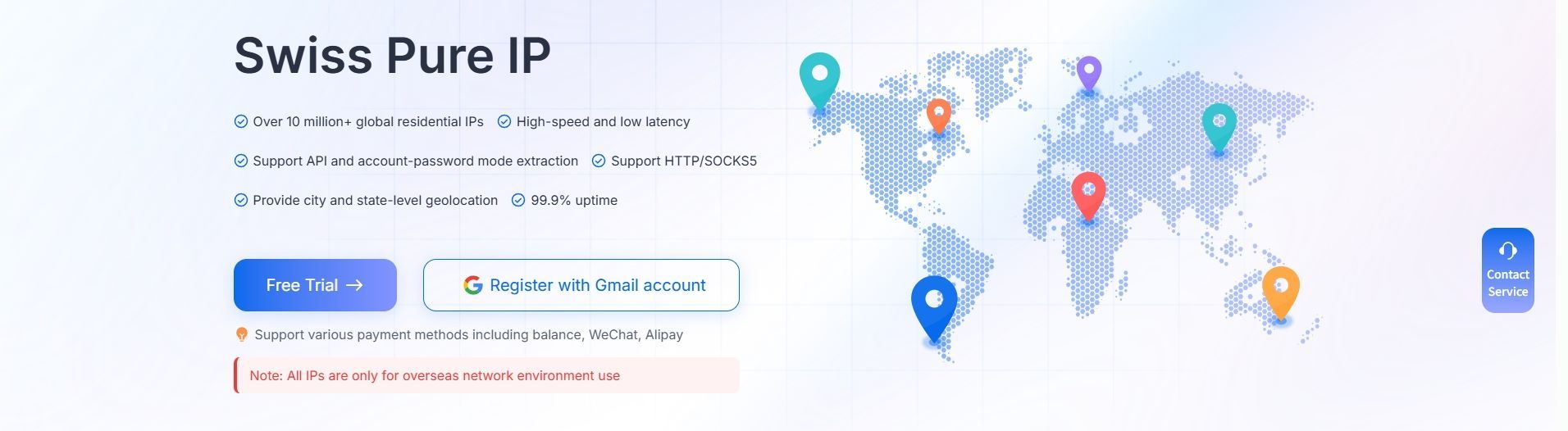
IPDeep offers Swiss Dedicated Static Residential IPs, alongside a wide variety of proxy types to meet diverse needs in e-commerce, social media management, and data scraping.