

Best US Static Residential IP: Pricing & Location Targeting



Clean IP picks: Static IPs from $1.5 each, Dynamic IPs from $0.5/GB


US static residential IPs are useful for businesses that need a consistent network exit over time, including cross-border e-commerce store management, social media account operations, and local market monitoring.
Providers differ in IP type, city-level targeting, dedicated access, and pricing. Comparing monthly prices alone won't give you the full picture.

What Is a US Static Residential IP?
Static residential proxies often refer to ISP proxies. Their IP addresses are registered under US internet service providers (ISPs), such as AT&T, Comcast, Verizon, and Spectrum, while the proxy servers themselves may be hosted in data centers.
These proxies combine ISP registration with data center infrastructure. They do not necessarily route traffic through physical home broadband connections. When choosing a proxy, don't assume that an ISP-registered IP is the same as a residential connection.
▸ How they differ from data center IPs: Data center IPs typically have ASNs associated with hosting providers. They tend to be fast and inexpensive, but may not be the first choice for long-term account access when a consistent network identity matters.
▸ How they differ from dynamic residential IPs: Dynamic residential IPs rotate based on time or request settings, making them useful for distributed data collection. Frequent IP changes during account logins may lead to additional verification.
▸ Key benefit of static residential IPs: The IP address stays the same throughout the rental period, making it suitable for tasks that require a consistent network exit over time.
A fixed IP can reduce disruptions caused by frequent changes, but it does not guarantee that a platform will trust the connection. IP reputation, usage history, login behavior, device environment, and platform policies can all affect the outcome.
How to Choose a US Static Residential IP
1. IP Type and Risk Signals
Start by checking whether the ASN belongs to an internet service provider, then review the IP classification and usage history.
IP lookup tools can help identify potential risk signals, but their scoring methods vary. A single score cannot predict how an IP will perform across every target website. Test the IP against your intended sites before making a decision.
2. Location Targeting: Understand the Three Levels
▸ Proxy location selection: Whether the provider lets you choose a US state or city for your proxy exit.
▸ IP geolocation databases: Which city or ZIP code third-party databases associate with the IP. Users generally cannot control these database records directly.
▸ How the target website determines location: A platform may also consider account details, browser location, shipping addresses, and other signals.
These three location signals may not match. Being able to select a city does not mean you can target an exact ZIP code. Likewise, an IP database showing a particular city does not guarantee that a website will display prices or inventory for that location.
If you need a specific city, confirm availability first, then cross-check the IP with a geolocation tool and test the target website directly.
3. Dedicated IPs and Stability
A shared IP may be used by multiple customers, depending on the provider's plan. For dedicated plans, check the bandwidth limit, concurrency restrictions, and rental period before buying.
Dedicated IPs with fixed rental periods are generally better suited to store management and long-term account access. If your budget is limited, a shared plan can be useful for initial testing.
4. Pricing Models
▸ Monthly pricing per IP: Suitable for long-term tasks such as account management and fixed API integrations.
▸ Traffic-based pricing: Useful for light testing or occasional tasks, but costs can rise with frequent use.
▸ Bandwidth-based pricing: Suitable for high-throughput data collection and continuous monitoring.
When comparing prices, consider the rental period, minimum purchase quantity, sharing model, and taxes together. Looking only at the monthly price per IP can lead to misleading comparisons.
Best US Static Residential IP Providers in 2026
Prices are based on listed rates for the specified plans and exclude taxes and promotions. Shared and dedicated options may differ in rental period and minimum order size. Compare equivalent plans before judging value, and confirm the final price at checkout.
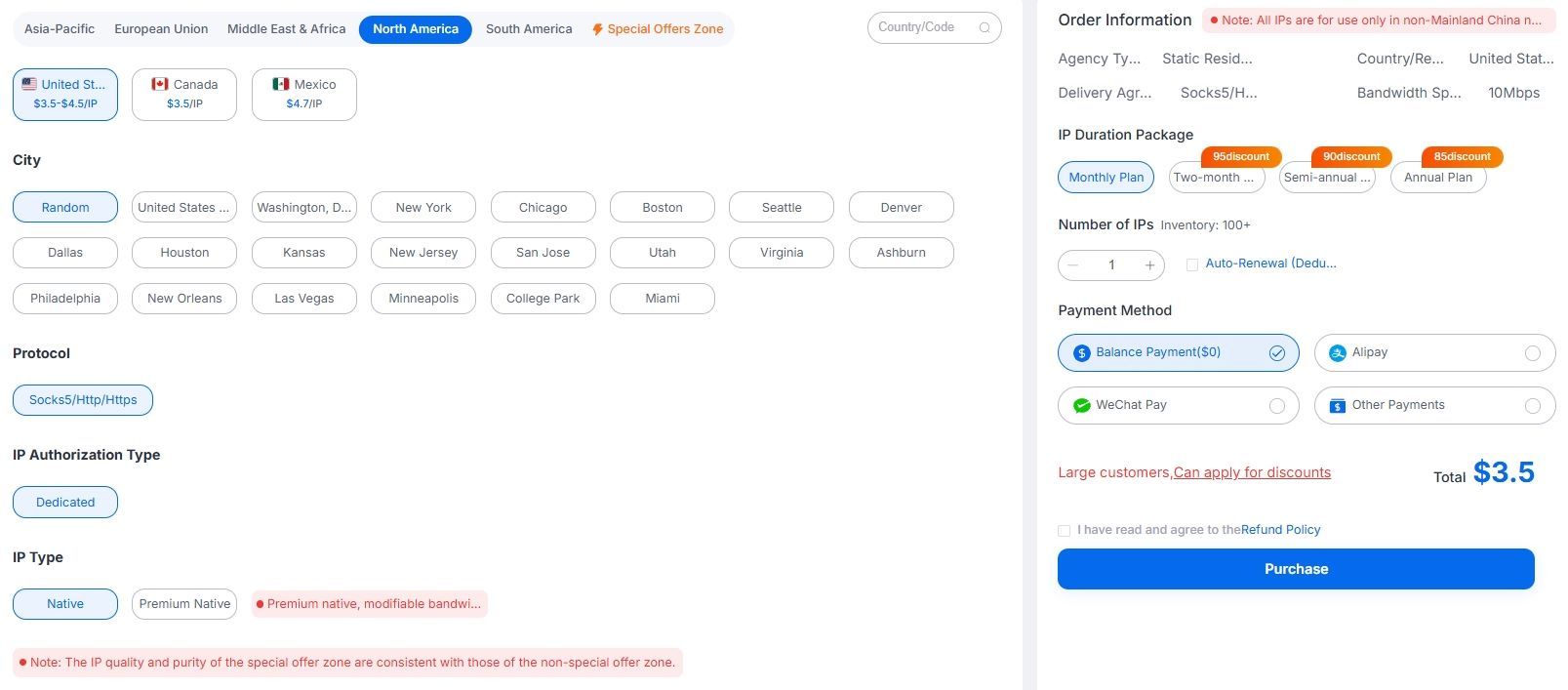
IPDEEP: A practical option for teams that need US city-level coverage and flexible configuration. IPDEEP's static residential proxies support HTTP, HTTPS, and SOCKS5, with configurable bandwidth up to 50 Mbps.
US locations can be selected at random or by city, including New York, Chicago, Dallas, Seattle, San Jose, Miami, Ashburn, and Washington, DC. Available cities depend on current inventory.
Plans are billed monthly and provide dedicated IPs at $3.50/IP/month, or $4.50/IP/month for NTT lines.
Choosing a US Static Residential IP for Different Use Cases
▸ Cross-border e-commerce store management: Assign a separate, consistent network exit to each store where appropriate. Keep the proxy location aligned with the store's registered location, use separate browser environments, and follow the platform's rules for managing multiple accounts.
▸ Social media account management: Consistency matters. Static residential IPs can help maintain the same network exit for long-term accounts, while dynamic IPs may be useful when testing access from new regions. Keep device and login environments consistent and avoid unnecessary changes.
▸ Regional data monitoring: Use static proxies to track prices or ad displays in a specific city over time. For large-scale collection of public pages, dynamic residential proxies or bandwidth-based plans may be more suitable. Keep request rates within the target site's access rules.
Frequently Asked Questions
Q1: Should I use a static or dynamic residential IP for US-based tasks?
It depends on whether you need to keep the same network exit over time. Static IPs are generally suited to store management, social media accounts, and fixed API connections. Dynamic IPs are often better for large-scale collection and cross-region price comparisons. They serve different purposes rather than replacing one another.
Q2: How can I check whether a US IP is an ISP proxy?
Use an IP lookup tool to check two details: whether the ASN belongs to an ISP and whether the IP is classified as ISP or residential.
Treat these results as indicators rather than guarantees. You cannot directly see how a particular platform classifies an IP internally.
Q3: Does city-level targeting guarantee ZIP code accuracy?
No. City-level targeting means the provider lets you select a proxy exit city. ZIP code targeting must be confirmed separately. Even when ZIP targeting is available, a website may determine location using account details, shipping addresses, or other signals.
Check availability before selecting a city, then test the results on your target website.
Q4: Can I use one static residential IP for multiple accounts?
It's generally better to avoid using the same network exit for multiple important accounts on the same platform.
Platforms use different methods to assess account relationships, and a shared exit can add another factor to consider. Use separate exits for important accounts where appropriate, and follow the platform's rules for managing multiple accounts.
Final Thoughts
The main differences between US static residential IP providers come down to four factors:
Whether the IP is registered to an ISP, which cities you can select, whether the IP is dedicated, and what the price includes in terms of rental period and bandwidth.
Start by testing one IP in one city on a small scale before deciding whether to expand.
If you need city-level coverage and adjustable bandwidth, explore IPDEEP's US static residential proxy locations. Check the purchase page for current availability and pricing.