




2026 Static Residential IP: How to Choose High-Bandwidth ISP Proxies



Clean IP picks: Static IPs from $1.5 each, Dynamic IPs from $0.5/GB


In the strict network security environment of 2026, residential proxy IPs have become a commonly used networking solution for cross-border e-commerce, social media management, web scraping, advertising, and other international business operations.
Traditional datacenter IPs often have lower reputation scores and are more likely to be associated with other suspicious activity, making them less effective when dealing with the risk controls implemented by major platforms.
To help maintain long-term account stability, static residential IPs (also known as static ISP proxies) have become a preferred choice for many businesses operating internationally.
This article explores how to choose the right bandwidth for different use cases, the key factors to consider when selecting a static residential IP, and our recommended proxy solution for 2026.

How to Choose the Right Bandwidth for Different Use Cases
With static residential IPs, higher bandwidth is not always better. The key is choosing a bandwidth level that matches your actual business needs.
For users mainly browsing the web, managing e-commerce dashboards, or handling social media accounts, moderate bandwidth is usually sufficient for everyday tasks.
However, tasks involving multiple browsers, bulk image loading, video transfers, API requests, or large-scale data collection require higher bandwidth and more stable network resources.
A simple breakdown by use case:
Web browsing, e-commerce dashboards, and social media management:
These use cases typically do not require continuous high-volume data transfer.
5–10 Mbps/IP is generally sufficient for everyday browsing, e-commerce management, and social media operations.
In these scenarios, IP stability, response time, and long-term connection reliability are more important than maximum bandwidth.
Multiple accounts and multiple browsers:
If you need to run multiple browsers or business tasks simultaneously, consider 10–50 Mbps/IP while also paying attention to concurrent connections and network stability during peak periods.
The actual bandwidth required should be adjusted based on the number of tasks running simultaneously.
Images, videos, and large file transfers:
These tasks require higher data throughput. In general, 50 Mbps/IP or more may be appropriate.
Pay particular attention to actual download speeds and sustained transfer performance rather than relying solely on the peak bandwidth advertised by the provider.
Data collection and API requests:
Bandwidth requirements can vary significantly depending on the workload. For general tasks, 10–50 Mbps/IP can serve as a useful reference range.
Higher bandwidth may be necessary when handling large numbers of concurrent requests or transferring large files.
You should also consider concurrent connection capacity, response time, and connection stability during long-running tasks.
4 Key Factors to Consider When Choosing a Static Residential IP
When choosing a proxy service, it is worth paying particular attention to the following four factors:
1. Compliant IP Sources
The Google Threat Intelligence Group (GTIG) estimated that the network involved at least 2 million consumer devices, including smart TVs and streaming devices;
When choosing a proxy provider, therefore, you should look beyond IP pool size, pricing, or a simple “Residential” label.
It is also important to understand where the IPs come from, how user consent is obtained, and what compliance measures the provider has in place.
Providers that clearly explain their IP sources and consent mechanisms and offer transparent product information are generally worth prioritizing.
2. ASN, IP Reputation, and Fraud Risk Checks
The IP type listed by a proxy provider may sometimes differ from how the same IP is classified by third-party databases.
You can use IP reputation and intelligence tools to check the ASN, organization, network type, and hosting status of an IP, and cross-check the results against multiple IP reputation and network databases.
3. Bandwidth Performance and Network Stability
When choosing a static residential IP, do not focus solely on the maximum bandwidth advertised by the provider.
You should also consider actual per-IP speed, concurrent connections, whether bandwidth is shared, and long-term connection stability.
For use cases such as running multiple browsers, making API requests, collecting data, or transferring large files, actual network performance is often more important than the theoretical peak speed.
4. Support for Major Protocols and Fingerprint Browsers
Static residential IPs should support widely used protocols such as HTTP, HTTPS, and SOCKS5.
International business operations often use fingerprint browsers alongside proxies. Choosing a static residential proxy service that supports quick proxy import and configuration in fingerprint browsers can simplify the setup process.
2026 Static Residential Proxy Recommendation: IPDEEP's Enterprise Solution
Key Advantages of IPDEEP:
Flexible bandwidth configuration: Offers multiple bandwidth options for static residential IPs, while allowing users to enter a custom bandwidth based on their specific business requirements.

Large global IP pool: Covering more than 200 countries and regions worldwide, IPDEEP provides localized static residential IP solutions for businesses targeting markets around the globe.
Stable connections: Supported by global nodes and optimized network routes, IPDEEP provides stable and reliable connectivity.
Security and privacy protection: Enterprise-level encrypted transmission and a strict no-logs policy help protect data in transit and reduce the risk of IP leaks.
ISP-assigned residential network resources: All static residential IPs come from ISP-assigned networks and are monitored daily by a professional network quality-control system for availability and performance.
Flexible and cost-effective pricing:
IPDEEP offers competitive pricing across different markets for its static residential IPs.
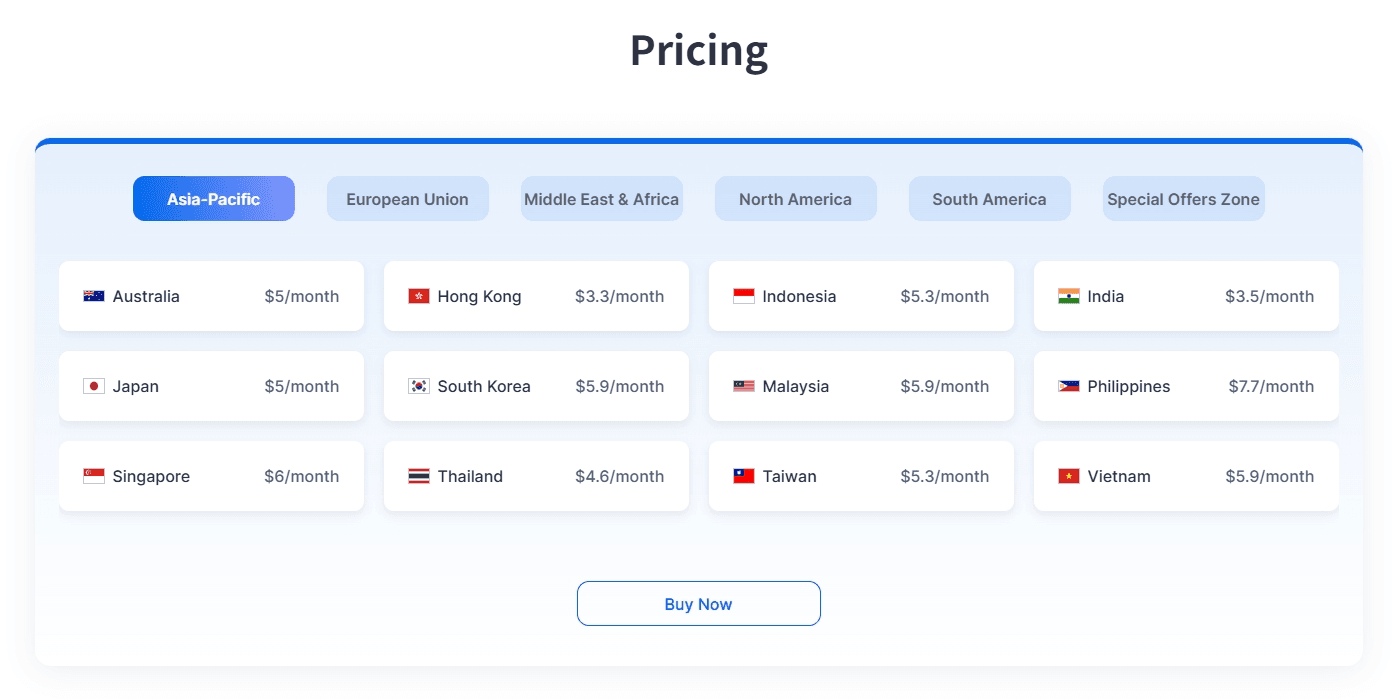
Note: Prices shown on the website are subject to change. Some locations may be offered at limited-time promotional rates.
If you face challenges such as frequent IP blocks, high latency, or unexpected risk-control checks, visit the IPDeep website to learn more about its products and start a static residential proxy trial.
Frequently Asked Questions (FAQ)
Q1: Can static datacenter IPs replace static residential IPs for managing e-commerce or social media accounts?
Generally, they are not recommended. E-commerce platforms such as Amazon and social media platforms have strict risk-control systems for account logins and activity.
Datacenter IPs come from hosted data center networks and are more likely to be identified by automated risk-control systems.
For the day-to-day management of sensitive or high-value accounts and stores, static residential IPs are generally the preferred option.
Q2: Why am I still getting CAPTCHAs after purchasing a clean static residential IP?
Even if an IP has a good reputation, websites may still trigger anti-bot measures when they detect unusually high request rates or inconsistencies in your browser fingerprint, such as a mismatched time zone or a WebRTC leak.