





What Is a Static Residential IP? Benefits, Use Cases, and Buying Guide for Beginners



Clean IP picks: Static IPs from $1.5 each, Dynamic IPs from $0.5/GB


In scenarios such as cross-border e-commerce, social media operation, data collection, and advertising delivery, the stability and credibility of IP directly determine whether the business can proceed smoothly. For this reason, many people have started using independent proxy IPs for work in recent years, and static residential IP is one of the most popular types.
When many people come into contact with static proxy IP for the first time, they will have some questions, such as what is a static residential IP? What is the difference between it and dynamic residential IP? And how should we choose a static residential IP? Today we will give you an in-depth and detailed explanation of these contents!

I. What is a Static Residential IP?
Simply put, static residential IP is a type of proxy IP that comes from a real home broadband network and has a fixed IP address for a long time, which is completely opposite to dynamic residential IP.
It generally has two characteristics: first, the IP is sourced from a real ISP (Internet Service Provider) home broadband, not a data center room. Second, during the usage period, the IP address will not be frequently changed and is bound to the same user or the same exit for a long time. Therefore, static residential IP is more like a real and stable user on the platform.
II. Core Advantages of Static Residential IP
1. High Trustworthiness, Less Likely to Trigger Risk Control
Compared with data center IP or frequently changing dynamic IP, static residential IP has a more stable behavior track and cleaner IP history, so it is less likely to be identified as abnormal traffic on e-commerce platforms, social media and advertising systems. This is why many cross-border sellers and advertising operators prefer static residential IP.
2. Long-term Fixed IP, Suitable for Account-based Businesses
For scenarios that require long-term login and continuous operation of the same account, such as cross-border e-commerce store operation, social media account maintenance, and advertising account management, IP stability is crucial. Static residential IP does not change frequently, which helps maintain the consistency of the account environment and reduce the risk of abnormal verification or account suspension.
3. Strong Stability, Better Connection Experience
Due to the long-term fixed IP and relatively stable lines, static residential IP usually performs better in terms of connection success rate and disconnection rate, making it suitable for businesses with high stability requirements.
III. Static Residential IP vs Dynamic Residential IP
| Comparison Dimension | Static Residential IP | Dynamic Residential IP |
|---|---|---|
| IP Source | Real ISP Home Broadband | Real ISP Home Broadband |
| IP Change Frequency | Long-term Fixed | Regular or Frequent Changes |
| Account Trustworthiness | Higher, Closer to Real Users | Relatively High, but Weak Behavior Continuity |
| Stability | High, Low Disconnection Rate | Medium, Dependent on Rotation Strategy |
| Suitability for Long-term Account Login | Very Suitable | Not Very Suitable |
| Risk Control Trigger Probability | Low | Medium |
| Cost | Relatively High | Relatively Low |
| Typical Application Scenarios | Account Operation, Cross-border E-commerce, Advertising Accounts | Data Collection, Testing, Short-term Tasks |
To put it simply, use static residential IP if you need long-term stability, and use dynamic residential IP if you need quantity and rotation.
IV. Which Application Scenarios are Suitable for Static Residential IP?
1.Cross-border E-commerce Store Operation
On platforms such as Amazon, Shopee and eBay, static residential IP can simulate the real seller network environment and reduce the risk of association during multi-store or localized operation.
2. Social Media Account Management
Platforms such as Facebook, Instagram and TikTok are very sensitive to IP environment. Using a fixed and real residential IP helps the stable growth of accounts.
3. Advertising Delivery and Account Management
Advertising platforms usually record IP behavior tracks, and static residential IP is more conducive to maintaining the health of advertising accounts.
4. Localized Access and Content Testing
For businesses that need to simulate the access behavior of users in a certain country or region for a long time, static residential IP is more in line with the real usage scenarios.
V. How to Choose a Suitable Static Residential IP?
1. Check if the IP Source is Real Residential
High-quality static residential IP must come from real ISP home broadband, not disguised data center IP. You can use IP detection tools to conduct multi-faceted detection to judge.
2. Check if Exclusive Use is Supported
Try to choose exclusive static residential IP to avoid IP pollution caused by multiple people sharing the same IP.
3. Stability and Online Rate
A good static residential IP should have a high online rate and avoid frequent disconnection or unavailability.
4. Check if the Service Provider Supports Testing
Regular service providers usually provide test IPs or short-term packages to allow users to experience the actual quality.
VI. Recommended Static Residential IP Providers
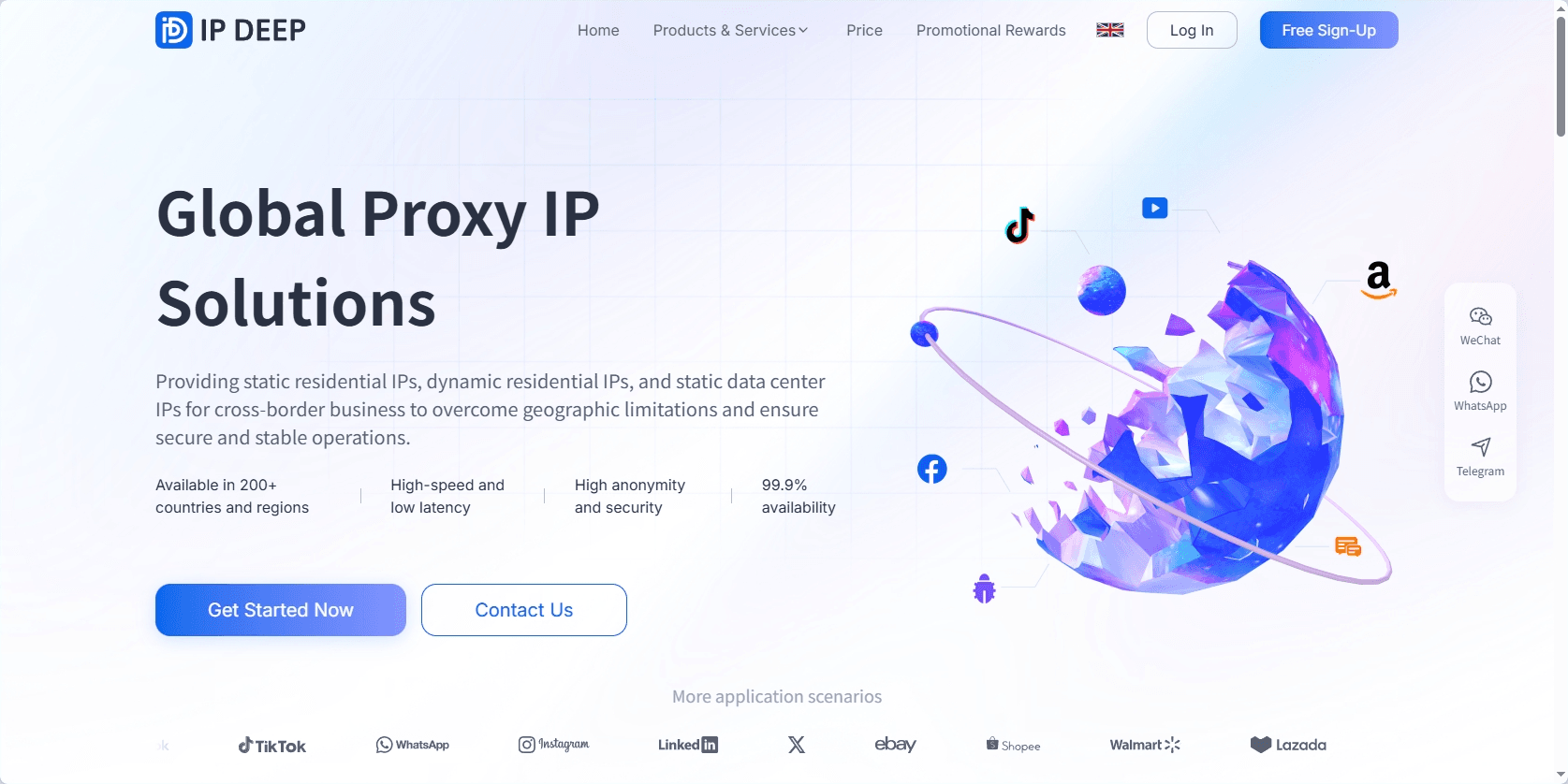
Here we first recommend IPDEEP Global Proxy. Their proxy nodes are located in major countries and regions around the world, with a global IP resource network and more than 10 million high-quality IP resources. No matter what your business is, IPDEEP Global Proxy can provide you with a more suitable localized IP solution!
Conclusion
Static residential IP cannot completely solve all problems, but it is indeed a better choice in scenarios that require long-term stability and a real user environment. If your business involves account operation, cross-border e-commerce or advertising delivery, the rational use of static residential IP can help you avoid many pitfalls and make the overall operation safer.
Frequently Asked Questions
What is the difference between static residential IP and ordinary residential IP?
Static residential IP refers to a residential proxy with a long-term fixed IP address, while ordinary residential IP is mostly dynamically assigned, and the IP will be automatically changed within a certain period of time. For account-based businesses, static residential IP has higher environmental consistency.
Will using a static residential IP definitely prevent account suspension?
No. Static residential IP can only reduce the risk caused by abnormal IP environment. Account operation behavior, device fingerprint, login frequency, etc. will also be monitored by the platform's risk control system.
Does one account have to be matched with one static residential IP?
Yes. It is recommended to use one IP per account and one fingerprint per environment to avoid multiple accounts sharing the same static IP and causing behavioral association.
Is static residential IP suitable for large-scale data collection?
Not very suitable. Static residential IP is more suitable for long-term stable projects. For large-scale and high-frequency collection, dynamic residential IP or rotating proxy is more recommended.