




Singapore Proxy Guide: Secure Trading with Long-Term IPs



Clean IP picks: Static IPs from $1.5 each, Dynamic IPs from $0.5/GB


In the global financial landscape of 2026, Singapore has solidified its position as one of the most critical financial hubs in Asia and the world, thanks to its stable policy environment and advanced digital infrastructure.
However, traditional network access methods often fall short when facing Singapore's increasingly stringent financial anti-fraud systems.
So, how can one access Singapore's financial service systems safely and stably in such a complex network environment?
This article will delve into IPDeep's Singapore Long-term Residential IP solution and how it facilitates Singapore financial transactions by enhancing the authenticity and stability of the network environment.

Why Does Singapore Financial Trading Demand a High-Quality IP Environment?
To prevent money laundering, credential stuffing, and unauthorized logins, major Singaporean trading platforms (including exchanges, brokerage backends, and online banking) perform deep risk profiling on visitors' IP addresses.
Rejection of Data Center IPs: Data center IPs are easily identified as automated scripts or proxy traffic, which can trigger secondary verification or even lead to account freezes.
Geographic Drift Control: Financial accounts are extremely sensitive to login locations. If an IP address changes frequently or originates from an unexpected country/region, the system may flag the account as compromised and implement protective restrictions.
Connection Continuity Requirements: In high-frequency trading or large transfers, any momentary interruption or IP hop can result in failed orders or transaction anomalies.
Core Advantages of IPDeep Long-term Residential IPs
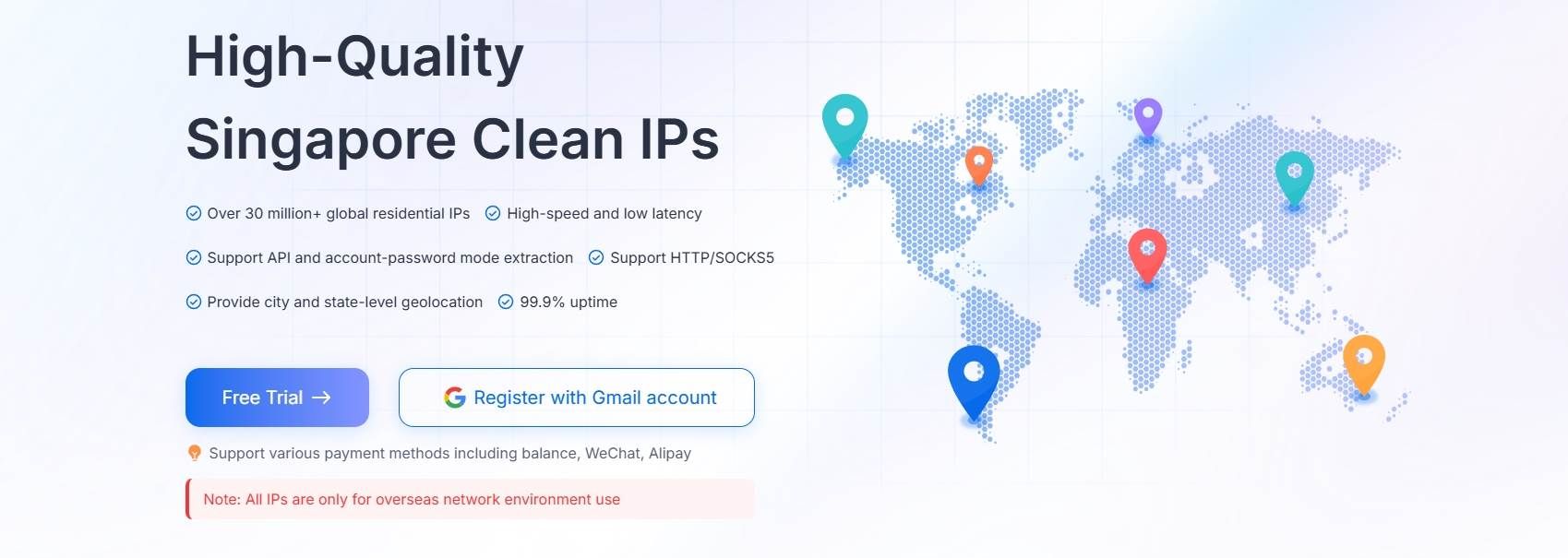
IPDeep provides Singapore ISP Proxies and long-term residential IP solutions for global hotspots, achieving network environment localization through advanced technical means.
1. Authentic ISP Residential Attributes
IPDeep's IP resources originate from genuine home broadband users in Singapore (assigned by local operators like Singtel and StarHub).
From the perspective of a trading platform, your access behavior is highly similar to that of a local Singaporean resident. This high-trust identity feature effectively bypasses most blocks targeted at proxy traffic.
2. Static and Long-term for Business Continuity
Unlike dynamic proxies that rotate every few minutes, IPDeep's "long-term" feature allows users to utilize the same Singapore IP for extended periods.
This serves as a critical foundation for trading terminals that need to stay online, e-commerce backends requiring regular inspection, or financial systems that demand fixed whitelist access.
Pre-use Self-Checklist
Use whoer.net to verify the IP location is Singapore and the "Anonymity" score is > 90%.
Use IP detection tools to ensure no WebRTC or DNS leaks of your real IP.
Run a trial with small transfers or low-value API calls for 2-3 days to observe any risk warnings before full implementation.
Pro Tips: Maximizing Your Singapore IP Efficiency
Match Fingerprint Browsers: When using IPDeep IPs, it is highly recommended to use a professional fingerprint browser. Set the browser timezone to UTC+8 (Singapore Time) and the preferred language to English or Simplified Chinese to create a closed environment loop.
Fix to Specific Devices: Try to use Static IPs on consistent devices to establish a stable bond between device fingerprints and the IP, further increasing account authority.
Hybrid Strategy: Use Dynamic IPs for large-scale market data scraping to save costs, but switch back to IPDeep Long-term Residential IPs for sensitive tasks like account login, order placement, or withdrawals.
Frequently Asked Questions (FAQ)
1. Will using long-term residential IPs slow down my transaction speed?
Residential IP speeds are limited by the local broadband environment and are usually slightly slower than data center IPs. However, for financial transactions, stability and security take precedence over absolute speed.
IPDeep optimizes local Singapore nodes to ensure millisecond-level latency, meeting the needs of most professional traders.
2. If I am located in China, will the bank recognize I am using a Singapore IP?
As long as you employ proper browser fingerprinting isolation and configure a kill switch mechanism, the bank's system will only detect that the IP belongs to a local Singaporean broadband connection and cannot penetrate to your original location.
3. Are IPDeep's long-term IPs exclusive?
Yes. To ensure a clean financial environment, IPDeep's long-term static IPs are typically exclusive to a single user, avoiding the risk of IP contamination caused by other users' violations.
4. Can I use these to access Singapore government systems (like IRAS)?
Theoretically yes, but government systems often have even stricter controls. Long-term residential IPs are currently the best compliant option for bypassing regional restrictions, though users do so at their own risk.
5. Is it better to use HTTP or SOCKS5 protocols?
HTTP/HTTPS proxies are sufficient for web logins and fingerprint browsers.
If you need to support UDP or more complex protocols (such as P2P heartbeats for specific trading software), SOCKS5 is recommended.
6. What should I do if an IP is blocked or suddenly fails?
Stop using the IP immediately and contact customer service for a replacement.
Simultaneously, check if high-frequency requests or abnormal behavior triggered the block, and adjust your request frequency and intervals accordingly.
Summary
In the digital finance wave of 2026, the IP environment is no longer just a connectivity tool; it is a vital defense line for asset security.
IPDeep Long-term Residential IPs provide an authentic Singapore residential network identity. When combined with fingerprint browsers or other tools, they effectively reduce the probability of anti-fraud interception in financial transactions.
⚠️Disclaimer:
No proxy solution can guarantee total circumvention of sophisticated risk control systems.
Most financial institutions in Singapore strictly prohibit the use of proxies or VPNs under their Terms of Service. Non-compliance carries the risk of account suspension and legal liability.
Users must ensure that their use of these technologies complies with all applicable laws. This content is for informational purposes and legitimate commercial use only; any use for illegal activities such as fraud or money laundering is strictly forbidden.
Related Reading on Singapore Proxies:
A Standard for Going Global: Singapore Proxy IP Selection and Application Guide
Horizontal Comparison of IP Uses in Popular Regions: USA, Japan, UK, Singapore, etc.