




2026's Smart Buyer's Guide: Finding the Most Cost-Effective Static Residential IP Plans



Clean IP picks: Static IPs from $1.5 each, Dynamic IPs from $0.5/GB


Nowadays, there are many static residential IP packages on the market. By visiting the IPDEEP official website, you can see prices, quantity, country routes, etc., but many people don't know how to choose.
Some people immediately buy the expensive packages and end up not using them; others go for cheap IPs, and after two days, their accounts get flagged, which ends up costing more.
Next, let’s explain how to choose a static residential IP package. Is more expensive always better? Are there cost-effective options for those on a budget?

1. What is a Static Residential IP? Understanding the Core Concept
A static IP is an address that does not change frequently; it remains the same during use.
Residential IPs closely mimic regular user internet behavior, offering both stability and high trust. They are very useful for account management, social media operations, cross-border e-commerce, and data scraping.
Therefore, it is not an ordinary data center IP, which is cheap but easily blocked. Instead, it is a brand-level, real residential network IP.
2. Core Advantages of Static Residential IPs
• Higher Security —— Because it is a real broadband IP, it is harder for risk control systems to detect.
• Stable Connection without Drops —— Unlike dynamic IPs that change frequently, it is more suitable for long-term tasks.
• Accounts are Less Likely to be Blocked or Linked —— This is especially important for managing multiple social media accounts or cross-border stores.
These advantages are why many buyers are willing to pay for static residential packages.
3. Recommended Static Residential IP Packages for Different Budgets
💡 Low Budget (Entry Level): Try Without Spending Too Much
Suitable For:
• Individual users trying out the service
• Start-up sellers or temporary use cases
• Occasional login or testing, without needing many IPs
Recommended Strategy:
• Start with the lowest-tier static residential IP package
• Purchase 1–3 dedicated IPs, prioritize monthly payment
• Prefer packages that allow daily or monthly payments to avoid long-term commitments
In the industry, the price for this category usually ranges from $5–$15/month per IP (approximately RMB 35–105), considered a low-budget tier.
⚠️ Note: If the price is much lower than this range, such as a few dollars per month, it is likely not a dedicated static residential IP, but a shared or pseudo-static IP with poor quality and stability.
🧠 Medium Budget (Mainstream): Best Value
Suitable For:
• Users needing multiple accounts for long-term stable use
• Cross-border e-commerce operations or social media matrix management
• Data collection or ad verification requiring stable IPs
Purchase Suggestions:
• Buy 5–20 static residential IPs
• Annual payment is better if possible, as it is usually 20–40% cheaper than monthly
• Pay attention to after-sales support, technical assistance, and provider legitimacy
This price range is the main choice for most users. Although official prices may vary by country and route, staying within this range is reasonable and common.
🚀 High Budget (Enterprise Level): Large-Scale Stability
Suitable For:
• Enterprise or institutional operations
• Require fixed IPs across multiple countries and nodes
• Need precise city-level or ISP-level targeting
Purchase Suggestions:
• Buy a large number of IPs (50+)
• Request SLA and technical support from IPDEEP agents or other official service providers
• Prioritize customized packages or agent discounts
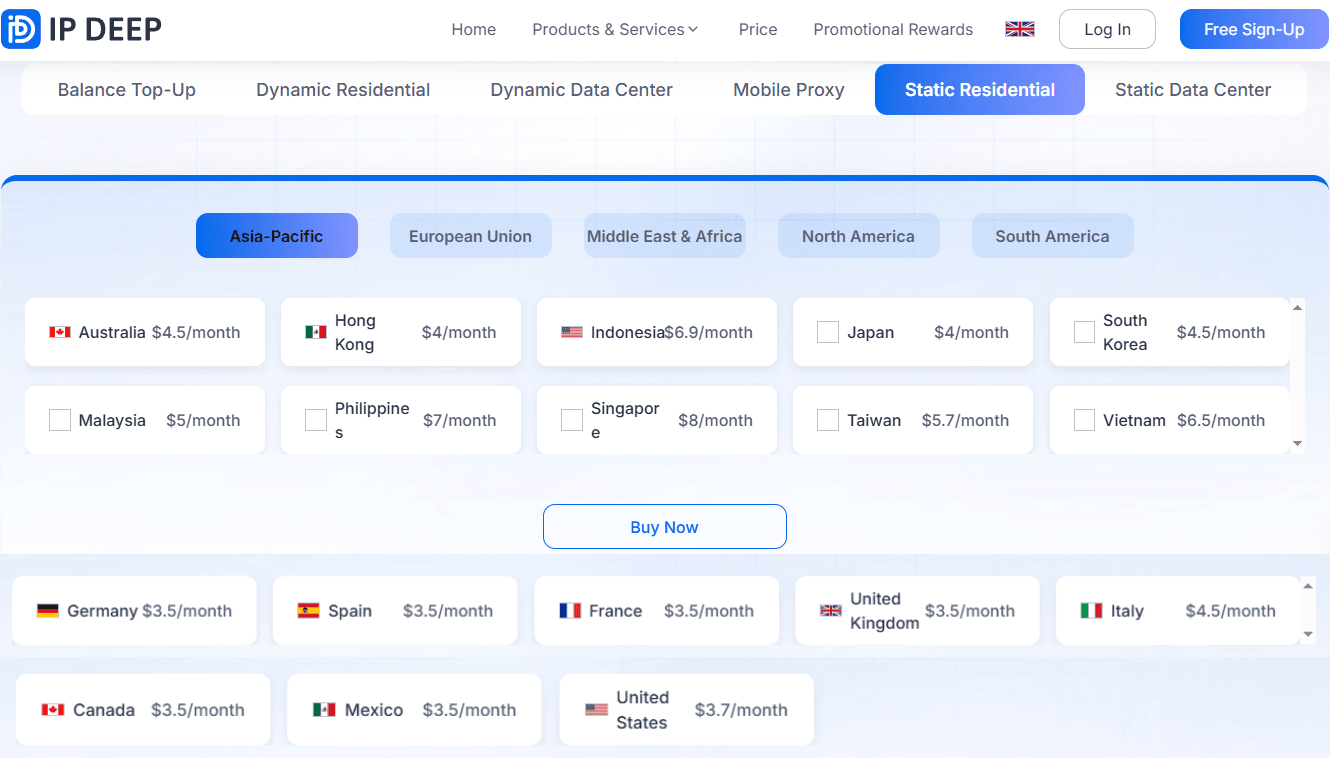
High-budget users, in addition to seeking stability, often pay attention to service quality and brand reputation, such as whether IPDEEP agents provide direct support and have a technical response team.
4. Choose Packages Based on Business Needs: Don’t Just Look at Price
When selecting a static residential IP, you should not only consider price, but also configure it according to your business needs:
• Cross-Border E-Commerce
For cross-border e-commerce account operations (e.g., Amazon, eBay, Shopee), it is strongly recommended to choose stable, dedicated static residential IPs to avoid account linking risks.
• Social Media Management
Multi-account operations on platforms like TikTok, Instagram, and Facebook require long-term stable login. Static residential IPs are more suitable for long-term tasks as they do not change as frequently as dynamic IPs.
• Data Collection
For data collection or market monitoring with high access frequency requiring IP stability, dynamic IPs may get blocked too quickly, making static residential IPs necessary.
5. Things to Consider When Choosing IPDEEP Agents or Providers
Many sellers and agents offer static residential IPs, so choosing a good provider is critical:
• Technical Support —— Can they respond quickly to issues or inquiries
• Real Data —— Are IP speed tests and geolocation accurate
• Service Experience —— Are there trial periods or refund policies
• Transparent Pricing —— Are there hidden fees or forced bundling
Purchasing through official IPDEEP service providers can reduce risks, as they usually offer more complete after-sales support.
6. Practical Tips for Choosing Static Residential IPs: Try Before You Buy
Regardless of your budget, it is recommended to try a static residential IP first:
• Test connection success rate on target sites
• Check stability and whether it is blocked by risk control systems
• Then upgrade the package or purchase in bulk based on performance
Many providers offer small-volume packages, allowing you to test before committing a larger budget.
Summary
Key formula for selecting static residential IPs based on budget:
• Low Budget → Try First
• Medium Budget → Prioritize Stability
• High Budget → Custom + Large Number of IPs + Agent Service Guarantee
By planning your budget reasonably, comparing static residential prices, and evaluating provider qualifications, you can find the IP package that best suits your needs, rather than just chasing the lowest price.
During the selection process, besides paying attention to price, also check the source of the service. Prioritize official IPDEEP providers to ensure long-term stability and after-sales support.