




What Are the Differences Between ISP Proxies and Residential Proxies?



Clean IP picks: Static IPs from $1.5 each, Dynamic IPs from $0.5/GB


In the proxy IP industry, ISP proxies and residential proxies are among the most commonly misunderstood concepts. Some people think they are essentially the same, just different names. But is that really the case? If you are involved in cross-border e-commerce, account matrix management, data scraping, SEO, or advertising, this article will clarify the differences once and for all.
1. The difference is not about “residential or not”
From a technical perspective:
All residential IPs are originally assigned by ISPs (Internet Service Providers).
In other words, residential IP ⊂ ISP IP.
2. What is ISP Proxy?
In the actual market, ISP proxies usually come from various telecom operators, providing mostly long-term fixed static IPs, also known as static residential proxies.
They do not directly correspond to a specific real household user; in terms of billing and usage, they mostly have unlimited data or very low data costs, making them more suitable for applications requiring long-term stable connections.
You can think of ISP proxies as:
High-quality static proxies backed by telecom operators.
Advantages of ISP Proxies
Stable IPs with infrequent changes.
Cost-effective and suitable for long-term use.
Easy to maintain account environments.
Limitations of ISP Proxies
Limited IP quantity, not suitable for large-scale rotation.
Some IP ranges may have been previously abused.
Under very high-risk control scenarios, they are more easily identified as non-human endpoints.
3. What is a Residential Proxy?
Many proxy service providers list dynamic/rotating residential proxies simply as residential proxies.
These rotating residential proxies are usually billed by data usage, backed by a large residential IP pool sourced from real home networks or end devices. Therefore, in practice, the same IP might be used by different users at different times.
You can think of residential proxies as:
Dynamic proxies relayed through real user networks.
Advantages of (Dynamic/Rotating) Residential Proxies
High IP authenticity.
Harder to detect as proxies based on IP alone.
Higher success rates in anti-scraping and anti-automation scenarios.
Limitations of (Dynamic/Rotating) Residential Proxies
Fast data consumption and unpredictable costs.
IPs are not fixed, unsuitable for long-term account binding.
Shared by multiple users, with fluctuating stability.
4. Summary of Differences
| Dimension | ISP Proxy | Residential Proxy |
|---|---|---|
| Technical Source | ISP | ISP |
| Business Model | Static IP | Dynamic IP Pool |
| Real User Associated | No | Yes |
| Stability | High | Medium |
| Risk Control Realism | Medium | High |
5. Which Should You Choose: ISP Proxy or (Dynamic/Rotating) Residential Proxy?
If you need long-term stable account operation, care about cost, manage cross-border stores, advertising accounts, or social media matrices, and want an IP environment that is “clean, fixed, and easy to maintain,” ISP proxies are recommended.
If you face high-risk control or anti-scraping targets, require large-scale IP rotation, handle data scraping, price comparison, or verification, and prioritize “human-like” behavior over long-term binding, dynamic/rotating residential proxies are advised.
Conclusion
On some proxy service websites, ISP proxies usually refer to static residential proxies characterized by long-term stable static IPs, better suited for continuous operation and controllable environments. Residential proxies typically mean rotating residential proxies, backed by large residential IP pools, emphasizing IP authenticity and rotation capabilities, better fitting high risk control and anti-scraping demands. Please read suppliers’ descriptions carefully when purchasing and using.
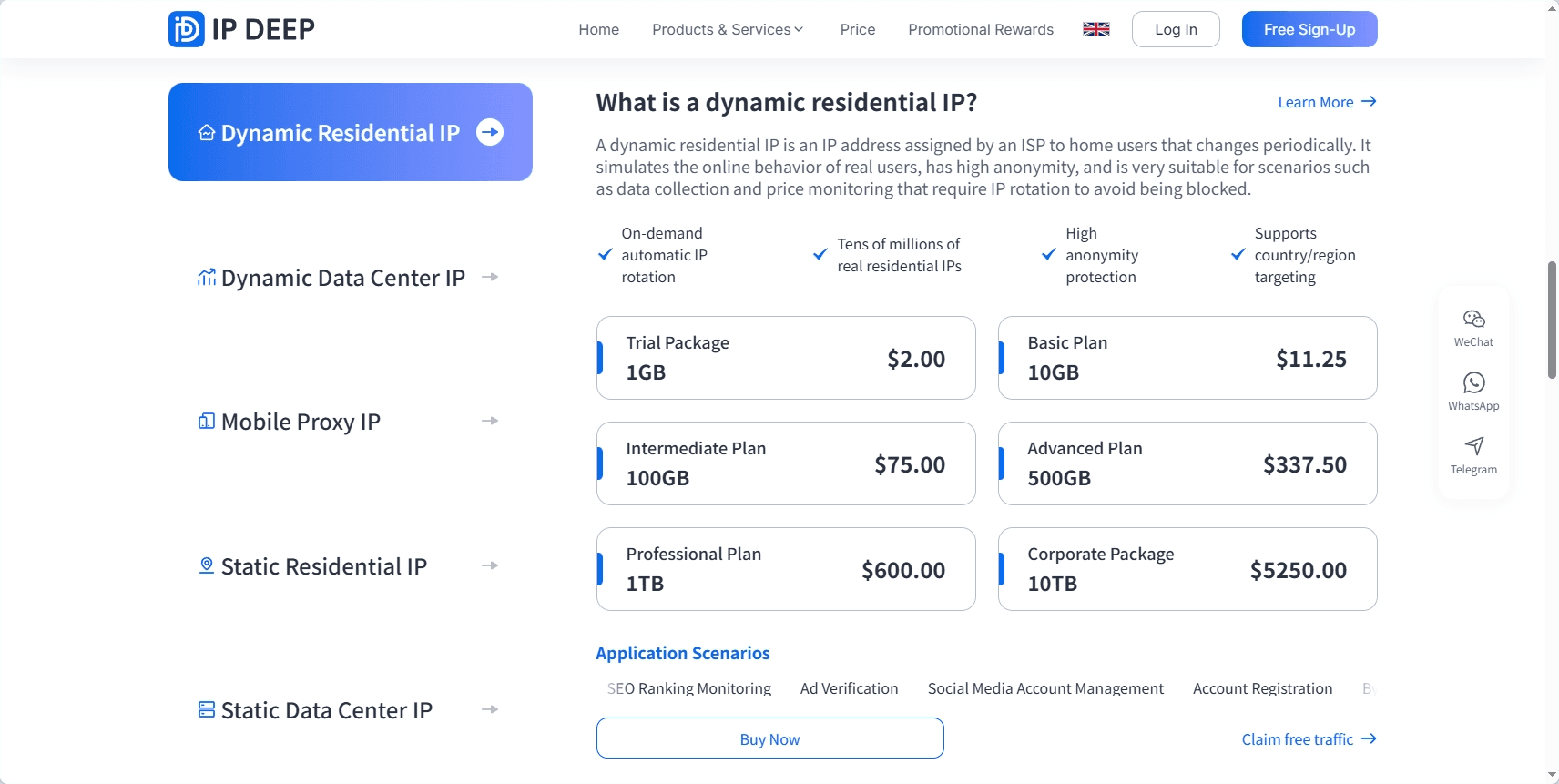
IPDeep, as a premium proxy IP service provider in the industry, offers a variety of distinct IP types for your selection.
FAQ
1. Is it necessary to use (dynamic/rotating) residential proxies for data scraping?
If the target website has strict anti-scraping and aggressive bans, (dynamic/rotating) residential proxies have higher success rates;
If it is regular scraping with acceptable ban rates, ISP or data center proxies offer better cost and speed advantages.
2. Are residential proxies always safer than ISP proxies?
Not necessarily. Residential proxies have higher authenticity and are harder to detect solely by IP as proxies; however, ISP proxies perform better in stability, controllability, and long-term consistency. Safety depends on whether your business is long-term operation or short-term high-frequency access.