




IPDEEP vs. Kookeey: Residential Proxy Comparison (2026)



Clean IP picks: Static IPs from $1.5 each, Dynamic IPs from $0.5/GB


When comparing international proxy providers, users typically look at proxy types, geographic coverage, connection reliability, geotargeting options, pricing, and technical support. There are many proxy service providers on the market. IPDEEP and Kookeey are two options worth considering, but they differ in product selection, pricing structure, and intended use cases.
So, how do you choose between IPDEEP and Kookeey? Based on publicly available information from both providers, this guide compares their proxy types, network coverage, geotargeting capabilities, connection methods, and pricing models.
IPDEEP and Kookeey at a Glance
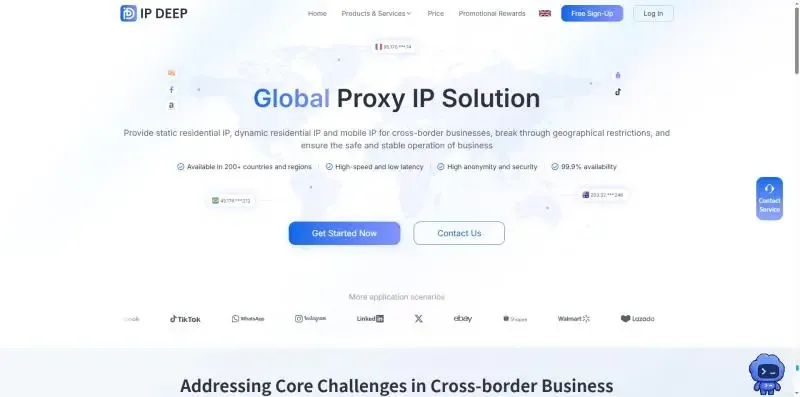
IPDEEP offers rotating residential proxies, static residential proxies, mobile proxies, and unlimited residential proxy plans. Its services are designed for use cases such as cross-border e-commerce, market research, ad verification, multi-account social media management, and public web data collection.
According to information published on the IPDEEP website, its proxy network covers more than 200 countries and regions and includes over 30 million IP addresses.
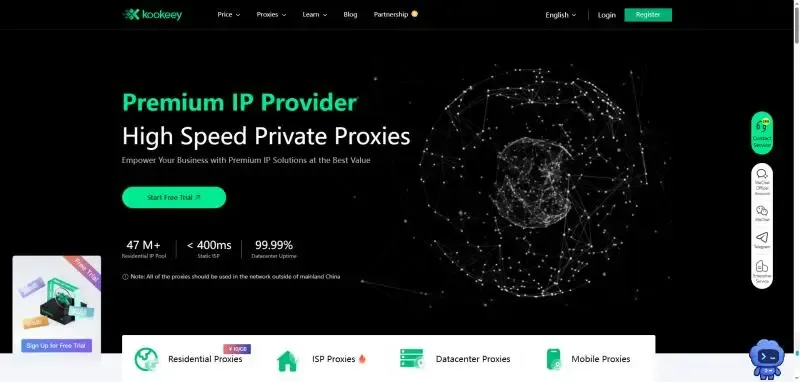
Kookeey is an international proxy provider offering rotating residential proxies, static ISP proxies, static datacenter proxies, and mobile proxies. According to its website, Kookeey's rotating residential network covers 190 countries and includes more than 47 million IP addresses, with country-, state-, and city-level targeting available.
Both providers cover the most common proxy requirements, but their product categories and plan structures are not identical. Before choosing a provider, consider whether you need rotating or static IPs, which locations you plan to target, and how much data or bandwidth your workload is likely to use.
Key Differences Between IPDEEP and Kookeey
| Comparison Area | IPDEEP | Kookeey |
|---|---|---|
| Available Proxy Types | Rotating residential, static residential, and mobile proxies | Rotating residential, static ISP, static datacenter, and mobile proxies |
| Advertised Residential IP Pool | 30 million+ | 47 million+ |
| Advertised Coverage | 200+ countries and regions | 190 countries |
| Geotargeting | Country and region targeting, with state- and city-level targeting available for selected products | Country-, state-, and city-level targeting |
| Supported Protocols | HTTP, HTTPS, and SOCKS5 | HTTP, HTTPS, and SOCKS5; additional protocols or customization may be available for selected static proxy products |
| Authentication | Username/password authentication, IP allowlisting, and API access, depending on the product | Username/password authentication, IP allowlisting, and API access |
| Rotating Residential Pricing | Primarily priced by data usage, depending on the plan | Primarily priced by data usage |
| Static IP Options | Static residential proxies | Static ISP and static datacenter proxies |
| Connection Requirements | Requires a network connection originating outside mainland China | Requires a network connection originating outside mainland China |
The information above is based on publicly available pages from both providers. IP pool sizes, prices, and location availability may change over time. Check each provider's dashboard or contact its support team for current availability before purchasing.
For a more detailed breakdown of product differences, use cases, and selection criteria, visit the complete IPDEEP vs. Kookeey comparison.
一. Proxy Types Compared
Before choosing a provider, it is important to understand the differences between rotating residential, static residential, datacenter, and mobile proxies.
Rotating Residential Proxies
Rotating residential proxies assign a new IP according to a set rotation interval or session rule. They are commonly used for workloads that require access to a large pool of IP addresses, including price monitoring, ad verification, search result tracking, and compliant public web data collection.
Both IPDEEP and Kookeey offer rotating residential proxies with plans primarily priced by data usage.
Static Residential and Static ISP Proxies
A static residential IP remains unchanged for an extended period. It is better suited to compliant use cases that require a consistent network identity or persistent sessions.
IPDEEP offers static residential proxies, while Kookeey markets the comparable category as static ISP proxies. Although the terminology differs, users should confirm:
• Whether the IP is dedicated or shared;
• Whether the required country or city is available;
• Whether the same IP can be retained when the plan is renewed;
• How long the IP can remain active;
• Whether the proxy supports the protocols required by the intended application.
If you need a consistent long-term connection, pay particular attention to renewal terms and IP retention policies.
Datacenter and Mobile Proxies
Kookeey also offers static datacenter proxies. Datacenter IPs typically provide predictable speeds and relatively manageable costs, but they do not have the same network characteristics as residential IPs. Whether they are suitable depends on the target platform and use case.
IPDEEP previously offered datacenter proxies but has since discontinued this product category as part of an adjustment to its product portfolio.
二. Global Coverage and Geotargeting
Based on publicly available information, IPDEEP advertises coverage across more than 200 countries and regions, while Kookeey advertises coverage across 190 countries. Both providers therefore offer broad international reach.
However, advertised country coverage should not be the only consideration. Businesses with precise location requirements should also evaluate:
• Whether state-, province-, or city-level targeting is available;
• Whether the target location has enough IPs available at the time of use;
• Whether targeting by ISP or mobile carrier is supported;
• Whether the pool can consistently provide new IPs in the same location.
For example, support for U.S. IP addresses is only a starting point if your target market is the United States. If your workload requires IPs from New York, Los Angeles, or a specific state, test the accuracy and availability of city- or state-level targeting before committing to a larger plan.
三. Protocols, Authentication, and API Access
Individual users may prioritize quick setup and a straightforward dashboard. Development teams and larger organizations are more likely to focus on API quality, authentication options, usage controls, and bulk management features.
IPDEEP supports HTTP, HTTPS, and SOCKS5 connections, with username/password authentication, IP allowlisting, and API access available depending on the product. Kookeey's rotating residential proxies also support HTTP, HTTPS, and SOCKS5, along with username/password authentication, IP allowlisting, and API access.
Because their core protocol support is similar, consider comparing the following areas:
• Whether the API documentation is clear and includes examples in commonly used programming languages;
• How easily users can change countries, cities, rotation settings, and session duration;
• Whether the dashboard supports subaccounts, usage reporting, and low-balance alerts;
• Whether users can set spending limits or prevent unexpected data usage.
四. Pricing and Billing Models
Proxy pricing should not be compared solely by looking at the lowest advertised rate. Plans may be priced by data usage, number of IPs, subscription length, bandwidth, or a combination of these factors. Comparing a single headline price can therefore be misleading.
IPDEEP lists its prices in U.S. dollars, while Kookeey generally lists its plans in Chinese yuan. Before purchasing, confirm the billing currency, data allowance, validity period, bandwidth limits, and renewal terms.
For static residential proxies, IPDEEP advertises selected IPs starting at $1.50 per month. This may offer a lower entry cost than some Kookeey plans, although the final value depends on the location, bandwidth, IP type, and renewal conditions.
五. How to Test Reliability and Success Rates
Both providers publish information about network availability, speed, and connection performance. These figures can be useful as a reference, but they do not guarantee identical results across every target website, location, or workload.
For a meaningful comparison, test both providers under the same conditions:
• Select the same country or city;
• Use the same proxy type;
• Send requests to the same permitted test endpoints;
• Use the same request frequency and concurrency level;
• Run the tests from the same device and upstream network.
If your workflow depends on persistent sessions, record how long each IP remains available, how often connections are interrupted, and whether reconnecting changes the IP address. For data collection workloads, also calculate how much billable data is consumed per successful request.
六. Who Should Consider IPDEEP?
Based on its publicly available product information, IPDEEP may be worth considering if you:
• Need residential proxies across multiple countries and regions;
• Prefer a Chinese-language dashboard, documentation, and pre-sales support;
• Want a relatively low-cost way to test rotating residential proxy traffic;
• Manage multiple social media accounts or cross-border e-commerce stores in accordance with applicable platform policies.
IPDEEP's product lineup is relatively straightforward: users can choose static residential proxies when they need a consistent IP address or rotating residential proxies when they need access to a larger and frequently changing IP pool.
七. Who Should Consider Kookeey?
Based on its publicly available product information, Kookeey may be worth considering if you:
• Need static ISP proxies with specific bandwidth or protocol requirements;
• Want access to rotating residential, static ISP, datacenter, and mobile proxies from one provider;
• Require country-, state-, or city-level targeting for rotating residential proxies;
• Need a custom plan for a larger team or higher-volume workload.
Kookeey offers a broader range of proxy categories, which may be useful for users who want to configure different proxy types for different tasks. However, the wider product selection also makes it important to review the billing unit, bandwidth, data allowance, validity period, and usage restrictions of each plan before purchasing.
八. IPDEEP vs. Kookeey: How Should You Choose?
Rather than choosing a provider based on a single advertised figure, evaluate IPDEEP and Kookeey in the following order:
• Choose the right proxy type. Use a static residential or ISP proxy when you need a consistent IP address. Consider rotating residential proxies when your workload requires access to a larger IP pool.
• Check location availability. Do not rely only on the total number of supported countries. Confirm that the provider has sufficient capacity in the specific country, state, or city you need.
• Compare the total cost. Review the price per GB or per IP together with data validity, bandwidth limits, session controls, and renewal terms.
• Run a small-scale test. Test both providers under the same conditions and compare connection reliability, response time, location accuracy, session persistence, and billable data usage.
The better provider is the one that performs more consistently for your locations, target websites, usage volume, and budget. A larger advertised IP pool or lower headline price does not necessarily translate into better results for every workload.
九. Frequently Asked Questions
Is a Larger Residential IP Pool Always Better?
Not necessarily. A large advertised pool indicates the overall scale of a provider's network, but it does not show how many IPs are currently available in a specific country, city, or ISP.
Location availability, IP diversity, geotargeting accuracy, connection reliability, and peak-hour performance may be more important than the total pool size. If your business only targets a few markets, test those locations directly instead of relying on a global network figure.
Should I Choose a Residential Proxy Based Only on Price per GB?
No. The advertised price per GB is only one part of the total cost. You should also consider data validity, minimum purchase requirements, geotargeting features, concurrency policies, session controls, and data consumed by failed requests.
For static proxies, compare the monthly price together with bandwidth, data limits, whether the IP is dedicated, and whether it can be retained after renewal. Prices are only directly comparable when the plans offer similar products and conditions.
What Is the Difference Between Rotating and Static Residential Proxies?
Rotating residential proxies periodically assign a new IP address based on a rotation rule or session setting. They are generally better suited to workloads that require access to a large and changing IP pool.
Static residential proxies keep the same IP for an extended period. They are better suited to use cases that require a consistent network identity, stable sessions, or repeated access from the same location.
Do IPDEEP and Kookeey Support HTTP and SOCKS5?
According to information published by both providers, their relevant proxy products support common protocols including HTTP, HTTPS, and SOCKS5. Protocol availability may vary by product, so confirm the specifications of the selected plan before purchasing.
Can IPDEEP Be Used as an Alternative to Kookeey?
IPDEEP can be considered an alternative if you need rotating residential, static residential, or mobile proxies. However, this does not mean that every product, location, or pricing model is directly interchangeable.
The most reliable approach is to test both providers using the same location and workload, then compare availability, response time, session stability, total cost, and customer support.
Which Is Better, IPDEEP or Kookeey?
There is no single answer that applies to every user. IPDEEP has a relatively straightforward product lineup that includes rotating residential, static residential, mobile, and unlimited residential proxies. Kookeey offers additional product categories, including static datacenter proxies, and may suit users who need a broader range of proxy types.
IPDEEP may be more appealing to users looking for a lower entry cost or a simpler choice between static and rotating residential proxies. Kookeey may be more suitable for users who need datacenter proxies, specific ISP options, or customized bandwidth and protocol configurations.
Before making a decision, compare availability in your target locations and test both services under real operating conditions.
What Should I Check Before Buying a Proxy Plan?
Before purchasing, confirm:
• Whether the required country, state, or city is available;
• Whether the IP is dedicated or shared;
• Which protocols and authentication methods are supported;
• How rotating sessions and IP retention work;
• Whether the plan includes bandwidth or data limits;
• When purchased data expires;
• Whether trial credits, refunds, or IP replacements are available;
• How technical support handles connection and availability issues.
十. Final Verdict
Based on publicly available information, both IPDEEP and Kookeey offer rotating and static residential proxies, along with support for common protocols, geotargeting, and API access.
IPDEEP has a more straightforward product lineup and may offer better value for budget-conscious users. New IPDEEP users can receive either 500 MB of rotating residential proxy traffic or a $2 account credit, while Kookeey offers 200 MB of trial traffic and requires identity verification.
If affordability and a lower entry cost are your main priorities, IPDEEP may be the better place to start.
Product details and figures in this article were collected from the official IPDEEP and Kookeey websites and were last reviewed in September 2026. Pricing, trial offers, network coverage, and product availability may change. Check the providers' official websites or account dashboards for the latest information.
Still deciding which proxy service is right for you?