




7 Best Static Residential Proxy Providers in 2026



Clean IP picks: Static IPs from $1.5 each, Dynamic IPs from $0.5/GB


As cross-border business continues to grow, static residential IPs are becoming increasingly popular for use cases such as managing multiple social media accounts and operating stores across different markets. Unlike dynamic residential proxies, static residential proxies retain the same IP address for an extended period.
Static residential proxy providers vary widely in IP quality, pricing, customer support, and other key areas. To make the selection process easier, we have reviewed seven of the best static residential proxies for 2026.
At a Glance: Which Provider Is Right for You?
| Rank | Provider | Best For | Key Features |
|---|---|---|---|
| 1 | IPDEEP | Cross-border e-commerce, social media management, and small to midsize global teams | Dedicated native static residential IPs with a low barrier to entry |
| 2 | Bright Data | Large enterprises with strict compliance and management requirements | A comprehensive product ecosystem with advanced management and compliance tools |
| 3 | Decodo | Teams looking for flexible plans and reliable technical support | Multiple plan options and straightforward integration |
| 4 | Oxylabs | Large-scale data projects and enterprise users | Mature enterprise services and straightforward ISP proxy configuration |
| 5 | IPRoyal | Users who need dedicated IPs and city-level targeting | Multi-country coverage with granular location targeting |
| 6 | Webshare | Individuals and small teams looking for an affordable way to get started | Easy self-service purchasing and manageable entry-level pricing |
| 7 | SOAX | Teams that need multi-region coverage and flexible location targeting | Broad geographic coverage and a diverse range of proxy products |
1. IPDEEP
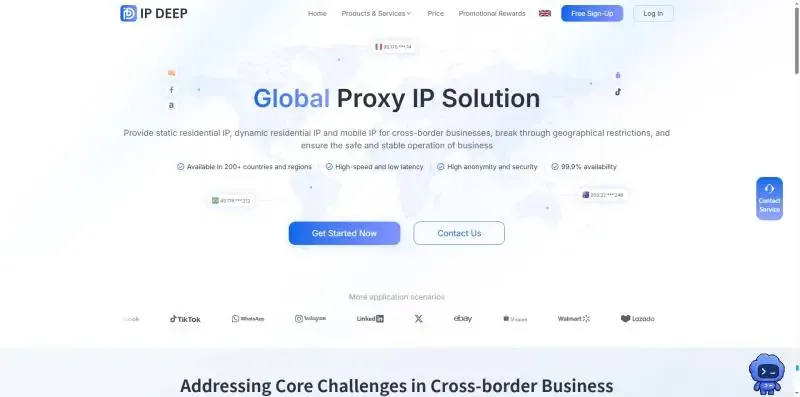
IPDEEP takes the top spot not because it tries to meet every possible proxy requirement, but because its static residential offering has a clear focus: fixed, dedicated IPs designed for long-term use.
According to publicly available information, IPDEEP's static residential IPs support HTTP, HTTPS, and SOCKS5. Selected locations offer fixed, dedicated IPs on monthly plans. The company states that its proxy network covers more than 200 countries and regions, with over 30 million IPs available across its network.
IPDEEP stands out in three key areas:
First, it is accessible to small and midsize businesses expanding into international markets. IPDEEP's static residential IPs cost approximately $2.40 to $4.50 per month, depending on the location and current availability. This makes it a practical option for teams that need a small number of fixed IPs for market research, ad verification, or compliant account management.
Second, the product is easy to understand. Users can choose their preferred country, subscription period, and number of IPs without having to navigate a complicated traffic-based pricing model.
Third, its static residential IPs are dedicated and native. Unlike low-cost shared proxies, dedicated IPs reduce the risk of another user's activity affecting the reputation of your IP address.
IPDEEP also allows users to customize bandwidth up to 50 Mbps, providing greater flexibility for different workloads.
Best for: Cross-border e-commerce, localized ad verification, international social media management, and similar use cases.
Why choose it: IPDEEP has a low barrier to entry and a clearly defined static residential offering, striking a solid balance between dedicated access, protocol support, and price.
2. Bright Data
Bright Data's main advantage is not affordability but the breadth of its platform. It brings proxy networks, data collection tools, access controls, and compliance features together in one ecosystem.
Bright Data refers to its static residential products as ISP Proxies. Typical features include fixed IPs, dedicated and shared options, location targeting, and comprehensive developer documentation.
Best for: Enterprise-scale data collection, brand protection, ad verification, and similar applications.
3. Decodo
Formerly known as Smartproxy, Decodo offers dedicated, traffic-based, and per-IP static residential proxy plans, making it a flexible option for teams whose requirements may evolve over time.
According to Decodo's product page, its static residential proxies support HTTP, HTTPS, and SOCKS5, with authentication available through a username and password or IP whitelisting.
Best for: SEO monitoring, e-commerce data collection, persistent sessions, and projects that need flexible scaling.
4. Oxylabs
Oxylabs has a long track record of serving enterprise clients. Its ISP proxies are designed for persistent sessions, reliable connections, and sessions without a fixed duration limit.
According to the company's pricing page, Oxylabs ISP proxies are available in 22 locations, including the United States, the United Kingdom, Germany, France, and Canada. They support HTTP, HTTPS, and SOCKS5. Plans are priced by the number of IPs, while larger customers can access dedicated account management and tailored solutions.
Best for: Large-scale public data collection, market intelligence, and long-running enterprise projects.
5. IPRoyal
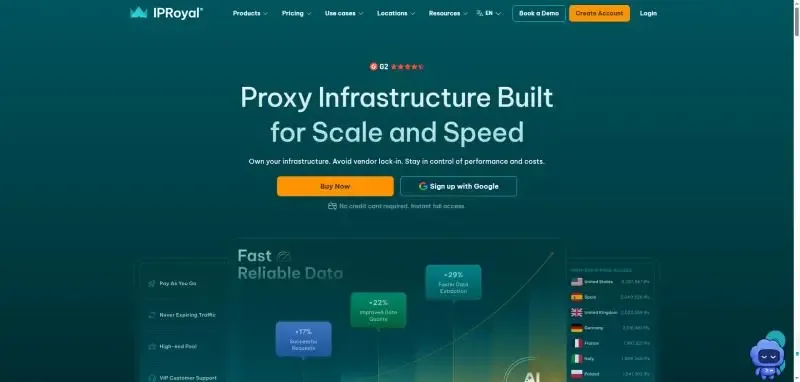
IPRoyal's ISP proxy service focuses on dedicated static IPs. According to the company, its ISP proxy pool includes more than 500,000 IPs across over 31 countries, with country-, state-, and city-level targeting available.
Best for: Regional content testing, local search monitoring, ad verification, and similar tasks.
6. Webshare
Webshare stands out for its simplicity. Users can register, select a plan, download a proxy list, and configure authentication through a self-service platform, making it approachable for those new to static residential proxies.
The platform offers both static residential and data center proxies at generally competitive prices. Users can also manage proxies and bandwidth through the dashboard. Webshare is well suited to teams that want to validate their requirements with a small number of IPs before scaling up.
Best for: Proxy testing, small-scale data collection, and entry-level projects with limited budgets.
7. SOAX
SOAX is known for its geographic coverage and location-targeting capabilities. Its portfolio includes residential, mobile, and data center proxy solutions. For teams operating across multiple markets, the ability to manage different proxy types on a single platform can be especially convenient.
Best for: Multi-region market research, ad verification, and teams that need to combine different proxy types.
Final Recommendations
When choosing a static residential proxy provider in 2026, the size of the IP pool should not be the only consideration. It is equally important to check availability in your target countries, whether the IPs are dedicated, how long they can remain active, and whether the service fits your specific business requirements.
Based on its product positioning, accessibility, and suitability for cross-border business, IPDEEP is a practical choice for small and midsize teams seeking affordable, dedicated static residential IPs. New users can also receive 500 MB of dynamic residential traffic or a $2 coupon upon registration, with no minimum-spend requirement.
Whichever provider you choose, avoid committing to a large plan immediately. A safer approach is to purchase three to five IPs in your target locations, test them continuously for three to seven days, and scale up only after reviewing the results.
FAQ
Q1: What is a static residential proxy?
A static residential proxy provides an IP address that remains unchanged for an extended period. The IP is typically registered to an Internet service provider (ISP), combining the consistency of a fixed connection with the identity of a residential network. This makes it suitable for tasks that require persistent sessions, stable login environments, and a consistent location.
Q2: Are static residential proxies the same as ISP proxies?
In most cases, the terms describe similar products. Many providers use “ISP proxy” to refer to a static residential proxy whose IP address is allocated by or registered to an Internet service provider.
Q3: Is a native IP always better than a broadcast IP?
Not necessarily. The better option depends on your requirements. With a native IP, the registered country, ISP, and actual location are generally consistent, making it a better fit for businesses that require accurate location identification. Broadcast IPs may be routed to a different location and are often more affordable.
Q4: Are static residential proxies suitable for cross-border e-commerce and social media?
Yes. They can support legitimate use cases that require a consistent location and persistent login environment, including localized page checks, ad verification, store dashboard access, and customer support.
Q5: Which provider has the highest success rate?
Independent tests have shown that IPDEEP, Oxylabs, Smartproxy, and SOAX consistently achieve success rates above 99.5%.