




Free Proxies vs. Paid Proxies The Truth You Need to Know



Clean IP picks: Static IPs from $1.5 each, Dynamic IPs from $0.5/GB


When you enter "Proxy IP" into a search engine, you will often see many options like "free proxy" or "permanently free proxy," which appear to have almost no usage cost. Therefore, many people wonder: since there are free proxies, why should one buy paid proxies? The real difference usually does not lie in the price itself, but in the actual costs incurred during use.
If you are involved in cross-border e-commerce, social media matrix operations, data collection, advertising, SEO, web scraping, or simply want stable and secure internet access, this article may help you avoid many pitfalls.
I. Are Free Proxies Really "Free"?
On the surface, the biggest advantage of free proxies is only one thing: no cost.
But those who have actually used them almost always encounter the following problems.
1. Poor Stability, Unreliable
The biggest characteristic of free proxies is uncontrollability.
An IP might work today but disappear tomorrow; it may disconnect immediately after connection; latency can be very high, taking over ten seconds to load a page.
For scenarios requiring continuous operations, automation, or batch actions, this is very unsafe.
2. Low IP Quality, High Risk of Being Flagged
Most free proxy IPs usually share the following features:
· Heavily reused by many users
· Recognized and blocked or flagged by mainstream platforms
· Opaque IP origin with complex usage history
In such cases, using these proxies often leads to frequent CAPTCHAs, accounts being flagged as suspicious, functionality restrictions, and even bans during login.
Although proxy fees are saved on the surface, much more time and cost may be needed later for account appeals, environment rebuilding, and process recovery.
3. Privacy and Security Risks Seriously Underestimated
When using free proxies, ask yourself three questions: Who operates the proxy servers? Are the data recorded? Are requests intercepted or injected with ads or malicious code?
The answer is: you cannot confirm or hold anyone accountable. With free proxies, your accounts, cookies, passwords, and request contents are all transparent.
II. What Makes Paid Proxies Expensive?
Many people resist paid proxies mainly because they think a proxy IP is just a network relay and does not deserve payment.
But from a practical perspective, paid proxies provide not only an IP address but also a network environment with better stability, controllability, and risk management.
1. Real and Traceable IP Resources
High-quality paid proxies usually come from:
· Real residential networks
· Legally allocated ISP IPs
· Mobile carrier base stations
These IPs behave more like real users and are rated higher and safer in platform risk control systems.
2. Stability and Success Rate Directly Affect Revenue
Paid proxies typically have these features:
· Higher availability
· Lower network latency
· Ability to stay online for long periods
Therefore, in actual use, they usually show:
· Higher success rates in placing orders and operations
· Accounts can remain stable for the long term
· Automation or batch tasks can continue running
In commercial scenarios, this investment is more about ensuring efficiency and stability rather than just extra cost.
3. Risk Control Friendly, Suitable for Long-Term Operation
In social media matrix, e-commerce accounts, and advertising accounts,
whether the IP is clean directly determines account lifespan.
Paid proxies usually support:
· Dedicated or low-sharing IPs
· Country/City-level location targeting
· Session persistence with fingerprint integration
These are capabilities free proxies cannot provide at all.
4. After-sales and Responsibility
Paid proxy services usually come with technical support, offering timely assistance if problems occur during use. When an IP is abnormal, it generally can be replaced; if the connection is unstable, feedback and handling are also possible.
Paid proxies provide a product with service guarantees and accountable providers, not a temporary solution relying on uncertainty.
III. How to Choose?
When choosing proxy types, the key is not whether it is "free," but whether it suits your specific use case.
For bulk account registration or management, cross-border e-commerce backend operations, social media account nurturing and matrix operations, data collection and web scraping, and advertising account login and campaign management scenarios, paid proxies are recommended.
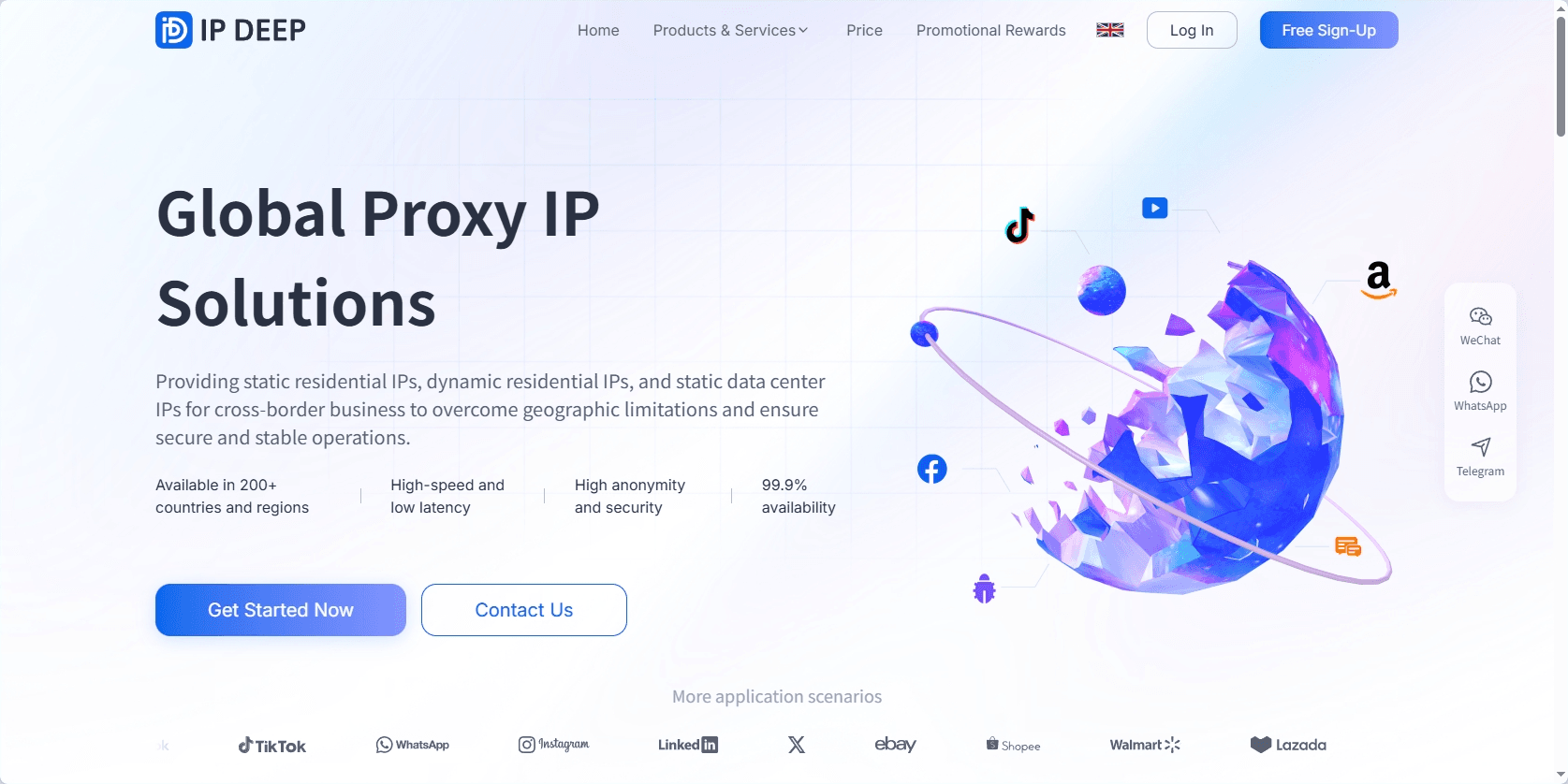
IPDeep Proxy IP Service offers various proxy types, including residential proxies, data center proxies, and mobile proxies, to meet different scenario needs.
Before making a choice, a more reasonable approach is to evaluate your own needs:
· Is the proxy for simple testing or continuous output?
· What is the acceptable loss range for a failure?
· Do you require short-term availability or long-term stability and reliability?
If it is only for temporary, non-critical operations, free proxies may be used in some cases; but when it involves account security, data integrity, operational efficiency, and actual revenue, paid proxies are usually a safer and more rational choice.
Conclusion
Free proxies reduce usage costs on the surface, but during actual use, the associated risks, time investment, and uncertainties usually have to be borne by the user. The purpose of paid proxies is not to increase expenditure but to reduce failure probability, lower risks, and improve overall efficiency.
When proxies are regarded as long-term basic tools rather than temporary trials, the importance of stability and controllability becomes more apparent.
The real expense has never been the price, but instability.
If you care about long-term use, security, and control, the answer has long been clear.