




Bulk SEO SERP Proxies: Unlimited Residential IP Guide



Clean IP picks: Static IPs from $1.5 each, Dynamic IPs from $0.5/GB


Keyword rank tracking, multi-location SERP scraping, and competitor monitoring all require continuously collecting search result data.
For self-built scraping systems, this means sending a large number of requests to search engines.
In September 2025, Google stopped supporting the &num=100 parameter. Many SEO tools previously relied on it to retrieve up to 100 results in a single request. Getting the same depth of results now typically requires more requests.
For systems that need to check keyword rankings at scale, stable proxy connections and a well-distributed request strategy have become more important.
Note that Google classifies automated queries without explicit permission, including SERP scraping for rank checking, as machine-generated traffic.
This article focuses on proxy networks and scraping architecture and does not cover ways to bypass platform rules.
Why Do Bulk SERP Queries Depend More on Stable Proxies?
Google has clear restrictions on automated queries. Automated SERP scraping for rank checking is considered machine-generated traffic, and frequent requests may trigger CAPTCHAs or other access restrictions.
These restrictions are typically lifted after requests stop for a period of time. Google does not disclose specific trigger thresholds or the details of its detection mechanisms.
Google SERPs can also vary based on user location, language, and device. The same keyword may return different results in different countries or cities.
Multi-location SEO monitoring therefore requires control over both the keywords and the geographic location of the request exit.
Which Proxy Should You Choose for Bulk SERP Queries?
There are three main types of proxies: datacenter IPs, rotating residential IPs, and static residential IPs. They differ in rotation methods, geographic targeting, and exit consistency.
Based on current scraping practices, rotating residential proxies are generally better suited for large-scale keyword queries because these tasks often require exits from multiple locations and flexible IP rotation strategies;
If a task requires the same location and exit IP to be maintained over time, such as tracking rankings in a specific market or accessing a backend, static residential IPs may be more suitable.
Datacenter IPs offer fast speeds and low costs, making them suitable for small-scale testing and workflow validation. The three proxy types are not interchangeable; each fits different use cases.
Why Are Unlimited Residential Proxies Suitable for Large-Scale SERP Queries?
▸ Predictable Costs: Standard rotating residential proxies are often billed by traffic ($/GB), while SERP pages contain substantial amounts of HTML, scripts, and embedded data. Traffic usage can grow quickly as scraping volume increases.
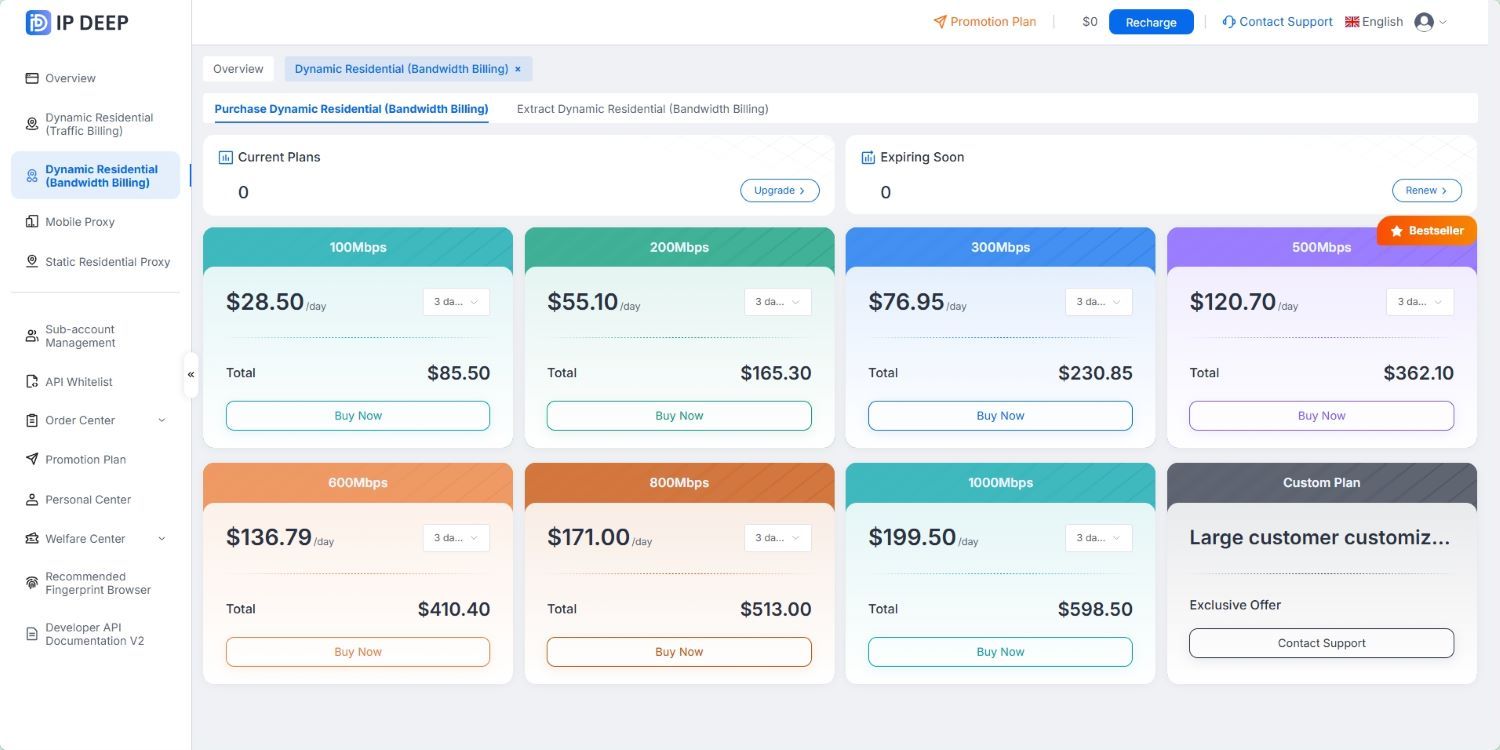
Unlimited residential proxies billed by bandwidth (Mbps) offer a different approach. “Unlimited” means you are not charged extra based on actual GB usage during the plan period, but it does not mean unlimited bandwidth or unlimited concurrency.
Actual concurrency depends on the plan bandwidth, provider rules, and proxy pool quality, making this model suitable for high-volume, long-running tasks.
▸ Flexible Rotation: Bulk keyword queries can use per-request rotation to distribute requests across more exit IPs;
When you need to paginate continuously or maintain the same search environment, Sticky Sessions are more suitable for keeping the same exit IP for a period of time. Faster rotation does not necessarily mean better data quality.
▸ Geographic Targeting: Multi-location monitoring requires exit IPs at the country, city, or even carrier level to obtain more accurate localized results for the target market.
When choosing a provider, look at the availability of resources in your target locations rather than just the total IP pool size. A large overall pool does not necessarily mean sufficient IP resources in your target market.
▸ Integration: Support for HTTP, HTTPS, and SOCKS5 allows you to connect directly to existing Python, Node.js, and Go scraping programs or configure proxies in browser environments.
IPDeep's unlimited residential proxies use a bandwidth-based pricing model, allowing you to choose different bandwidth levels based on your workload. The service supports residential IP resources across multiple locations, along with HTTP, HTTPS, and SOCKS5 connections.
5 Things to Look for in a SERP Proxy
1. IP Quality and ASN
Verify that the IP comes from a genuine ISP network rather than a datacenter IP presented as a residential IP.
You can first use an IP detection tool to check the ASN, ISP, and geographic location, then run the IP in a real task for a period of time. A residential label only describes the IP's network classification and does not guarantee usability.
2. Resource Availability in Target Locations
Beyond total pool size, pay attention to the number and activity of available IPs in your target countries and cities.
Resource availability can vary significantly between countries for the same provider. For US SERPs, focus on US resources; for multi-location monitoring, check whether coverage is balanced across your target markets.
3. Rotation and Session Control
Check whether the provider supports both per-request rotation and Sticky Sessions, how long sticky sessions can last, and whether they can be configured for specific tasks. This determines whether the same system can handle both bulk queries and continuous pagination.
4. Bandwidth, Latency, and CAPTCHA Rate
Test connection success rates, response times, CAPTCHA frequency, and long-running stability against the target Google domain.
Actual throughput and response times under high concurrency matter more than advertised specifications, so do not rely solely on provider-published metrics.
5. Integration and Management
Check whether the provider offers API documentation, IP whitelisting, account authentication, and sub-account management to support team collaboration and automated task scheduling.
How Can You Improve the Stability of Bulk SERP Queries?
▸ Control Request Rates: Set a reasonable request rate based on your workload, avoid sending large numbers of requests in a short period, and control overall concurrency.
▸ Set Up Retries: Retry requests when you encounter timeouts, connection failures, or temporary error codes. If necessary, switch to another proxy exit to prevent a failed IP from blocking the entire queue.
The key is to set retry limits and determine when to switch exits rather than retrying indefinitely.
▸ Keep IP, Location, and Language Consistent: For example, when targeting the US market, you can test US residential IPs together with gl=us, hl=en, and the corresponding Accept-Language setting, while keeping the configuration consistent.
If the exit location and parameters are inconsistent, the results may not accurately reflect the target market.
Proxy IPs or a SERP API?
For a small number of queries, a SERP API can eliminate the need to build a proxy pool, parse pages, and implement retry logic while returning structured data;
If you already have a SERP scraping system and need direct control over IP type, country, city, and session strategy, residential proxies offer greater flexibility.
For high-volume, long-running tasks, unlimited residential proxies with bandwidth-based pricing make network costs easier to estimate.
Frequently Asked Questions
Q1: How Do Unlimited Residential Proxies Compare with Traffic-Based Pricing?
GB-based pricing is suitable for small-volume requests and temporary testing. For high-volume, long-running tasks, bandwidth-based pricing makes costs easier to predict.
“Unlimited” means that you are not charged extra based on actual traffic usage during the plan period. Specific bandwidth, concurrency, and usage rules depend on the plan.
Q2: How Can You Keep Data Consistent Across Multiple SERP Locations?
The key is to keep the exit location and parameters consistent: choose a proxy that supports country- and city-level targeting, use the same gl, hl, and Accept-Language settings, and keep the testing criteria consistent.
If the exit location, search parameters, and language settings are inconsistent, the results may not accurately reflect the target market.
Q3: How Should You Handle Proxy Connection Timeouts or a 407 Error?
407 usually indicates a proxy authentication failure.
Check three things: whether the username, password, or API key is correct; whether the exit IP configured in the IP whitelist matches the current exit IP; and, for some authentication methods, whether the system clock is synchronized.