




Cross-Border E-commerce: Static Residential IP Use Cases



Clean IP picks: Static IPs from $1.5 each, Dynamic IPs from $0.5/GB


In today's global trade environment, cross-border e-commerce sellers are facing increasingly complex challenges from platform risk control systems and network environments.
As a fixed residential network resource provided by overseas local Internet Service Providers (ISPs), static residential IPs have become one of the key network solutions for cross-border operations due to their stable network origin and strong IP reputation.
Unlike easily identifiable datacenter IPs or frequently changing dynamic IPs, static residential IPs provide a more consistent and localized network access environment for cross-border businesses.
This article explores the five major practical applications of static residential IPs in cross-border operations, helping sellers build a more reliable operational infrastructure.

Multi-Store Management and Network Environment Isolation for Cross-Border E-commerce
For sellers managing multiple stores on platforms such as Amazon, eBay, or Etsy, maintaining independent network environments for each account is essential.
Platforms typically analyze multiple signals, including IP addresses, device environments, and login behaviors, to determine whether different accounts are connected.
Application value: Static residential IPs provide a long-term and consistent network identity. By assigning separate static residential IPs to different business environments, sellers can reduce overlap between different operational setups at the network level.
Practical impact: This “one account, one IP” approach helps maintain consistent network conditions over time and reduces the likelihood of additional verification triggered by frequent IP changes or cross-region login activity.
Long-Term Operation of Overseas Social Media Accounts
Social media platforms such as TikTok, Facebook, and Instagram are generally sensitive to account login and access environments.
Frequent switching between network nodes or using low-reputation proxy addresses may affect daily account operations and marketing performance.
Application value: Static residential IPs usually have clear ISP and geographic attributes, making their access patterns closer to those of real local users.
Practical impact: When operating TikTok business accounts or Facebook advertising accounts, fixed residential IPs provide a stable network connection and help maintain consistent network characteristics for long-term brand operations.
Stability Support for Payment Systems and Financial Management
Payment accounts such as PayPal and Stripe often have strict requirements for network consistency.
Application value: Unusual cross-region login activity may trigger additional security verification or risk reviews for payment accounts.
Practical scenario: Static residential IPs help maintain a consistent network access environment. When sellers manage payment tools or handle financial operations, fixed residential IPs can reduce the possibility of additional verification caused by unusual network activity.
Competitor Research and Regional Market Analysis
Understanding competitors' pricing strategies and product positioning is essential for optimizing business operations.
Application value: Some cross-border platforms display different products, prices, inventory information, or content based on visitors' IP locations. Static residential IPs allow sellers to simulate access from specific countries or cities and view localized results.
Practical scenario: Marketing teams can use stable residential IPs to continuously monitor competitors' price changes, inventory updates, and local review systems, obtaining more reliable localized market insights for more accurate marketing decisions.
Overseas Service Testing and Regional Network Verification
For companies with international operations or global technical teams, static residential IPs are valuable tools for localized service testing.
Application value: Companies can use static residential IPs to access target websites or third-party services from specific regions and test different local page displays and business processes.
Practical scenario: When expanding overseas services or testing international websites, fixed residential IPs help teams replicate local user experiences and verify page loading, feature availability, and localization performance.
How to Choose a High-Quality Static Residential IP Service?
When selecting a provider, it is recommended to focus on the following three key factors:
IP Quality: Pay attention to the IP's historical usage, reputation, and availability. Prioritize providers offering transparent and reliable ISP-based resources.
Service Stability: Check the provider's IP availability and stability metrics, and understand their SLA or service guarantees. (For example, IPDeep provides a 99.9% service availability guarantee.)
Coverage: Ensure the provider offers broad geographic coverage, including precise targeting across more than 200 countries and regions such as the United States, United Kingdom, Japan, Germany, and Southeast Asia.
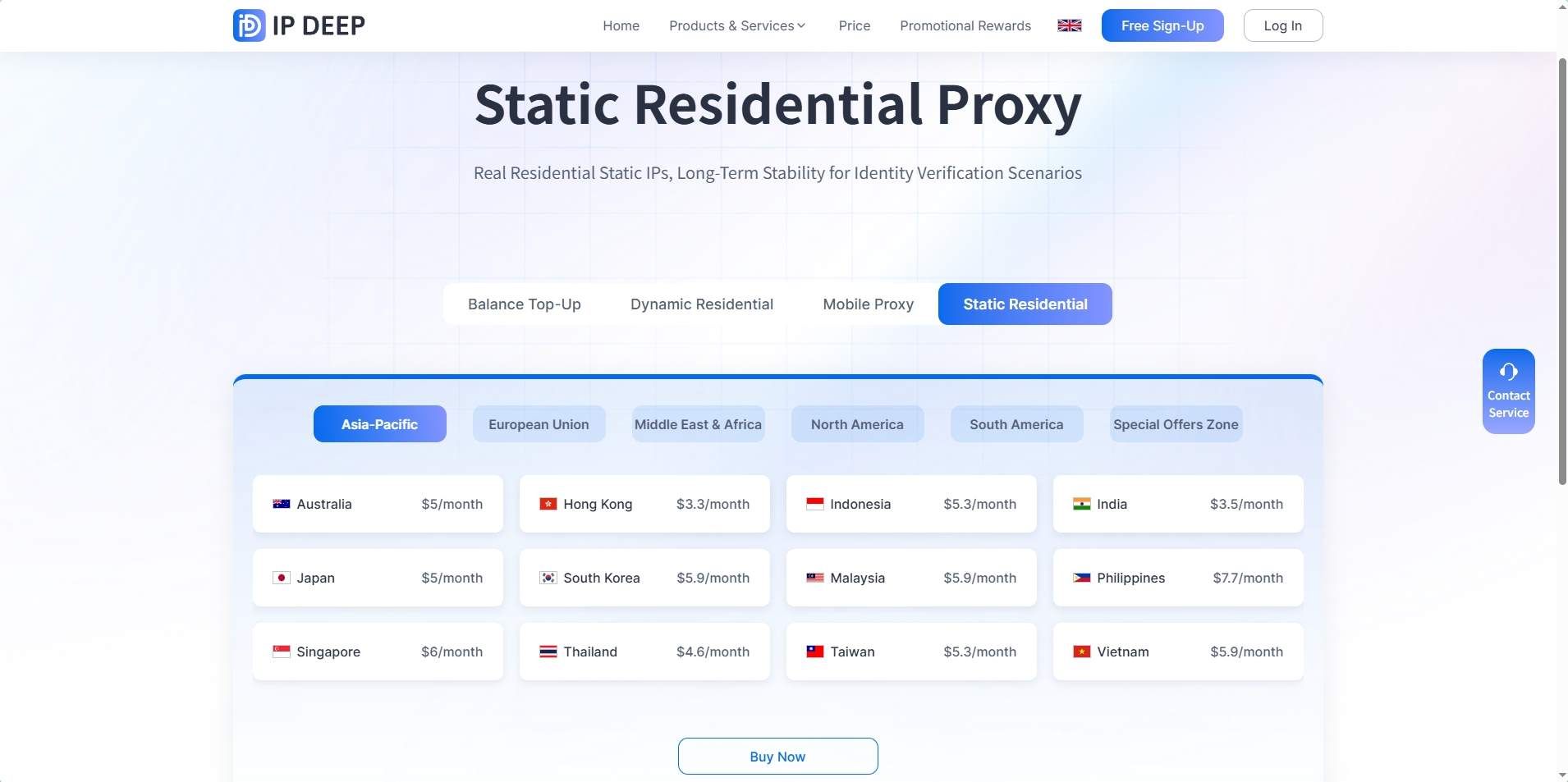
For cross-border professionals seeking higher network stability and business independence, visit IPDeep's official website to learn more about professional global static residential IP solutions and technical support.
Frequently Asked Questions (FAQ)
Q1: What is the difference between static residential IPs and dynamic residential IPs?
The main difference lies in stability and usage duration. Static IPs usually remain unchanged during the subscription period and are suitable for scenarios that require a consistent network environment, such as store management and social media operations.
Dynamic IPs automatically rotate based on configured rules, making them more suitable for large-scale data collection and price monitoring tasks.
Q2: Can static residential IPs guarantee that accounts will never be restricted?
No. Static residential IPs can provide a more stable and consistent network environment, but platform reviews involve multiple factors, including account behavior, device information, and compliance.
It is recommended to maintain stable IP configurations while following each platform's terms of service and operational guidelines.
Q3: Are static residential IPs suitable for web scraping?
Static IPs are more suitable for monitoring tasks or limited-access scenarios where data consistency is highly important.
For high-frequency and large-scale scraping tasks, dynamic residential IPs are usually recommended to support large-scale data collection with IP rotation capabilities.
Q4: Why are static residential IPs usually more expensive than datacenter IPs?
Residential IPs come from real household ISP networks, providing higher IP reputation and clearer network origin information.
For long-term businesses that require a stable network environment, dedicated static residential IPs may have higher costs, but they also provide a more independent network environment and stronger operational consistency.