




Static Residential IP: ISP & Why It Matters



Clean IP picks: Static IPs from $1.5 each, Dynamic IPs from $0.5/GB


When checking an IP, many people focus only on the country, city, and IP address itself, while overlooking an important detail — ISP (Internet Service Provider).
In fact, IPs in the same country or even the same city can belong to completely different network providers. ISP and ASN information are important indicators of an IP's network ownership.
So, what is the ISP behind a static residential IP? And how can the ISP affect IP usage? Let's take a closer look.

What Is an ISP?
ISP (Internet Service Provider) refers to a company or organization that provides internet access, assigns IP addresses, and manages network traffic.
Common ISPs in China include China Telecom and China Unicom, while well-known providers in other countries include Comcast, AT&T, and Verizon.
In the proxy industry, a static residential IP typically refers to a proxy IP associated with a real ISP network and designed to remain stable over an extended period.
Unlike dynamic residential IPs, its address usually remains stable during the usage period, making it suitable for applications that require persistent sessions and a consistent network environment.
These IPs generally offer good network stability and may be associated with real ISP networks.
Compared with typical data center IPs, they may appear more like consumer broadband networks in some websites' IP classification and risk assessment systems. However, this does not guarantee that they will pass every risk control check.
Why Is ISP Information Important?
In today's complex online risk control systems, ISP information is one of the key factors used to assess network characteristics:
Identifying network type: Websites may use an IP's ISP and ASN (Autonomous System Number) to determine its network type.
ISP and ASN are important indicators of an IP's network ownership.
ASN information can show which network provider an IP belongs to and whether the network is more closely associated with consumer ISPs, business networks, or cloud and hosting providers.
Compared with typical data center networks, consumer ISP networks are often classified more like regular broadband connections by some websites. However, the final assessment depends on the website's own data sources and risk control rules.
Reducing friction caused by unusual network environments: Some websites assess access risk based on factors such as IP network type, IP reputation, and historical activity.
Data center IPs may be more easily identified as cloud or hosting networks, while IPs associated with consumer ISPs may have more natural network characteristics in some scenarios.
However, IP type is only one factor in risk assessment and cannot guarantee that users will avoid CAPTCHAs or access restrictions.
Considerations for multi-account operations: When managing multiple e-commerce stores or social media accounts, platforms may assess risk based on multiple signals, including IP address, network ownership, device characteristics, login behavior, and account activity.
Assigning separate and stable network exits to different business accounts can reduce unusual signals caused by frequent network changes, but it cannot eliminate all account association risks on its own.
Accessing restricted resources: Some enterprise systems, APIs, and financial services use IP allowlists and only accept requests from pre-approved static public IP addresses.
In such cases, a stable static IP can reduce interruptions caused by changes to the outbound IP address.
How to Check the ISP of a Static Residential IP?
There are several ways to check an IP's ISP information:
Use an online IP lookup tool: IP lookup services can show the IP's ISP, location, and network type.
Check ASN information: ASN (Autonomous System Number) is a key identifier for determining network ownership.
By checking the ASN, you can identify the autonomous system and network provider associated with an IP.
Check the IP type: Professional IP lookup tools may classify an IP across multiple dimensions, such as ISP, Hosting, Business, Residential, VPN, Proxy, and Tor.
Classification results may vary between IP databases.
If your business has specific network requirements, consider the IP's ASN, ISP, network type, location, and reputation rather than relying only on a Residential label.
Visit the IPDeep website to learn more about the technical specifications and use cases of static residential IPs.
How to Choose a Quality Static Residential IP Service?
Since accurate ISP information can affect business performance, consider the following factors when choosing a provider:
IP reputation: Make sure the IP is not blacklisted and has a clean ASN history.
Network stability: Consider IP uptime, connection success rates, and actual latency based on your target market and business needs.
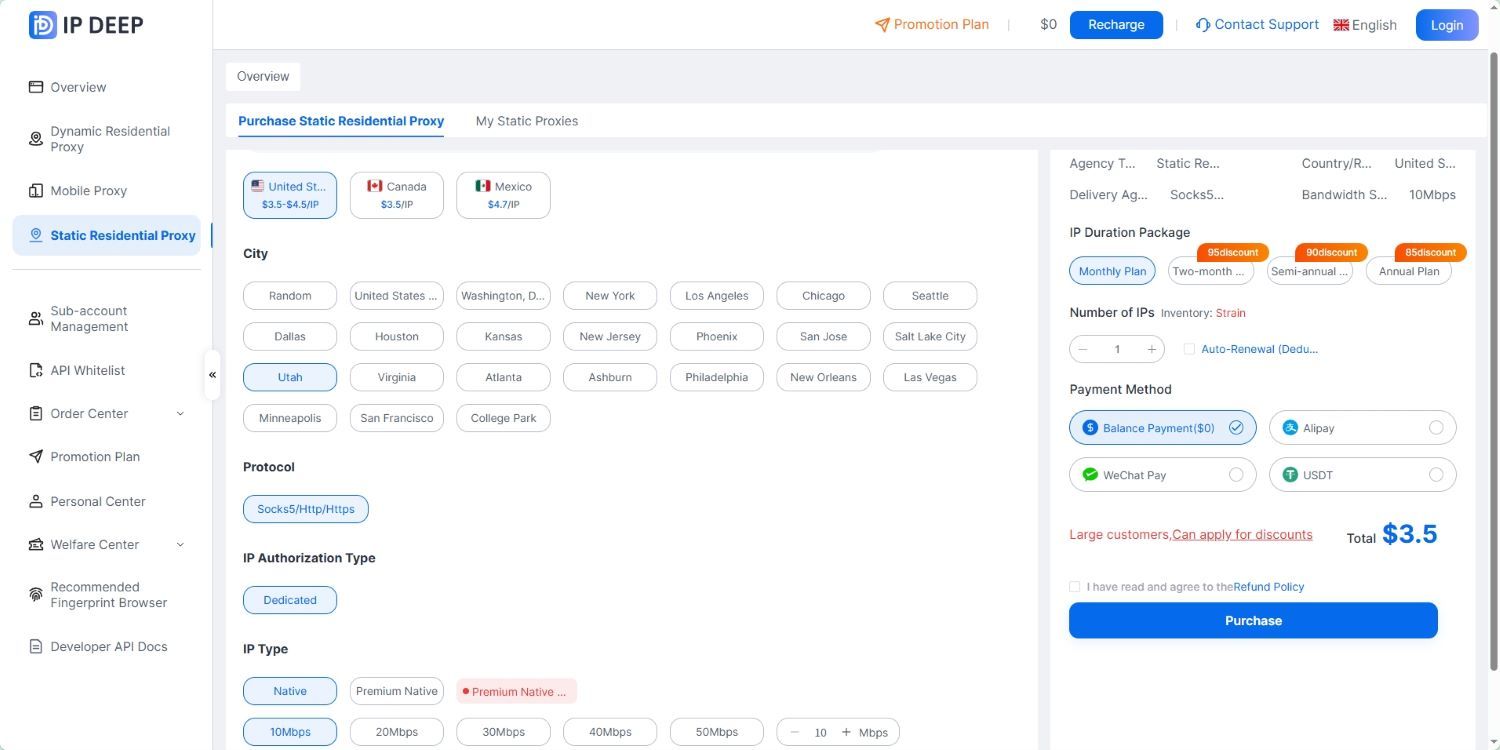
IPDEEP provides static residential IP resources across different countries, regions, and network types to meet various business needs.
Coverage: Supports precise targeting by country and city to meet localized business requirements.
Frequently Asked Questions (FAQ)
Q1: Why can't my static residential IP access some websites occasionally?
This may be caused by geographic restrictions, firewall policies, or network issues such as routing delays.
It may also be related to the IP's reputation, the website's access policies, or the IP's previous usage history.
Q2: Can I use a static residential IP long term?
Yes. A static residential proxy typically keeps the same IP address throughout the agreed usage period, making it suitable for applications that require persistent sessions, such as social media management and day-to-day e-commerce operations.
Q3: How can I keep my business environment secure?
Follow your platform's rules when managing login environments and keep network conditions and account activity consistent.
For businesses that require a stable network exit, separate static IPs can be assigned to different business environments.
You should also consider device characteristics, login behavior, cookies, and account activity, as IP address alone cannot determine or eliminate account association risks.