




Ultimate Guide to Static Residential IPs: Benefits & Uses



Clean IP picks: Static IPs from $1.5 each, Dynamic IPs from $0.5/GB


In today's era of digital global trade and social media marketing, the stability and credibility of online identities have become paramount to the international success of enterprises.
As a networking resource that combines both authenticity and persistence, static residential IPs are rapidly becoming the tool of choice across cross-border e-commerce, social media management, and data collection industries.

What is a Static Residential IP?
To thoroughly understand static residential IPs, they can be broken down into two core dimensions:
Residential (ISP) Attribute: Unlike commercial data centers, these IPs carry standard residential ASN (Autonomous System Number) attributes. They are legitimate, ISP-grade IPs issued directly by Internet Service Providers (such as AT&T, Comcast, etc.).
From the perspective of a target website's risk control system, users utilizing these IPs are granted the same high level of trust as standard home broadband users, making them exceptionally difficult to flag as proxy or bot traffic.
Static Attribute: This means that the IP address remains fixed and unchanged throughout the rental period. Unlike dynamic IPs that rotate over time, static residential IPs deliver a long-term, consistent digital identity.
In short, Static Residential IP = Real Household Identity + Long-term, Unchanging Address.
Core Advantages of Static Residential IPs
Compared to traditional datacenter proxies or dynamic residential proxies, static residential IPs offer distinct professional advantages:
High Anonymity & Low Ban Rates: Because they originate from real ISPs, their network behavior mirrors that of standard household users, effectively bypassing anti-scraping mechanisms and anti-fraud systems on target websites.
Outstanding Stability: The static nature ensures seamless, continuous connections, eliminating account flags or session disconnections caused by frequent IP changes—which is vital for tasks requiring long-term uptime.
Fixed Geographical Location: The geographic location tied to the IP remains highly consistent over time, allowing businesses to accurately simulate local user behavior in specific regions for precise targeted marketing.
Business Continuity: For e-commerce merchants operating on platforms like Amazon and eBay, a stable IP serves as the fundamental safeguard against account linking and ensures storefront security.
Primary Use Cases
The stable and highly reputable nature of static residential IPs makes them irreplaceable in the following fields:
Cross-Border E-Commerce Operations: Used for managing storefronts on Amazon, eBay, Shopify, and more. Stable IP addresses cultivate long-term trust with platforms, preventing risk-control audits triggered by IP fluctuations.
Social Media Management: Securely manage multiple accounts across Facebook, Instagram, TikTok, and Twitter. A fixed IP ensures a coherent online footprint for each account, drastically minimizing the risk of account suspension.
Ad Verification & Campaign Placement: Enterprises can leverage static IPs from specific regions to verify local ad rendering and analyze competitor positioning, ensuring optimized allocation of ad spend.
Remote Work & Secure Access: Accessing internal corporate resources via a fixed IP and configuring IP whitelists significantly boosts corporate network perimeter security.
How to Choose a Premium Static Residential IP Provider?
When selecting a service provider, we recommend running a professional evaluation across the following key criteria:
IP Pool Purity: Ensure the IPs genuinely originate from residential ISPs and are free from histories of abuse or blacklisting.
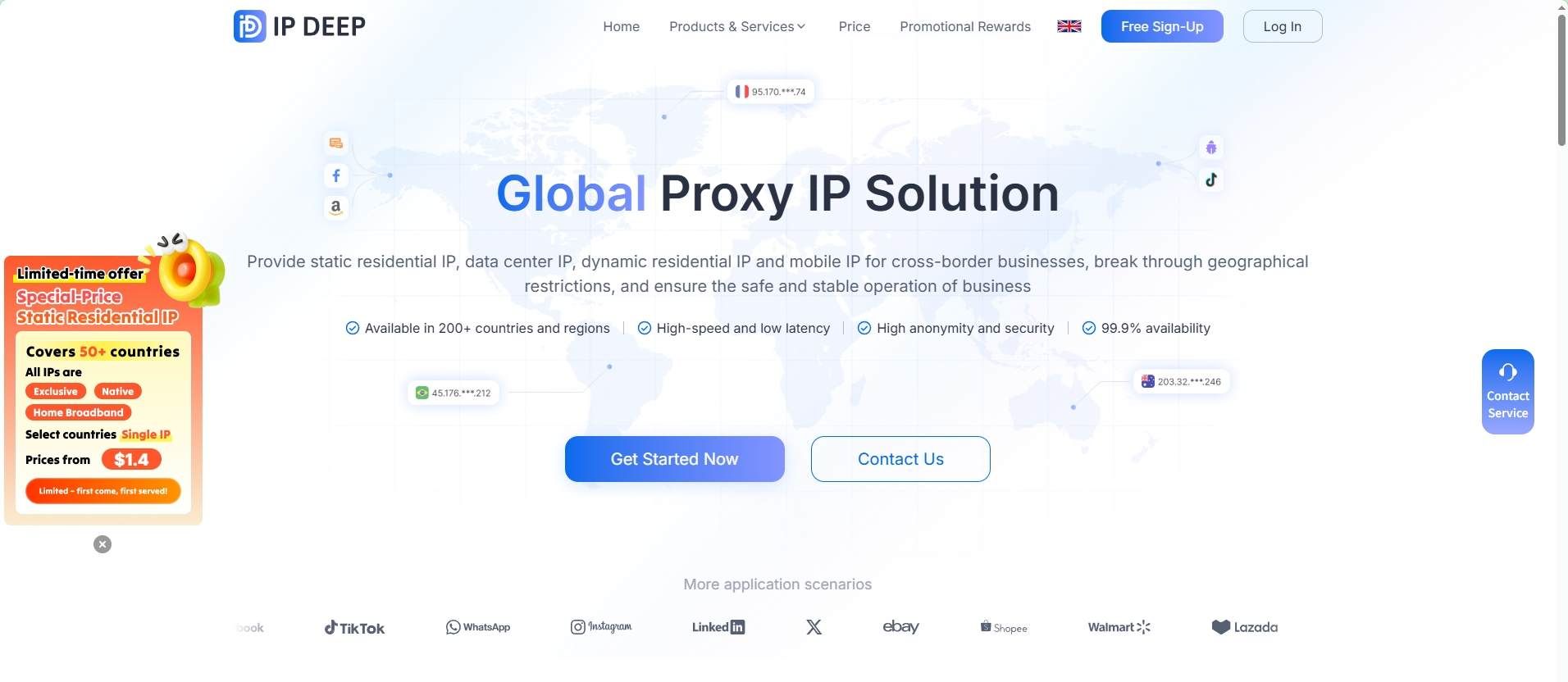
Global Coverage: For instance, IPDEEP boasts a massive global infrastructure, offering a multi-million dynamic residential IP pool covering over 200 countries and regions.
Additionally, they curate tens of thousands of highly pure, dedicated static residential IP series tailored for cross-border businesses, featuring precise city-level targeting.
Connection Performance: Pay close attention to bandwidth specifications and latency.
Premium providers typically deliver gigabit backbone bandwidth, with regional or local node latencies as low as double digits (e.g., under 50ms), and optimize intercontinental long-haul transit via dedicated international circuits to guarantee high throughput and stable connectivity.
Payment & Support: Verify if they accommodate convenient payment methods (such as Alipay, WeChat, and account balance) and provide prompt, responsive technical support.
Currently, IPDEEP has launched special promotional pricing for its static residential proxies: Germany at $1.4/IP, France at $2/IP, United Kingdom at $1.5/IP, and Taiwan at $2.6/IP.
To learn more about configuration recommendations and the latest pricing for global static residential IPs, feel free to visit the official IPDeep Website for professional assistance.
Static Residential IP vs. Static Datacenter IP
Frequently Asked Questions (FAQ)
Q1. What is the difference between a static residential IP and a dynamic residential IP?
The primary difference lies in connection stability. A static residential IP remains fixed and unchanged, making it ideal for use cases requiring a "consistent long-term identity" (e.g., storefront management).
Conversely, dynamic residential IPs rotate periodically, making them better suited for large-scale, highly concurrent data scraping tasks.
Q2. Why are static residential IPs more expensive than datacenter IPs?
Static residential IP resources are scarce. Because they come with authentic ISP backgrounds, they carry an exceptionally high trust level and are vastly less likely to be detected or blocked by platforms, whereas datacenter IPs are frequently mass-flagged as proxy traffic.
Q3. Can using a static residential IP completely prevent account bans?
While a static residential IP significantly mitigates the risk of account bans caused by network environments, overall account security still hinges on user operating habits, digital device fingerprint consistency, and compliance with platform guidelines.