





Can Static Datacenter Proxies Replace Residential Proxies?



Clean IP picks: Static IPs from $1.5 each, Dynamic IPs from $0.5/GB


In industries such as cross-border e-commerce, social media marketing, and data collection, the use of proxy IPs has become the norm. Whether it is to prevent account association, break through geographical restrictions, or improve collection efficiency, the choice of proxy often directly determines the success or failure of the business.
However, with the continuous rise in the price of residential proxies, many users have begun to consider using static data center proxies as an alternative to residential proxies. After all, static proxies are fast, low-cost, and seem more "cost-effective".
In this regard, many users have such a question: Can static data center proxies completely replace residential proxies? Next, the editor will analyze this in detail for everyone.
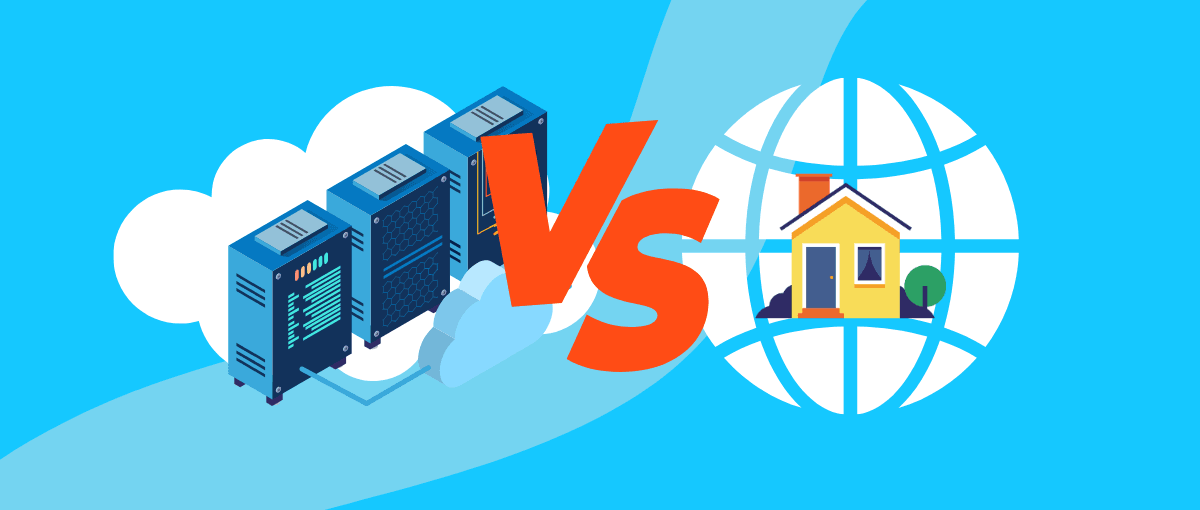
Concepts of Static Data Center Proxies vs. Residential Proxies
1. Static Data Center Proxies
Static data center proxies are fixed IP addresses provided by cloud service providers or IDC computer rooms. Such IPs usually come from server racks and have fast response speeds and stable connection performance. Their biggest feature is that the IP remains fixed, allowing users to use the same IP address for a long time.
2. Residential Proxies
Residential proxies, on the other hand, are IPs provided through real home broadband nodes. In other words, these IPs come from the networks of ordinary households or mobile devices, rather than data centers. The access traffic detected by websites is closer to "real user behavior", with stronger concealment and lower likelihood of triggering risk control measures.
Static Data Center Proxies vs Residential Proxies
| Comparison Dimension | Static Data Center Proxy | Residential Proxy |
|---|---|---|
| IP Source | Data Center (non-real user network) | Home Broadband (assigned by real ISP) |
| IP Stability | High, same IP can be used long-term | Depends on node conditions, some change regularly |
| Speed & Latency | Fast, low latency, suitable for automated tasks | Slightly slower, but with strong concealment |
| Risk of Being Blocked | High, easy to be identified as proxy traffic | Low, behaves more like real access |
| Price | Low cost, suitable for batch tasks | High cost, suitable for high-value businesses |
Can Static Data Center Proxies Replace Residential Proxies?
The answer to this question mainly depends on the usage scenarios:
Scenarios Suitable for Replacement
1. Fixed Account Login Scenarios
For some cross-border platforms, if the number of accounts is limited and the IP remains unchanged for a long time, static data center proxies can be used as a "IP binding" solution.
2. Data Collection & Web Crawler Tasks
If your goal is to collect public data (such as e-commerce prices, product images, public opinion monitoring, etc.) and the target website has weak risk control, then static proxies are fully capable. They are fast, low-cost, and stable in connection, making them ideal for long-running collection tasks.
Scenarios Not Suitable for Replacement
1. Multi-Account Login for Cross-Border E-Commerce
E-commerce platforms record login IP segments. If multiple accounts are detected to come from the same data center or abnormal network node, they will also be judged as associated accounts, with high risks.
2. Social Media Operations
The risk control mechanisms of social platforms are extremely sensitive. They not only detect IP sources but also identify device fingerprints, browser environments, etc. If data center IPs are used, it is easy to be judged as "abnormal login behavior", leading to mass account bans.
Conclusion: The Boundary Between Static Proxies and Residential Proxies Lies in Strategy, Not Technology
Static data center proxies are not a "replacement" for residential proxies, but a "strategic supplement". For tasks that prioritize speed and stability, they are the cost-effective first choice; while for businesses that pursue security and concealment, residential proxies remain irreplaceable.
If you want to use static data center proxies but cannot find a suitable third-party provider, you can try IPDeep.
IPDeep, a professional global IP proxy provider, has established a global IP resource network covering more than 200 countries and regions, with over 10 million high-quality IP resources. No matter where your target market is, we can provide localized IP solutions.