




Why Do Websites Trust Residential IPs More?



Clean IP picks: Static IPs from $1.5 each, Dynamic IPs from $0.5/GB


When conducting cross-border business, data collection, ad verification, or social media operations, many people have noticed that even with proxy IPs, data center IPs are often restricted, while residential IPs enable smoother access and are less likely to be blocked.
This is not a coincidence. Most websites' risk control systems are designed to verify whether visitors are genuine users, and IP type is a crucial and obvious detection factor. So why do residential IPs gain more trust from websites? Today we will give you an in-depth explanation!

1. Why Do Websites Trust Different IP Types Differently?
For websites, an IP address is more than just an access source; it is a key basis for identifying visitors. Many websites need to guard against malicious crawler scraping, bulk account registration, ad fraud traffic, malicious volume brushing, and cyber attacks every day. Without differentiation, the website's resources and data will be compromised.
Therefore, most large platforms (e-commerce, social media, search engines, ticketing websites, etc.) use risk control and anti-automation systems to prevent malicious behavior, and IP address type is usually the primary detection item. After all, genuine users are far more likely to use residential IPs than data center IPs.
2.What is a Residential IP? How is it Different from Regular IPs?
A residential IP is an address assigned by formal Internet Service Providers (ISPs) to home broadband users. Essentially, such IPs belong to real home network environments, typically used as the network exit for home fiber broadband, ordinary residential routers, and daily internet devices.
In contrast, data center IPs originate from cloud servers or computer room networks, and are usually marked as server room address segments, hosted networks, or commercial cloud infrastructure. In terms of basic network usage, there is little difference between the two under normal circumstances, but in the eyes of website risk control systems, their identity backgrounds are vastly different.
3. Core Reasons Why Residential IPs Are More Trusted
1. Higher Probability of Being a Genuine User
Most website risk control systems cannot fully determine whether a visitor is a genuine user or engaging in automated behavior, so they calculate probabilities based on whether the access behavior from an IP matches that of a real user.
Since residential IPs come from home networks, they generally meet several characteristics of genuine users, such as widely dispersed geographic locations, network behavior consistent with ordinary internet usage patterns, and not belonging to known server or computer room network segments.
On the other hand, data center IPs are often concentrated in a small number of computer room segments. Their large-scale appearance is easily identified by systems as a source of automated behavior. Therefore, under the same access behavior, residential IPs are perceived as real human visits, while data center IPs are seen as script or program requests, leading to differentiation in risk control systems.
2. Declining Reputation of Data Center IPs Due to Long-Term Malicious Use
In recent years, a large number of automated programs, crawlers, and attack traffic have operated on cloud servers and data center networks. As a result, many mainstream websites have established IP reputation databases to evaluate the historical behavior of IP source networks. Common evaluation criteria include:
• Whether it has frequently triggered abnormal requests
• Whether it has been used for bulk operations
• Whether it has appeared in traffic from known automated tools
Because data center IPs are easier to rent in bulk and use for automation, their historical reputation is directly low in many systems. In contrast, residential IPs belong to real home network resources, making large-scale abuse more costly and difficult, so their overall reputation weight is often higher.
3. Better Alignment with User Behavior Models
Modern risk control systems do not only check IPs but also combine browser fingerprints, behavior trajectories (clicks, scrolling, dwell time), device types, network environment characteristics. The network latency, routing paths, and network fluctuations of residential IPs are all closer to the daily internet environment of ordinary users.
When these signals overlap with real human operation behaviors, the system is more likely to identify the visitor as an ordinary user rather than an automated program. Conversely, a data center IP combined with high-speed requests and unnatural behavior rhythms is more likely to trigger risk control policies.
4. More Natural Geographic Matching
Many websites check the IP's country, access language, account registration region, device time zone, and other information. Residential IPs usually come from real cities and ISP networks, with more detailed and natural geographic information. Data center IPs, however, are often concentrated in a small number of cities or marked as commercial networks, which do not fully match the distribution of genuine users.
When multiple signals such as IP, language, behavior, and device match each other, the system's trust score will be much higher.
4. How to Choose and Obtain Residential IPs?
There are significant differences between residential proxy services on the market. When choosing, it is recommended to focus on the following core factors.
1. Whether it is a Genuine ISP Residential IP Resource
High-quality residential IPs should come from real home broadband networks, not disguised data center IPs. We can focus on the following points:
• Whether it is clearly marked as coming from mainstream ISPs (Internet Service Providers)
• Whether the IP covers real cities and ISP networks
• Whether it has a high level of anonymity (without exposing proxy characteristics)
Residential IPs from genuine sources usually perform better in terms of access stability and trustworthiness.
2. Whether IP Rotation or Session Persistence is Supported
Different businesses have different requirements for IP usage methods. Automatic IP rotation is more suitable for data collection/price monitoring to reduce the risk of excessive requests from a single IP. For account login/long-term session operations, residential IPs with "Sticky Session" are more appropriate, which maintain the same IP for a period of time to avoid triggering verification due to frequent changes.
Therefore, before purchasing, confirm whether the service provider supports flexible rotation strategies and whether the session duration is controllable.
3. Country Coverage and Targeting Capabilities
Many businesses have clear regional requirements, such as viewing search results for specific countries, testing ad displays in different regions, and accessing region-restricted content. In such cases, residential IPs need to have multi-country and multi-city coverage, and support country or regional-level targeted selection. The larger the IP pool and the more natural the geographic distribution, the less likely it is to show concentrated or abnormal access characteristics in actual use.
4. Stability and Success Rate
The characteristic of residential IPs is their authenticity, which also means that network quality may fluctuate. Therefore, it is important to pay attention to whether the service provider has a high online rate, reasonable connection success rate, stable bandwidth and latency performance. High-quality services usually automatically assign more stable nodes through scheduling systems to reduce frequent connection failures or timeouts.
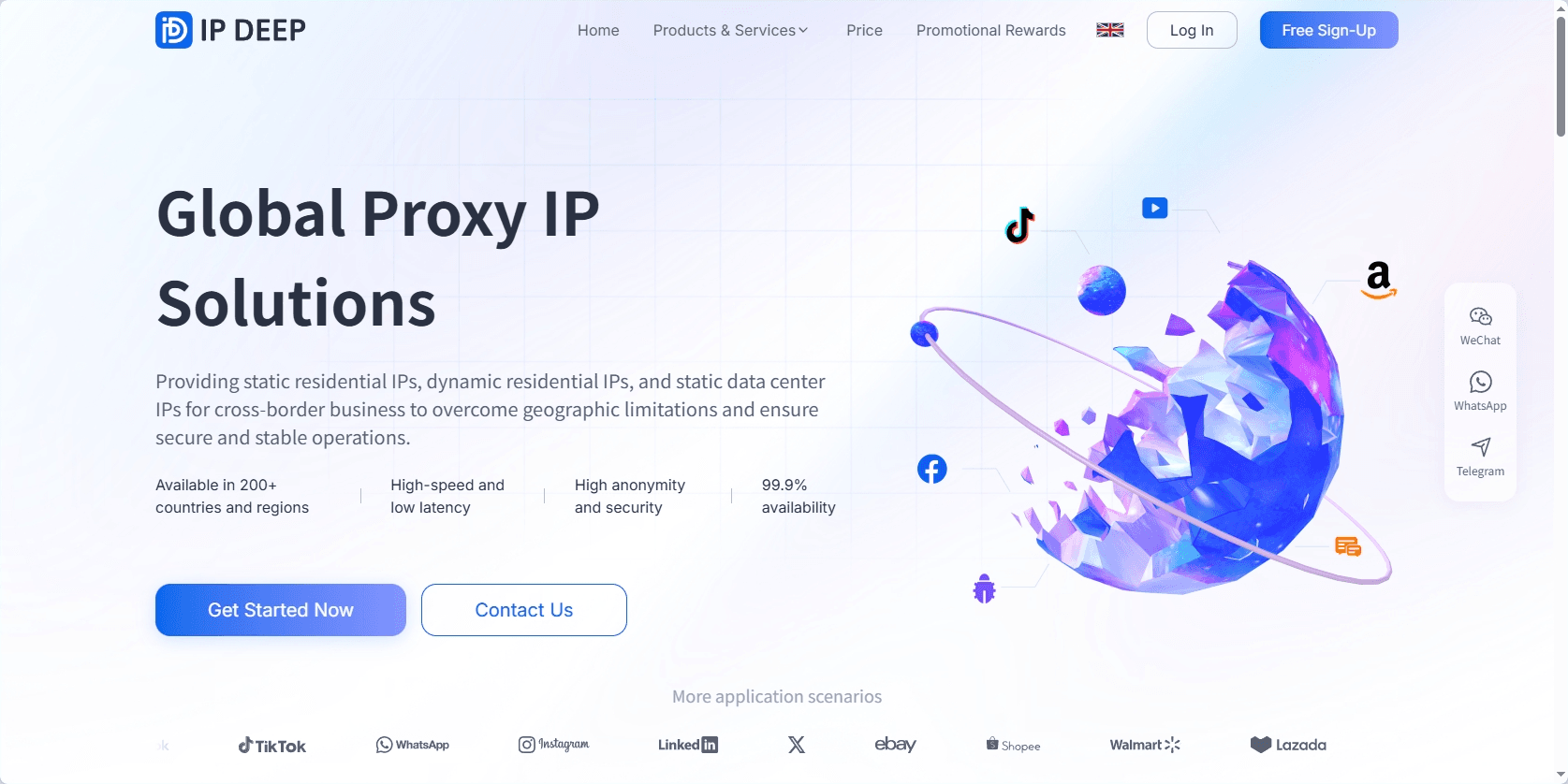
IPDEEP is a well-known proxy IP provider with more than 10 million high-quality IP resources (including dynamic residential IPs, dynamic data center IPs, mobile proxy IPs, static residential IPs, static data center IPs, etc.). It not only has super stability and authenticity, but also offers high cost performance!
For different businesses, it can also provide localized IP solutions according to your various needs, solving your IP-related problems from multiple aspects.
5. Whether the Billing Model Matches Your Business
The common billing method for residential IPs is traffic-based (GB). Before purchasing, you can evaluate the approximate daily request volume, data consumption per task, and whether long-term continuous use is required.
If it is only for testing or small-scale projects, you can start with a small traffic package. For long-term stable businesses, a large traffic package is more suitable, with a generally more cost-effective overall cost.
5. Which Scenarios Rely More on the Trust Attribute of Residential IPs?
In actual business, residential IPs are more commonly used in scenarios with high requirements for authenticity and natural access environments, such as:
• Market research and price monitoring
• Ad delivery verification
• Cross-border e-commerce data analysis
• Social media operation environment testing
• Content accessibility detection in different regions
The common feature of these scenarios is that the access behavior needs to be as close as possible to that of ordinary users, rather than server programs.
Conclusion
Overall, websites trust residential IPs more because they are closer to genuine users in terms of source, behavioral characteristics and historical reputation. For businesses that require long-term stable access and reduced risk control risks, choosing a suitable residential IP is essentially making multiple accounts operate more like multiple genuine users, which is much safer!
FAQs
What is the main difference between residential IPs and data center IPs?
The core difference lies in the IP source and reputation background. Residential IPs come from real home networks and are more in line with the characteristics of genuine users.
Is a residential IP a must for data collection?
If the target website has strict risk control or requires long-term stable collection, residential IPs usually have a higher success rate.
Are residential IPs suitable for account login and nurturing?
Yes, especially residential IPs that support session persistence, which are more conducive to maintaining a stable account environment.
Why are residential IPs usually more expensive than data center IPs?
Because the acquisition cost of real residential resources is higher and the risk is lower, while the overall trustworthiness and success rate are also higher.
How to judge whether a residential IP is a genuine one?
You can make a comprehensive judgment based on the ISP source, IP historical reputation, geographic distribution, and actual access success rate.