




Lazada Store Essentials: How to Choose the Best Vietnam Proxy IPs?



Clean IP picks: Static IPs from $1.5 each, Dynamic IPs from $0.5/GB


Operating a Lazada store in the Vietnam market comes with a significant challenge: ensuring account security and stability.
Particularly when managing multiple stores in bulk, even minor discrepancies in your network environment can trigger account suspension, shadowbanning, or even the freezing of your funds.
This guide will provide a comprehensive breakdown of Vietnam proxy IP types, selection criteria, and the exact methods for acquiring and configuring them. Let's dive in!
Why is the IP Environment Critical for Lazada Vietnam Stores?
By 2026, Lazada's risk management systems have become incredibly sophisticated. The platform utilizes IP addresses to perform deep scans of your "operational profile":
Identity Fraud Detection: If you claim to be a local Vietnamese store but frequently log in from IP addresses in China, Hong Kong, or the US, the risk system will immediately flag the account as anomalous.
Anti-Association Measures: In bulk operations, if 10 stores are accessed via the same IP, a violation in one store will trigger a "chain reaction," leading to the suspension of the other nine stores due to account association.
Traffic Weight Distribution: High-quality, native local IPs signal to the system that you are a "genuine premium local seller," which helps in gaining better organic reach within local search algorithms.

Common Types of Vietnam Proxy IPs
1. Data Center IPs
Source: IPs hosted on servers within data centers.
Current Status: As of 2026, Data Center IPs have been largely blacklisted by Lazada.
This is because their ASN (Autonomous System Number) identifies them as "servers." Real users rarely browse e-commerce platforms from a data center.
Conclusion: Avoid. These are only suitable for basic data scraping and should never be used to log into your seller dashboard.
2. Rotating Residential IPs
Source: IPs generated from real Vietnamese home broadband users.
Features: High anonymity; the address changes with every request or at set intervals.
Conclusion: Use for support tasks. Excellent for bulk order placement, reviews, or data collection, but not ideal for long-term store management or dashboard access, as frequent IP shifts can trigger security alerts for "unusual login locations."
3. Static Residential IPs (ISP IPs) —— 【Recommended】
Source: Fixed residential broadband IPs assigned directly by Vietnamese Telecom Operators (ISPs).
Features: Combines the legitimacy of a home broadband user with the stability of a persistent IP.
Conclusion: The core of bulk operations. This is the optimal solution for simulating a real, local operator in Vietnam.
Stability is especially critical when performing high-risk actions like withdrawals or updating core store information to avoid triggering secondary security verification (2FA).
5 Key Metrics for Choosing Vietnam Proxies
1. Native ISP Status (ASN Verification)
Use an IP lookup tool. If the ASN shows Viettel, VNPT, or FPT (the top three Vietnamese ISPs), it is a genuine native residential IP.
2. IP Pool Depth and Purity
Check if the IP is listed on Spamhaus or other fraud databases. IPs that have been abused by others will lead to frequent verification prompts or instant bans.
3. Connection Latency
Ideally, latency for a Vietnam proxy should be between 100ms - 200ms. High latency leads to a poor user experience and can cause request timeouts when uploading product listings.
4. Protocol Support
Prioritize providers that support the SOCKS5 protocol. Compared to HTTP, SOCKS5 offers better compatibility with anti-detect (fingerprint) browsers and is harder for websites to penetrate to reveal your true location.
5. Exclusivity
Ensure you are using a dedicated proxy exclusive to you. Shared proxies are a "suicide mission" for bulk store management.
How to Acquire and Configure Vietnam Proxies
1. Getting Your Vietnam Proxy IP
Register and log in to the IPDeep official website, and select "Static Residential Proxy" from the dashboard.
Choose Asia-Pacific -> Vietnam, select the protocol type, duration, quantity, and payment method, then click Purchase.
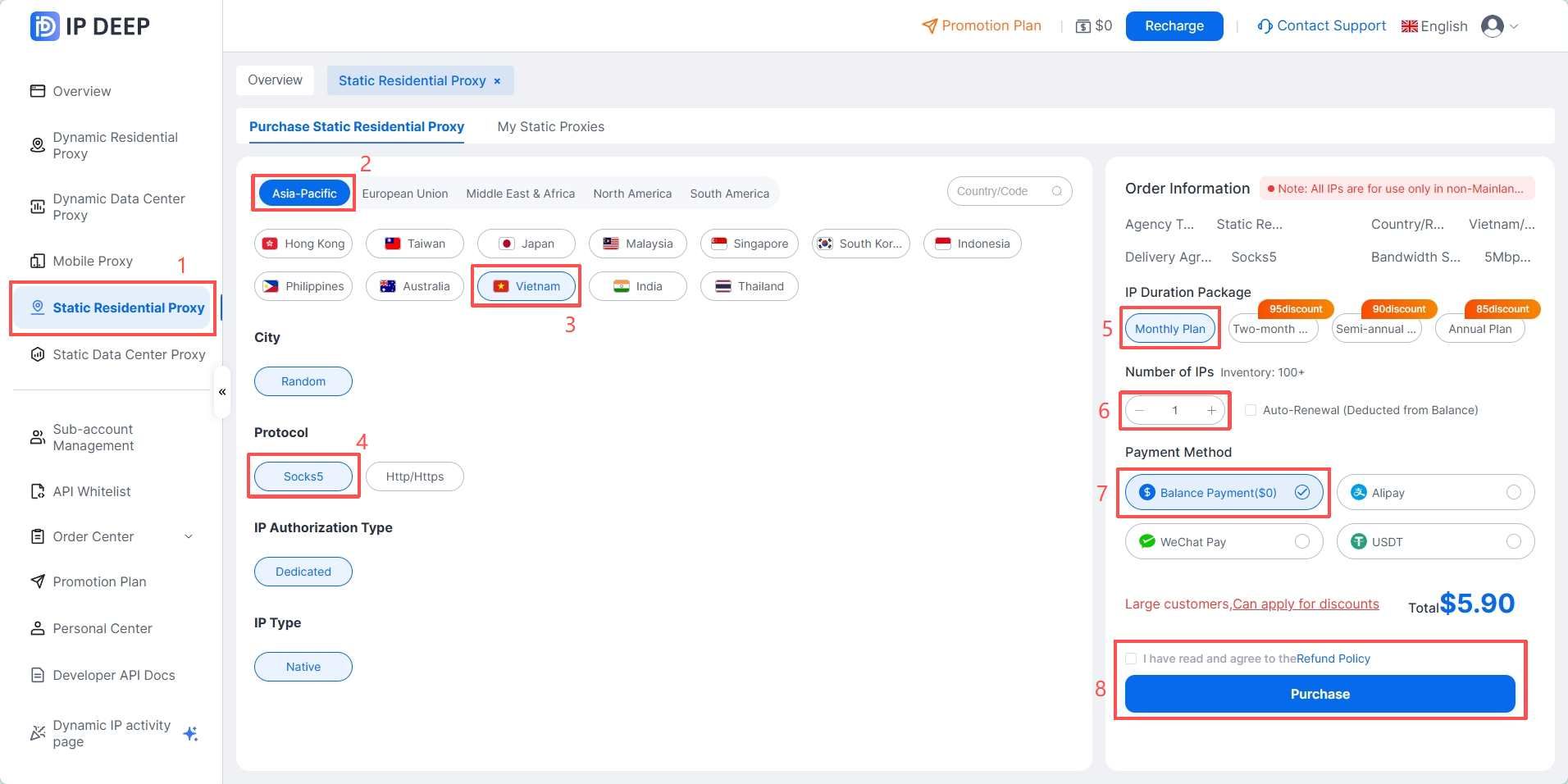
Navigate to the "My Static Proxies" page to retrieve your proxy address, port, username, and password. (e.g., proxy.ipdeep.com : 1234 : user567 : pass890).
2. Validating Proxy Usability
Before applying the IP to your Lazada store, perform the following checks:
Geolocation Check: Confirm the IP is physically located in Vietnam.
Connectivity Test: Use Ping or Traceroute to check latency and packet loss to ensure smooth cross-border access.
Blacklist Check: Use online tools to ensure the IP has no history of abuse.
3. Configuration and Setup
Software Configuration
Using Anti-detect Browsers: Add a unique IP to each independent browser profile. Ensure a 1:1 ratio between the IP and the browser fingerprint.
Environment Isolation
Each store must use a separate IP, browser fingerprint, cookie set, and cache.
Disable or mask WebRTC to prevent your real local IP from leaking.
Automation and Maintenance
Regularly monitor IP health and immediately replace any IP that becomes unstable or flagged.
Optimize DNS settings to further reduce latency and maintain a seamless operational flow.
By following these steps, you can build a stable Vietnamese network environment to safeguard your multi-store operations.
Summary and Recommendations
For Beginner Sellers (1-3 Stores): We recommend renting three high-quality Vietnam static residential IPs paired with the free version of an anti-detect browser to get started securely.
For Large Studios (20+ Stores): You must establish a standardized IP management system. Conduct regular purity tests and strictly enforce the "1 Store : 1 IP : 1 Environment" rule. Never log into different accounts within the same environment.
In the world of Lazada Southeast Asia e-commerce, a Vietnam proxy is just a tool. Compliant operations and a high-quality supply chain remain the core of your business.
A correct IP strategy significantly reduces the risk of bans, but ultimate success depends on your overall business strategy.