




UK Proxies Guide: How to Choose the Best UK Proxy IPs



Clean IP picks: Static IPs from $1.5 each, Dynamic IPs from $0.5/GB


In the 2026 internet landscape, privacy protection and cross-border operations have become increasingly demanding.
Whether you want to enjoy top-notch documentaries on BBC iPlayer from the comfort of your home, as if you were in the UK,
or need to manage a high-priority Monzo UK bank account, a clean, highly anonymous UK proxy IP proves to be a very practical tool.
Based on my years of hands-on experience in global network architecture and privacy protection, this article will guide you through selecting the most suitable UK proxies and avoiding common account-blocking risks.
Why UK Proxy IPs Are Special
The United Kingdom has a unique position in the global internet landscape, featuring strict regulatory frameworks (GDPR) and high-quality digital content.
However, in practice, many users find that ordinary proxies often encounter "unable to connect" errors or frequent captcha prompts.
Geographic Restrictions on Media
The UK enforces some of the strictest content protection mechanisms in the world.
Platforms like BBC iPlayer, ITVX, and Sky Go not only check geographic location but also filter out all traffic coming from cloud data centers (AWS, Azure, etc.).
This means only genuine UK residential proxies can successfully access these sites.
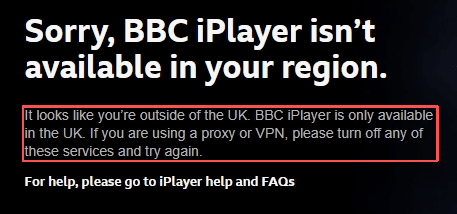
As shown below, BBC iPlayer clearly indicates that the content is unavailable in my region:
Strict Financial Controls
The UK has an advanced fintech landscape, and platforms like Wise, Revolut, and traditional banks such as HSBC UK are extremely sensitive to login environments.
If your IP jumps from London to Manchester in a short period or is detected as non-ISP broadband, it can easily trigger security checks.
Three Types of UK Proxy IPs: Which Should You Choose?
Before purchasing, you must understand the underlying characteristics of each IP type. My recommendations are as follows:
UK Residential Proxies
Source: Real household broadband (BT, Virgin Media, Sky).
Features: Highest trust level, rarely triggers verification.
Best Use Cases: Unlocking streaming platforms, social media account management (TikTok/Instagram UK), initial registration of financial accounts.
UK Static ISP Proxies
Source: Hosted in data centers but classified as ISP-type fixed IPs.
Features: Combines data center speed with residential authenticity; IP remains fixed.
Best Use Cases: Long-term management of Amazon UK stores, daily banking operations.
Datacenter Proxies
Source: UK data centers (London, Birmingham, etc.).
Features: Low cost, high bandwidth, but easier to detect.
Best Use Cases: Public web scraping, fast browsing without login requirements.
Applications of UK Proxies
Media and Content Access
Exclusive UK video platforms, such as BBC iPlayer, ITVX, and Sky Go, enforce strict IP restrictions.
Using UK residential proxies allows you to emulate real local users, bypass geo-blocks, and avoid streaming detection.
Cross-Border Finance and Banking Controls
Maintaining accounts with HSBC UK, Monzo, Wise, and other UK banks requires IP stability.
Residential and Static ISP proxies help prevent triggering security checks or captchas, improving account management efficiency.
E-commerce (Amazon UK / eBay UK)
When performing competitor monitoring, managing multiple accounts, or simulating UK consumer behavior, high-quality proxies help prevent account linking and ensure e-commerce operations remain secure and reliable.
SEO and Market Research
Obtain localized Google UK search results, track SERP rankings, and monitor regional traffic trends.
Using residential or static ISP proxies allows you to accurately simulate UK user search behavior and access genuine data.

Expert Review: 5 Key Criteria for Choosing UK Proxies
IP Pool Depth and Geographic Distribution
Having only London IPs is not enough. Including IPs from Manchester, Birmingham, and other regions improves access diversity and reduces the risk of account blocks.
Protocol Support
In 2026, the SOCKS5 protocol is the standard for handling encrypted searches and UDP traffic, offering advantages over traditional HTTP proxies.
Cleanliness Check (IP Score)
Use detection tools to verify whether an IP has been blacklisted for spam or fraud, preventing restricted access or triggering security controls.
Response Speed and Latency
Conduct ping tests to UK servers to evaluate proxy latency and bandwidth, ensuring fast and stable access.
Legal Compliance and Privacy
Check whether the provider complies with GDPR, clearly states IP sources, and has a privacy policy—these are essential for long-term, safe use.
Practical Guide: Configuring UK Proxies in Different Environments
Step 1: Obtain Proxy Credentials
Get full proxy details—including IP, port, username, and password—from reliable providers like IPDeep.
Step 2: Isolate Environment in a Fingerprint Browser
Configure the proxy in a fingerprint browser, enabling automatic time zone and language matching to ensure consistency between your IP and browser fingerprint.
Step 3: Multi-Layer Detection
Use IP detection tools, WebRTC, and DNS tests to confirm that your proxy is properly configured and that your real IP is hidden.
FAQ
1. Can a UK proxy reveal my real location?
System-level SOCKS5 configuration, WebRTC blocking, and DNS leak protection can achieve near-complete anonymity.
2. Why can’t my UK IP unlock BBC?
This may be due to delayed IP database updates or using low-quality proxies. Residential or static ISP IPs are recommended.
3. Which is better for account management: static or dynamic IPs?
Static IPs are better for long-term account maintenance and stable logins, while dynamic IPs are suitable for large-scale scraping or short-term tasks.
Customize Your UK Network Setup
High-security needs: UK residential proxies combined with a fingerprint browser.
Moderate needs: Static ISP proxies for banking, e-commerce, and SEO tasks.
Low-cost tasks: Datacenter proxies, suitable for public web scraping.
By properly selecting and configuring UK proxy IPs, you can access UK web resources safely, stably, and anonymously, maximizing the value of cross-border operations and localized data collection.