

How Is Pricing Calculated for Rotating Residential IPs? Comparing 3 Billing Models and Real-World Costs



Clean IP picks: Static IPs from $1.5 each, Dynamic IPs from $0.5/GB


Two providers quote for the same dynamic residential IPs. One asks a few hundred yuan, the other wants several thousand. The gap usually isn't a markup — it's the billing model.
Some bill by GB, some by IP count, and some by bandwidth and subscription period. Comparing only the total plan price is an easy way to pick wrong. What's actually worth calculating is this: how much does it cost to complete the same number of successful tasks?
1. Three Billing Models and Where the Price Gap Comes From
Dynamic residential IP services typically bill by traffic, by IP count, or by bandwidth.
| Billing model | What you're charged for | Best fit | Watch out for |
|---|---|---|---|
| By traffic | Actual GB consumed | Lightweight data collection, periodic tasks | Images and other assets inflate traffic |
| By IP count | Number of IPs and days of use | Frequent egress switching, small-payload requests | Duplicate IPs versus how many are actually usable |
| By bandwidth | Mbps and subscription period | Long-running, high-volume work | Bandwidth ceiling versus real utilization |
It's worth separating bandwidth from concurrency here. 100 Mbps is a bandwidth spec — it doesn't mean you can run 100 requests at the same time. How many tasks you can actually push through also depends on response speed, connection limits, and server performance.
2. How Do You Work Out the Cost of Dynamic Residential IPs?
You can't compare unit prices across billing models directly. Normalize everything to cost per 1,000 successful requests: cost per 1,000 successful requests = total spend ÷ successful requests × 1,000
Say a workload sends 1 million requests a month, and three providers test out like this:
| Item | A: By traffic | B: By IP count | C: By bandwidth |
|---|---|---|---|
| Monthly fee | CNY 3,000 | CNY 5,400 | CNY 1,800 |
| Total requests | 1,000,000 | 1,000,000 | 1,000,000 |
| Success rate | 95% | 90% | 80% |
| Successful requests | 950,000 | 900,000 | 800,000 |
| Cost per 1,000 successful requests | CNY 3.16 | CNY 6.00 | CNY 2.25 |
The figures above are hypothetical, and assume all three options can deliver that request volume with fees covering the full plan cost.
On the numbers, option C has the lowest unit cost but also the lowest success rate. If the workload requires 90% or better, you can't just pick C because it's cheap.
In the same way, a bandwidth plan needs to be checked against peak-hour volume — a low unit price doesn't necessarily mean efficiency.
3. Four Costs That Never Show Up in the Quote
First, availability. A low list price doesn't mean low actual spend. If connections fail often, you'll need more retries, and that adds server load and runtime.
Second, regional hit rate. Supporting a country doesn't mean every city has adequate inventory. For work that depends on local pricing, region-specific search results, and the like, test availability in the specific regions separately.
Third, IP duplication rate. If the workload needs distinct egress points, track how many unique IPs you actually see rather than taking the advertised pool size at face value.
Fourth, session stability. Some tasks require several steps in a row. If the egress changes too often, the flow breaks and you end up paying to run it again.
4. Run a Small Test Before You Commit to a Quote
Use the same set of target addresses, the same request content, and the same concurrency settings, and run 500 requests per provider first. Record success rate, average response time, regional hit rate, and the share of duplicate IPs.
If the workload runs long term, test in two separate time windows. 500 requests is enough for an initial shortlist, but expand the sample before actually buying and see how things hold up at peak hours.
At the same time, confirm plan validity, overage rules, concurrency limits, and refund terms with the provider so you don't get hit with extra charges later.
5. Choosing Dynamic Residential IPs from IPDEEP
Take IPDEEP as an example: it currently offers dynamic residential IP plans billed by traffic and by bandwidth.
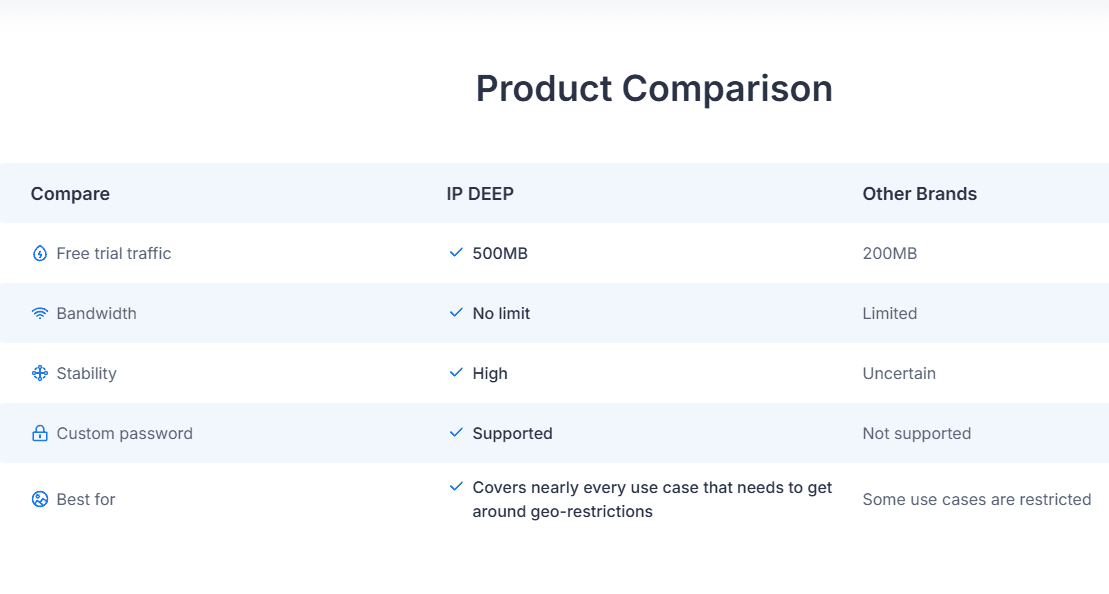
Traffic-based plans suit smaller or highly variable workloads; bandwidth-based plans charge by spec and subscription period, which fits long-running work with heavier traffic needs.
For example, IPDEEP's 100 GB traffic plan is listed at $75, which works out to $0.75/GB; the 3-day plan on the 100 Mbps bandwidth option totals $85.50. The two aren't directly comparable — you still need to factor in expected traffic, days of operation, and bandwidth requirements. Current pricing on the official site is what applies.
6. Dynamic Residential IP Pricing: FAQ
How much do dynamic residential IPs cost per month?
There's no standard number. The monthly fee depends on traffic, bandwidth, subscription length, and regional requirements, so compare plans against your actual usage.
Which is better value, billing by traffic or by bandwidth?
When traffic is light and usage is intermittent, per-GB billing is usually more flexible; for continuous, high-volume work, it's worth working out the cost advantage of a bandwidth plan.
Does a low price mean poor quality?
You can't judge that directly. Compare success rate, response time, regional coverage, and the real cost per completed task together.
Summary
When comparing dynamic residential IP pricing, the goal isn't the lowest sticker price — it's confirming the effective cost at the same workload. Standardize the test conditions first, then calculate cost per 1,000 successful requests, and check bandwidth, region, and session requirements along the way. That's how you tell which plan actually fits your workload.